Kilogram Definition: Why the 1889 Cylinder Has Uncertainty
The Yardstick Almanac Published No substantive revisions
Short answer
Since May 20, 2019, the Planck constant defines the kilogram; the 1889 prototype that defined it has a measured mass: 1 kg, with a 10-microgram standard uncertainty as of 2018.
Station index 8 sections
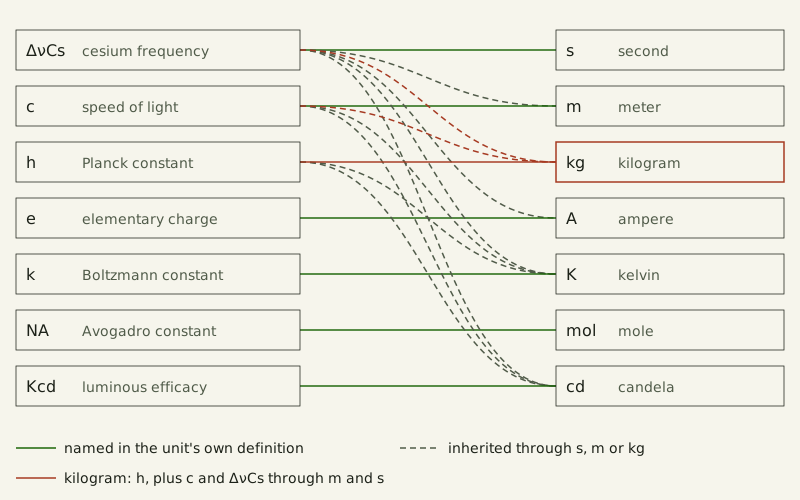
Figure: The Yardstick Almanac, CC BY 4.0
Credit line to copy
"The seven defining constants and the base units they fix" by The Yardstick Almanac, https://theyardstickalmanac.com/units/kilogram-definition/, licensed under CC BY 4.0 (https://creativecommons.org/licenses/by/4.0/).
Data: SI Brochure, 9th edition, version 4.01, sec. 2.3.1, by the BIPM, CC BY 4.0 (adapted: drawn as a diagram); 2026-11-01
Until May 2019, one metal cylinder had a mass of exactly one kilogram [exact by definition]; now that mass carries a 10-microgram uncertainty. The cylinder, the international prototype of the kilogram, was cast in 1879, NIST says, and the first General Conference on Weights and Measures (CGPM) made it the unit of mass in 1889. In 2018 the 26th CGPM handed the job to the Planck constant, starting May 20, 2019. What is left is a measurement-error remainder, our name for what a measurement convention leaves over: any gap between old and new kilograms, which the 2017 measurements of h could not resolve, now sits in the prototype's measured mass.
The kilogram is now defined by taking the fixed numerical value of the Planck constant, h, to be 6.626 070 15 × 10−34 in joule seconds [exact by definition]. That wording comes from the resolution and from the SI Brochure, the reference text of the International Bureau of Weights and Measures (BIPM). Because the meter and the second are fixed by the speed of light and the cesium frequency, the kilogram rests on three of the seven defining constants. The resolution puts the old prototype's mass at 1 kg with a relative standard uncertainty of 1.0 × 10⁻⁸, which is 10 micrograms [measured, u = 10 µg].
What defines the kilogram now?
The definition fixes a number, not an object. The 2018 resolution says the Planck constant “is 6.626 070 15 × 10–34 J s.” A joule second is a kilogram times a square meter per second. Once the meter and the second are pinned down, only one mass fits that number, and that mass is the kilogram.
The SI Brochure turns the definition around to show how big a kilogram is. One kilogram equals (299 792 458)2 divided by (6.626 070 15 × 10−34 × 9 192 631 770), times hΔνCs/c2. The brochure prints that factor as about 1.475 5214 × 1040 (rounded) [exact by definition]. We recomputed it with exact fractions and got the same eight digits.
Fixing h flipped which side gets measured. Under the 1889 definition, the prototype's mass was 1 kg by definition, and the Planck constant had to be found by experiment. The brochure puts the swap in one line: “The present definition fixes the numerical value of h exactly and the mass of the prototype has now to be determined by experiment.”
The kilogram was not the only value to change sides. Appendix 2 of the resolution lists four quantities that were exact under the old definitions. From May 20, 2019, each one is measured, with the relative standard uncertainty it had when the resolution was adopted.
| Quantity | Exact value before May 20, 2019 | Relative standard uncertainty from then | In its own unit (our arithmetic) |
|---|---|---|---|
| Mass of the international prototype, m(K) | 1 kg | 1.0 × 10⁻⁸ | 10 µg |
| Magnetic constant, μ0 | 4π × 10−7 H m−1 | 2.3 × 10⁻¹⁰ | 2.89 × 10⁻¹⁶ H m−1 |
| Triple point of water, TTPW | 273.16 K | 3.7 × 10⁻⁷ | 0.10 mK |
| Molar mass of carbon 12, M(12C) | 0.012 kg mol−1 | 4.5 × 10⁻¹⁰ | 5.4 × 10⁻¹² kg mol−1 |
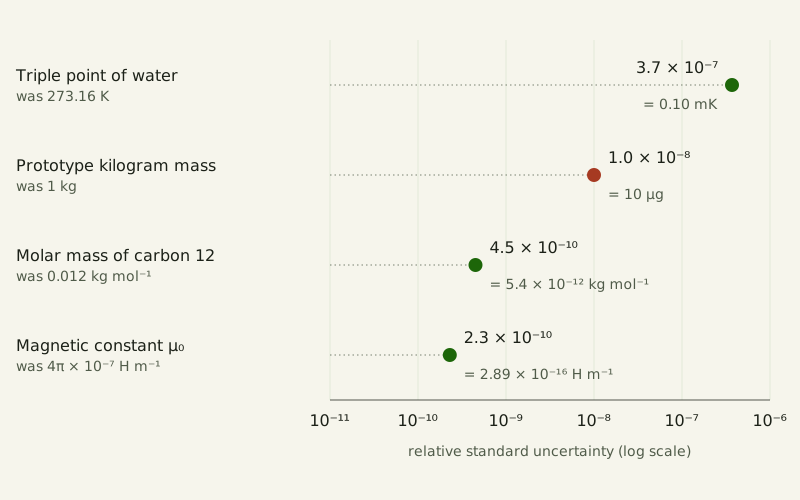
Figure: The Yardstick Almanac, CC BY 4.0
Credit line to copy
"Four values that became measured on May 20, 2019" by The Yardstick Almanac, https://theyardstickalmanac.com/units/kilogram-definition/, licensed under CC BY 4.0 (https://creativecommons.org/licenses/by/4.0/).
Data: CGPM Resolution 1 (2018), Appendix 2, by the BIPM, CC BY 4.0 (adapted: plotted); 2026-11-01
Why replace a metal cylinder?
The copies drifted, and no comparison could say which side had moved. When the first CGPM approved the prototype in 1889, it recorded that the national kilograms differed from it by amounts that “lie within 1 milligram” [bounds 0–1 mg]. The SI Brochure says forty similar prototypes were made at about the same time. They were machined and polished to nearly the same mass, and most went to member states.
By the second check of the national copies in 1946, their masses were drifting away from the prototype on average. The third check, from 1989 to 1991, put the median difference at about 25 micrograms [measured, source gives no uncertainty] for the original copies of 1889. That is 2.5 parts in 100 million of a kilogram. It is also 2.5 times the uncertainty the 2018 resolution gave the prototype.
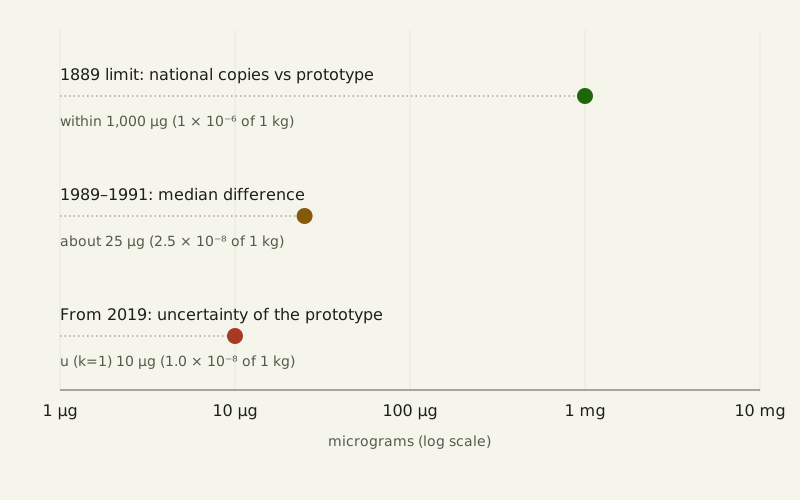
Figure: The Yardstick Almanac, CC BY 4.0
Credit line to copy
"Three mass differences around the kilogram prototype" by The Yardstick Almanac, https://theyardstickalmanac.com/units/kilogram-definition/, licensed under CC BY 4.0 (https://creativecommons.org/licenses/by/4.0/).
Data: SI Brochure, 9th edition, version 4.01, and CGPM Resolution 1 (2018), by the BIPM, CC BY 4.0 (adapted: plotted); 2026-11-01
A comparison between two cylinders shows that they moved apart. It cannot show which one moved. Under the old definition, the prototype was 1 kg by definition, so every gap was booked as a change in the copies.
NIST describes the practical cost: each standard's measured mass “drifted” a bit over time, and every step down the chain of comparisons added uncertainty. A 1 kg artifact could be checked against a 1 kg standard to a few parts in a billion; a milligram measured from the same kilogram carried a few parts in ten thousand.
The 21st CGPM named the risk in 1999. Its Resolution 7 pointed to “the intrinsic uncertainty in the long-term stability of the artefact defining the unit of mass” and noted that the ampere, the mole and the candela all depended on the kilogram. (BIPM texts use British spellings such as artefact, metre and litre.) It asked national laboratories to keep refining experiments that tie mass to fundamental or atomic constants.
How does a Kibble balance weigh with electricity?
A Kibble balance weighs a mass against an electromagnetic force, then measures the strength of that force in a second step. NIST credits Bryan Kibble of the UK's National Physical Laboratory, who conceived it in 1975. It was first called a watt balance because it compares electrical and mechanical power. NIST describes two modes:
- Weighing mode: a test mass sits on a pan attached to a coil of wire in a magnetic field. The current in the coil is adjusted until the upward magnetic force balances the weight. The current at balance is recorded as I.
- Velocity mode: the mass is removed and the current is switched off. The coil is moved through the same field at a constant velocity, v, and the voltage induced in it, V, is measured.
- Combine the two: the field strength and the wire length, which are hard to measure, cancel out. What is left is electrical power equal to mechanical power, IV = mgv.
- Solve for mass: m = IV/(gv). The local gravity, g, comes from an absolute gravimeter, and the velocity from laser interferometry.
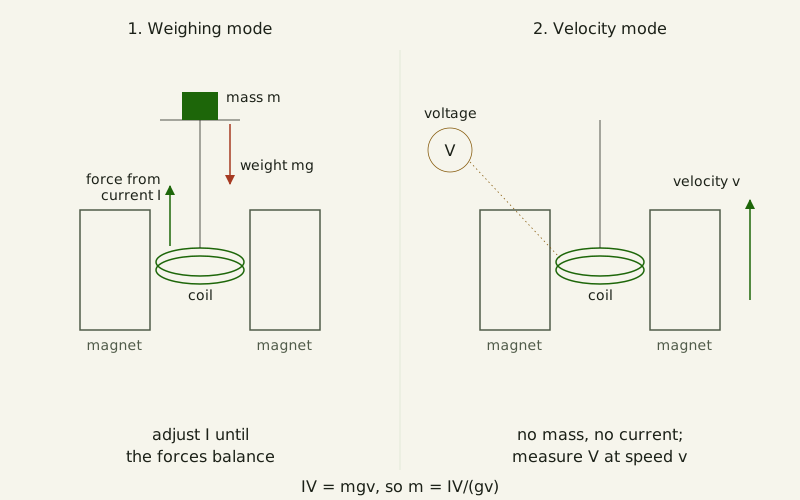
Figure: The Yardstick Almanac, CC BY 4.0
Credit line to copy
"The two modes of a Kibble balance" by The Yardstick Almanac, https://theyardstickalmanac.com/units/kilogram-definition/, licensed under CC BY 4.0 (https://creativecommons.org/licenses/by/4.0/).
Data: Drawn from the descriptions in NIST, Kilogram: The Kibble Balance (public domain), and the SI Brochure, 9th edition, version 4.01, Appendix 4 (BIPM, CC BY 4.0); 2026-11-01
The Planck constant enters through the electrical side. NIST explains that the current is measured with a resistor calibrated by the quantum Hall effect and the voltage with the Josephson effect, and the constants behind both are defined in terms of h and the elementary charge. With h fixed, the balance can measure an unknown mass with no reference cylinder at all. NIST's fourth-generation instrument, NIST-4, has replaced K20 as the official U.S. standard for realizing mass.
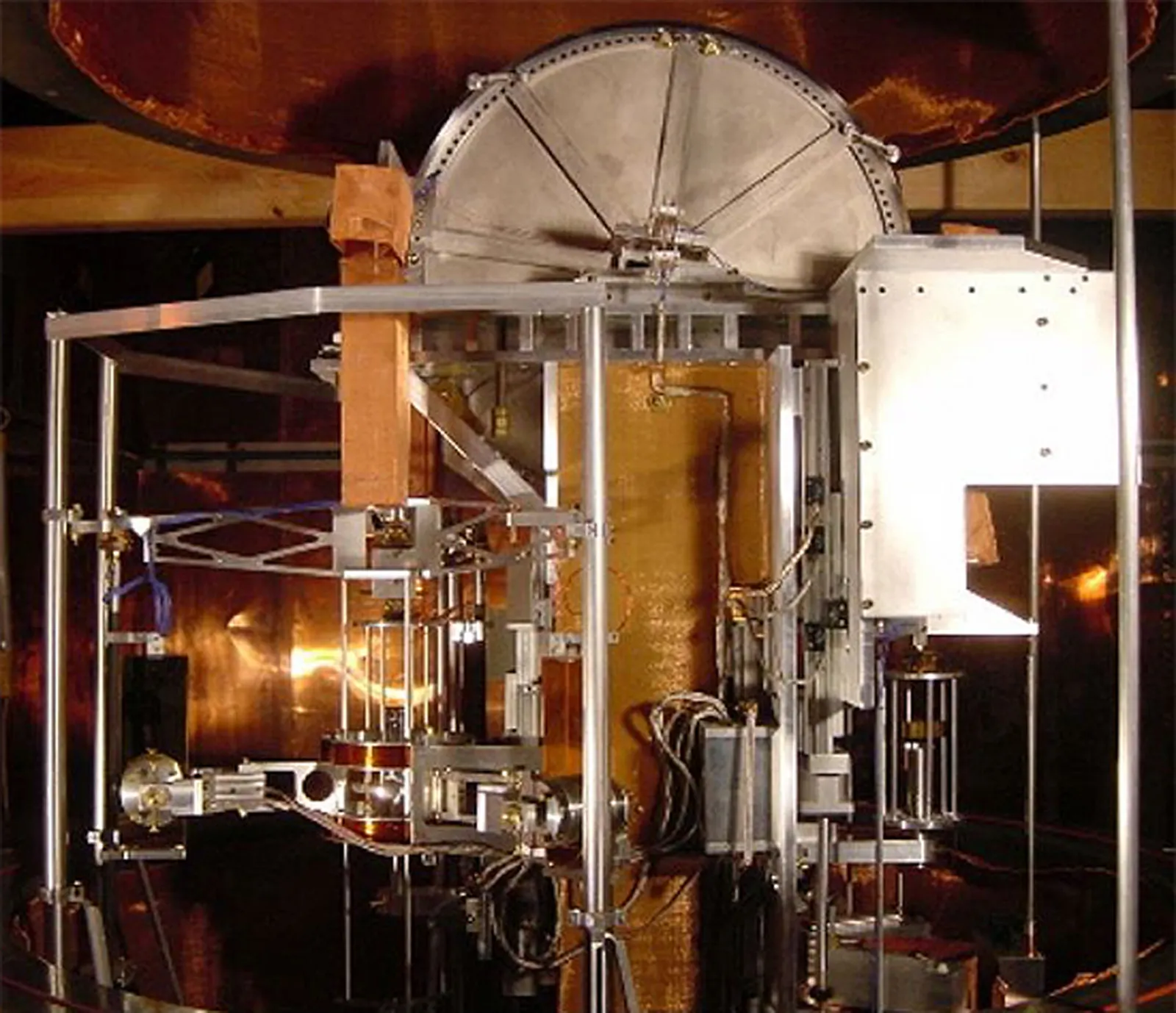
"International System of Units (SI); Watt Balance (NIST, 2010)" by Steiner, NIST — https://commons.wikimedia.org/wiki/File:International_System_of_Units_(SI);_Watt_Balance_(5940478911).jpg — Public domain (work of the U.S. federal government, 17 U.S.C. §105 (NIST photograph, credited "Steiner, NIST", posted to Flickr by NIST))
The balance is not the only route. The SI Brochure lists a second primary method that counts the atoms in a silicon sphere of about 1 kg. Because the definition fixes a constant instead of naming a machine, the brochure says any equation of physics that links mass to h, c and ΔνCs will do. The working recipes, called mises en pratique, are kept on the BIPM website, not in the brochure, so they can change when better experiments arrive.
Which seven constants define the SI?
The resolution that fixed h fixed six other constants at the same time. The brochure states: “The numerical values of the seven defining constants have no uncertainty.” Every SI unit can be built from them. The table restates Table 1 of the brochure; the last two columns are our tally from the base-unit definitions.
| Symbol | Defining constant | Fixed value [exact by definition] | Unit | Digits in the value | Base units that use it |
|---|---|---|---|---|---|
| ΔνCs | hyperfine transition frequency of cesium 133 | 9 192 631 770 | Hz | 10 | s, m, kg, A, K, cd |
| c | speed of light in vacuum | 299 792 458 | m s−1 | 9 | m, kg, K, cd |
| h | Planck constant | 6.626 070 15 × 10−34 | J s | 9 | kg, K, cd |
| e | elementary charge | 1.602 176 634 × 10−19 | C | 10 | A |
| k | Boltzmann constant | 1.380 649 × 10−23 | J K−1 | 7 | K |
| NA | Avogadro constant | 6.022 140 76 × 1023 | mol−1 | 9 | mol |
| Kcd | luminous efficacy of 540 × 1012 Hz radiation | 683 | lm W−1 | 3 | cd |
The cesium frequency reaches furthest. It fixes the second, the same second that leap seconds are counted in, and through the second it enters six of the seven base units. Only the mole, which counts entities with the Avogadro constant, stands apart. The speed of light fixes the meter, and with it the distance light covers in Grace Hopper's nanosecond.
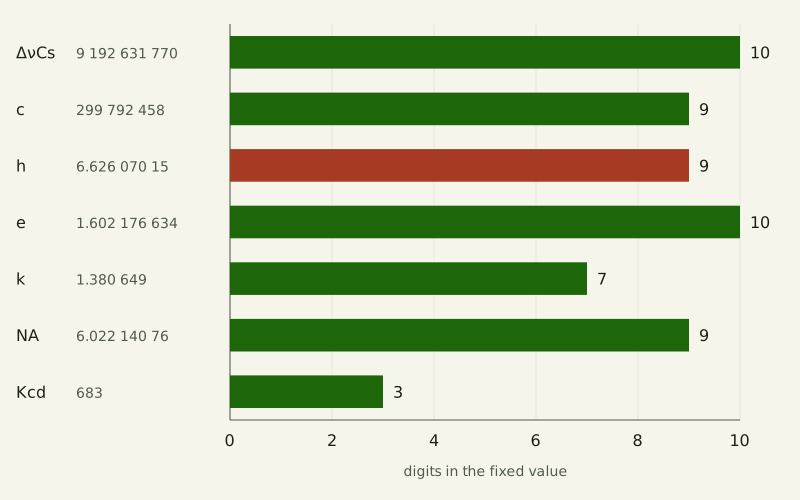
Figure: The Yardstick Almanac, CC BY 4.0
Credit line to copy
"Digits in each fixed value" by The Yardstick Almanac, https://theyardstickalmanac.com/units/kilogram-definition/, licensed under CC BY 4.0 (https://creativecommons.org/licenses/by/4.0/).
Data: SI Brochure, 9th edition, version 4.01, Table 1, by the BIPM, CC BY 4.0 (adapted: digits counted and plotted); 2026-11-01
We checked every value in the table, digit by digit, against the 2022 CODATA list of constants that NIST publishes, where all seven are marked exact. We checked five of them against a second unit library as well. The brochure says the values were chosen to agree with the earlier definitions “in so far as advances in science and knowledge allow.”
How did the kilogram get from 1799 to 2019?
The paper trail runs 220 years, and the cylinder sits near the middle. NIST's history page says the French republic defined the gram as the mass of 1 cubic centimeter of water at 4 degrees Celsius. A gram was too small to be practical, so the republic made a platinum artifact a thousand times heavier. The SI Brochure records that this kilogram and a platinum meter were placed in the Archives de la République in Paris on June 22, 1799.
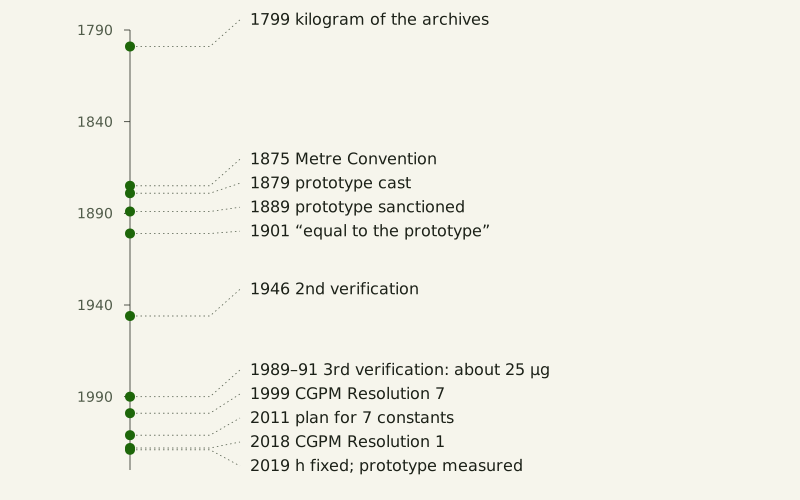
Figure: The Yardstick Almanac, CC BY 4.0
Credit line to copy
"The kilogram's paper trail, 1799–2019" by The Yardstick Almanac, https://theyardstickalmanac.com/units/kilogram-definition/, licensed under CC BY 4.0 (https://creativecommons.org/licenses/by/4.0/).
Data: SI Brochure, 9th edition, version 4.01, and CGPM Resolution 1 (2018), by the BIPM, CC BY 4.0 (adapted: drawn as a timeline), and NIST web pages (public domain); 2026-11-01
The same events, in order:
- June 22, 1799: the platinum kilogram of the archives is placed in Paris.
- May 20, 1875: 17 countries, including the United States, sign the Metre Convention, which creates the BIPM and the CGPM.
- 1879: the international prototype is cast in platinum-iridium, by NIST's account.
- 1889: the first CGPM approves the prototype, which “shall henceforth be considered as the unit of mass.”
- 1901: the third CGPM declares that the kilogram “is equal to the mass of the international prototype of the kilogram.”
- 1946 and 1989–1991: the second and third checks find the national copies drifting from the prototype.
- 1999: the 21st CGPM asks for work toward a definition based on constants.
- 2018: the 26th CGPM adopts Resolution 1, which builds on a plan laid out in 2011.
- May 20, 2019: the new definitions take effect, and the 1889 definition of the kilogram is abrogated.
The timing came from conditions set earlier. Resolution 1 says the CGPM had set them in 2011 and confirmed them in 2014 before the revised SI could be adopted, and that they “have now been met.” NIST reports that a group of 60 nations voted for the change in November 2018. The effective date fell 144 years to the day after the Metre Convention was signed, as our date calculation confirms.
What happened to the prototype and the national copies?
The prototype still exists, and it still sits at the BIPM. The SI Brochure says it “was, and still is, kept at the BIPM under the conditions specified by the 1st CGPM” of 1889. NIST adds its nickname, Le Grand K, and describes a triple-locked vault on the outskirts of Paris.
The national copies kept working too. NIST says the United States received two of them in 1890, K4 and K20. K20 was the primary U.S. national standard, and K4, a check standard, watched K20's mass. Both are “no longer official standards,” but NIST still uses them and other masses to pass the kilogram on to outside laboratories and industry.
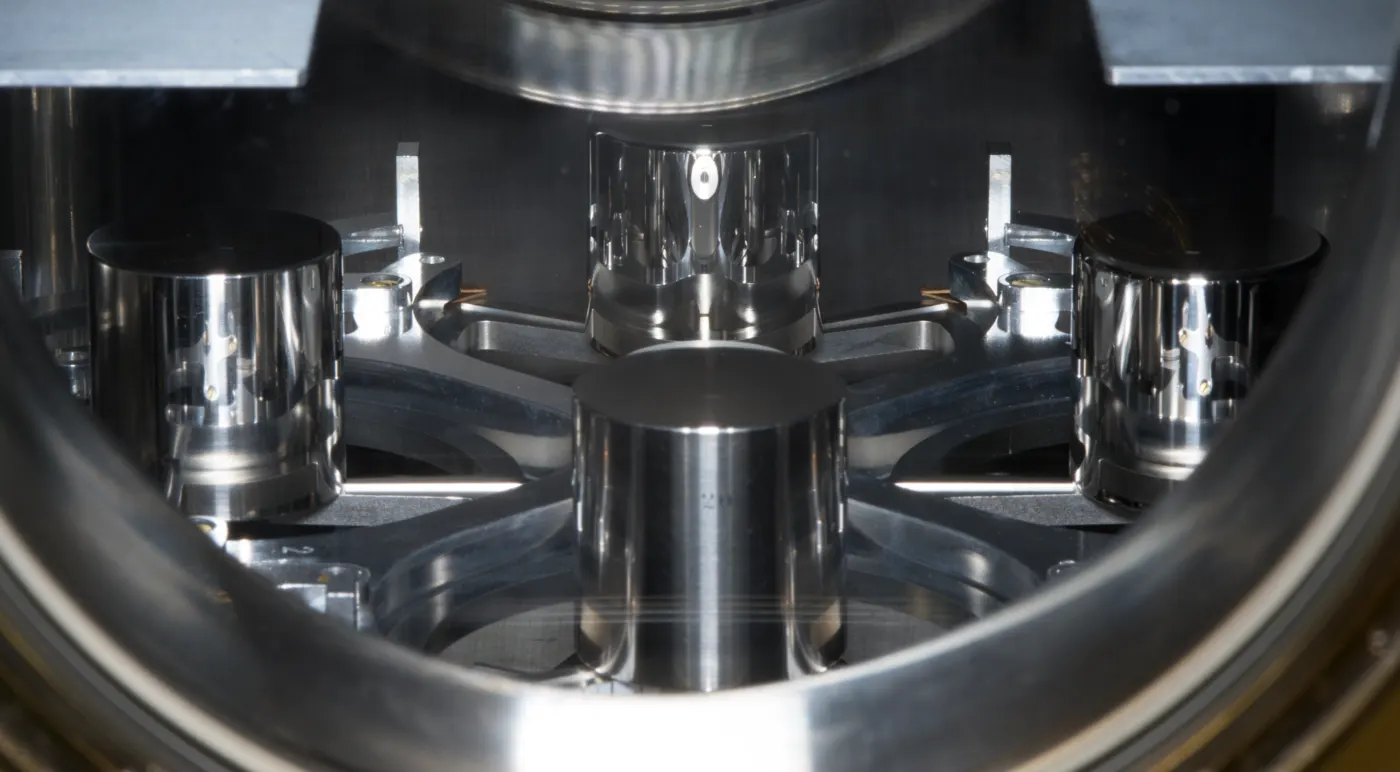
"K20 and Friends: four of the five U.S. national prototype kilogram artifacts, including K20 (front) and K4 (back)" by J. Lee/NIST, public domain
Full credit
"K20 and Friends: four of the five U.S. national prototype kilogram artifacts, including K20 (front) and K4 (back)" by J. Lee/NIST — https://commons.wikimedia.org/wiki/File:Kilograms-pml0013_K20_and_Friends_Four_of_the_five_U.S._national_prototype_kilogram_artifacts,_including_K20_(front)_and_K4_(back).png — Public domain (work of the U.S. federal government, 17 U.S.C. §105 (photograph by J. Lee of NIST, published by NIST in 2018); Commons also marks the file with the Public Domain Mark 1.0)
NIST also keeps six other platinum-iridium prototypes: K79, K85, K92, K102, K104 and K105. Its sets of working standards reach from 1 milligram up to 27,200 kilograms. In 2019 the chain got a new starting point. It begins at a Kibble balance tied to h, not at a cylinder in France.
What did the kilogram do to the liter?
For 63 years, the liter carried an error inherited from the kilogram. In 1901 the third CGPM defined the liter as “the volume occupied by a mass of 1 kilogram of pure water, at its maximum density and at standard atmospheric pressure.” That tied the liter to the mass of the prototype, a metal object, instead of to a length cubed.
The two did not match. In 1960 the 11th CGPM recorded that “the cubic decimetre and the litre are unequal and differ by about 28 parts in 106” [measured, source gives no uncertainty]. By our arithmetic, that is about 28 microliters in one liter. In 1961 the International Committee for Weights and Measures (CIPM) recommended giving accurate volume results in SI units, not liters.
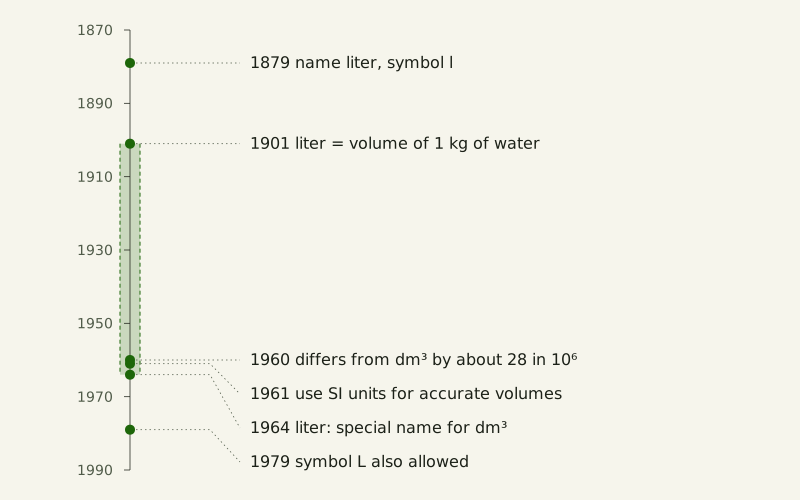
Figure: The Yardstick Almanac, CC BY 4.0
Credit line to copy
"How the liter was defined, 1879–1979" by The Yardstick Almanac, https://theyardstickalmanac.com/units/kilogram-definition/, licensed under CC BY 4.0 (https://creativecommons.org/licenses/by/4.0/).
Data: CGPM decisions of 1901, 1960 and 1964 and the SI Brochure, by the BIPM, CC BY 4.0 (adapted: drawn as a timeline); 2026-11-01
This is a case of what we call the frozen error: an error you can point to, written into a definition so that it stops counting as an error. The error is that the kilogram, carried from the 1799 platinum standard to the 1889 prototype, was not the mass of one cubic decimeter of water. The baseline is the water definition it was meant to match, and the evidence is the 1960 resolution's gap of about 28 parts per million. The 12th CGPM freed the liter in 1964: Resolution 6 “abrogates the definition of the litre given in 1901” and lets the word stand “as a special name for the cubic decimetre.”
Kilogram definition questions
Did the kilogram change weight in 2019?
No, by design. The SI Brochure says the value of h was chosen so that, at adoption, the kilogram equaled the mass of the prototype. The relative standard uncertainty was 1 × 10⁻⁸, the uncertainty of the best estimates of h at the time. The brochure adds that preserving continuity “has always been an essential feature of any changes to the International System of Units.”
Is Le Grand K still one kilogram?
Not by definition. Since May 20, 2019, its mass is a measured value: 1 kg with a relative standard uncertainty of 1.0 × 10⁻⁸ as of the 2018 resolution. Any later value has to come from experiment.
Did the pound change too?
No. NIST Handbook 44 lists the avoirdupois pound as “453.592 37 grams (exactly)” [exact by definition], so the pound follows whatever defines the kilogram. The U.S. side of that link, the 1959 yard and pound, is part of the story of the U.S. survey foot.
Sources
- General Conference on Weights and Measures (CGPM), 26th meeting (2018), Resolution 1, "On the revision of the International System of Units (SI)," Proceedings of the 26th CGPM (2018), 2019, p. 472, DOI 10.59161/CGPM2018RES1E. https://www.bipm.org/en/-/resolution-cgpm-26-1 Read: full text with its three appendices (English version; the official text is French) Text license: CC BY 4.0
- Bureau International des Poids et Mesures, The International System of Units (SI), 9th edition (2019), version 4.01 (June 2026), DOI 10.59161/AUEZ1291. Sec. 2.2 and Table 1; sec. 2.3.1 (the kilogram); Table 8, note (d); Appendix 1 (1st CGPM 1889; 3rd CGPM 1901 Declarations 1 and 2; 11th CGPM 1960 Res. 13; CIPM 1961; 12th CGPM 1964 Res. 6; 16th CGPM 1979 Res. 6; 21st CGPM 1999 Res. 7); Appendix 4, Parts 1–3. https://www.bipm.org/documents/20126/41483022/SI-Brochure-9-EN.pdf Read: full text Text license: CC BY 4.0
- CGPM, 3rd meeting (1901), Declaration 1, "Declaration concerning the definition of the litre," Proceedings of the 3rd CGPM (1901), p. 38, DOI 10.59161/CGPM1901DECL1E. https://www.bipm.org/en/committees/cg/cgpm/3-1901/resolution-1 Read: full text as published by the BIPM (English version; the official text is French) Text license: CC BY 4.0
- CGPM, 11th meeting (1960), Resolution 13, "Cubic decimetre and litre," Proceedings of the 11th CGPM (1960), 1961, p. 88, DOI 10.59161/CGPM1960RES13E. https://www.bipm.org/en/-/resolution-cgpm-11-13 Read: full text (English version; the official text is French) Text license: CC BY 4.0
- CGPM, 12th meeting (1964), Resolution 6, "Litre," Proceedings of the 12th CGPM (1964), 1965, p. 93, DOI 10.59161/CGPM1964RES6E. https://www.bipm.org/en/-/resolution-cgpm-12-6 Read: full text (English version; the official text is French) Text license: CC BY 4.0
- National Institute of Standards and Technology, "Kilogram: Introduction," SI Redefinition web pages (created May 14, 2018, updated February 22, 2023). https://www.nist.gov/si-redefinition/kilogram-introduction Read: full page
- National Institute of Standards and Technology, "Kilogram: The Past," SI Redefinition web pages (created May 14, 2018, updated August 13, 2025). https://www.nist.gov/si-redefinition/kilogram/kilogram-past Read: full page
- National Institute of Standards and Technology, "Kilogram: The Kibble Balance," SI Redefinition web pages (created May 14, 2018, updated May 28, 2026). https://www.nist.gov/si-redefinition/kilogram/kilogram-kibble-balance Read: full page
- National Institute of Standards and Technology, NIST Handbook 44 (2026 edition), Appendix C, "General Tables of Units of Measurement," DOI 10.6028/NIST.HB.44-2026. https://www.nist.gov/document/2026-nist-handbook-44-appendix-c Read: Appendix C, units of mass
- National Institute of Standards and Technology, Fundamental Physical Constants, complete listing, 2022 CODATA adjustment. https://physics.nist.gov/cuu/Constants/Table/allascii.txt Read: full listing (seven defining constants checked)
Data files (restated from CGPM Resolution 1 of 2018 and the SI Brochure, 9th edition, version 4.01, licensed CC BY 4.0 by the BIPM; values checked against the 2022 CODATA list and, for five constants, the Pint 0.26.2 unit library, BSD-3-Clause license; each file comes with a notes file giving its sources and license):
- The seven defining constants of the SI (CSV, source and license notes) Data: SI Brochure, 9th edition, version 4.01, Table 1, and CGPM Resolution 1 (2018), by the BIPM, CC BY 4.0 (adapted: restated one constant per row, digit counts and base units added); 2026-11-01
- Which defining constants each SI base unit uses (CSV, source and license notes) Data: Traced from the base-unit definitions in CGPM Resolution 1 (2018) and the SI Brochure, 9th edition, version 4.01, by the BIPM, CC BY 4.0 (adapted); 2026-11-01
- Four values that became measured on May 20, 2019 (CSV, source and license notes) Data: CGPM Resolution 1 (2018), Appendix 2, by the BIPM, CC BY 4.0 (adapted: uncertainties in each quantity's own unit computed); 2026-11-01
- Three mass differences around the kilogram prototype (CSV, source and license notes) Data: SI Brochure, 9th edition, version 4.01, Appendices 1 and 4, and CGPM Resolution 1 (2018), by the BIPM, CC BY 4.0 (adapted: converted to micrograms); 2026-11-01
- The kilogram's paper trail, 1799–2019 (CSV, source and license notes) Data: SI Brochure, 9th edition, version 4.01, and CGPM Resolution 1 (2018), by the BIPM, CC BY 4.0 (adapted: summarized one event per row), and NIST web pages (public domain); 2026-11-01
- How the liter was defined, 1879–1979 (CSV, source and license notes) Data: CGPM decisions of 1901, 1960 and 1964 and the SI Brochure, 9th edition, version 4.01, by the BIPM, CC BY 4.0 (adapted: summarized one decision per row); 2026-11-01
Cite this page
The Yardstick Almanac. "Kilogram Definition: Why the 1889 Cylinder Has Uncertainty." Published November 1, 2026. https://theyardstickalmanac.com/units/kilogram-definition/. Accessed [the date you read it].
More in Units & Standards
Units & Standards
U.S. Survey Foot: America Had Two Official Feet Until 2023
Image credit
"Measuring base with Invar tape, Stanfield, Oregon (NOAA Photo Library theb1656)" by U.S. Coast and Geodetic Survey — https://commons.wikimedia.org/wiki/File:Theb1656_-_Flickr_-_NOAA_Photo_Library.jpg — Public domain (work of the U.S. federal government, 17 U.S.C. §105; also released by the NOAA Photo Library under CC BY 2.0)
Units & Standards
Metric System in the U.S.: The Yard Is Defined by the Meter
Image credit
"Committee Meter Bar, made of platinum in 1799 (NIST Museum Collection)" by NIST Museum Collection — https://commons.wikimedia.org/wiki/File:Committee_Meter_Bar_Platinum_1799.png — Public domain (work of the U.S. federal government, 17 U.S.C. §105 (photograph from the NIST Museum Collection, source https://www.nist.gov/image/committee-meter); Commons also marks the file with the Public Domain Mark 1.0)
Units & Standards
Nautical Mile: 1,852 m, While a Minute of Latitude Varies
Image credit
"Sextant (NPS Photo, Lewis and Clark National Historical Park)" by NPS Photo — https://commons.wikimedia.org/wiki/File:This_instrument_was_used_to_measure_the_angular_distance_between_the_moon_and_sun_or_a_star_for_determining_longitude._(1d68d331-1dd8-b71b-0bf5-2e79f90f1e7b).JPG — Public domain (work of the U.S. federal government, 17 U.S.C. §105 (Commons tag PD-USGov-NPS: material based on a work of a National Park Service employee created as part of official duties; photographer field NPS Photo, publisher U.S. National Park Service, source NPGallery); structured data: public domain in the United States, work of the federal government)
How this page is checked: Where the numbers come from explains the value tags, the source order and how every figure is recomputed.
Corrections: every substantive change is logged in What we got wrong.
Spotted an error? Email contact@theyardstickalmanac.com with the sentence and your source, or read Write in first.