U.S. Survey Foot: America Had Two Official Feet Until 2023
The Yardstick Almanac Published No substantive revisions
Short answer
From 1959 through 2022 the U.S. had two official feet: the international foot, 0.3048 m, and the survey foot, 1200/3937 m, about 2 parts per million longer.
Station index 8 sections
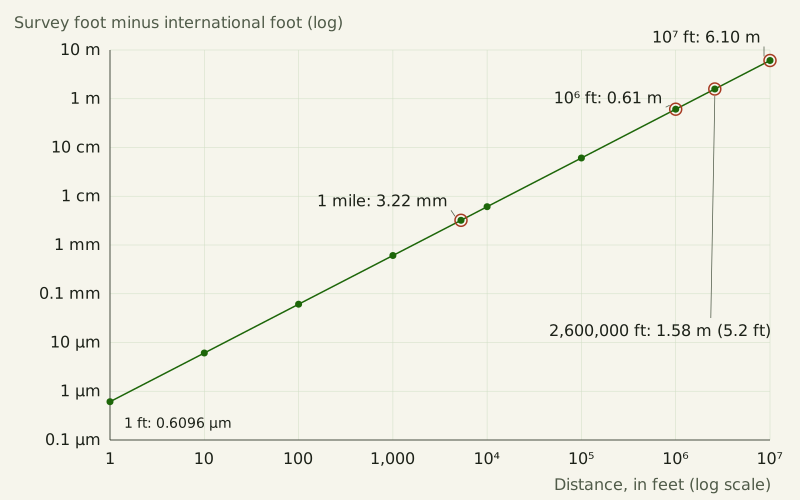
Figure: The Yardstick Almanac, CC BY 4.0
Credit line to copy
"Difference between the two feet by distance" by The Yardstick Almanac, https://theyardstickalmanac.com/units/us-survey-foot/, licensed under CC BY 4.0 (https://creativecommons.org/licenses/by/4.0/).
Data: Computed from the two foot definitions (24 FR 5348, 1959; NIST SP 811, 2008), 2026-11-01, CC BY 4.0
Until 2023, the U.S. had two official feet, and over a mile they differed by about 3 millimeters. The international foot of 0.3048 meter [exact by definition] comes from a Federal Register notice that took effect on July 1, 1959. The same notice kept an older foot of 1200/3937 meter [exact by definition] for geodetic surveys and named it the U.S. survey foot. The gap between the two is a rounding remainder, our name for what a measurement convention leaves over: an 1866 table put the meter at 39.37 inches, the 1959 values made the inch 25.4 millimeters, and those two round numbers do not agree.
The U.S. survey foot is defined as 1200/3937 meter, about 0.30480061 m, while the international foot is defined as 0.3048 meter. A survey foot is longer by 1 part in 499,999 [exact by definition], about 2 parts per million, which is 3.22 millimeters per mile (rounded) [exact by definition]. NIST and NOAA's National Geodetic Survey set December 31, 2022, as the date the survey foot was deprecated, in a final notice published on October 5, 2020 (85 FR 62698). From January 1, 2023, the international foot is the one approved foot, and survey-foot values are kept for historic and legacy records.
How far apart are the survey foot and the international foot?
Per foot, the difference is 0.6096 micrometer (rounded) [exact by definition]. Both definitions are fractions of a meter, so the gap can be written out in full: 1200/3937 m minus 0.3048 m is 24/39,370,000 m. Over a mile of 5,280 feet that becomes 12,672/3,937 mm, which rounds to 3.22 mm [exact by definition], about an eighth of an inch.
NIST Special Publication 811 states the relation as 1 international foot = 0.999 998 U.S. survey foot. It calls the relation exact. Turned around, one survey foot equals 1 + 1/499,999 international feet. Either way the gap rounds to 2 parts per million: 1/499,999 of an international foot, or 1/500,000 of a survey foot.
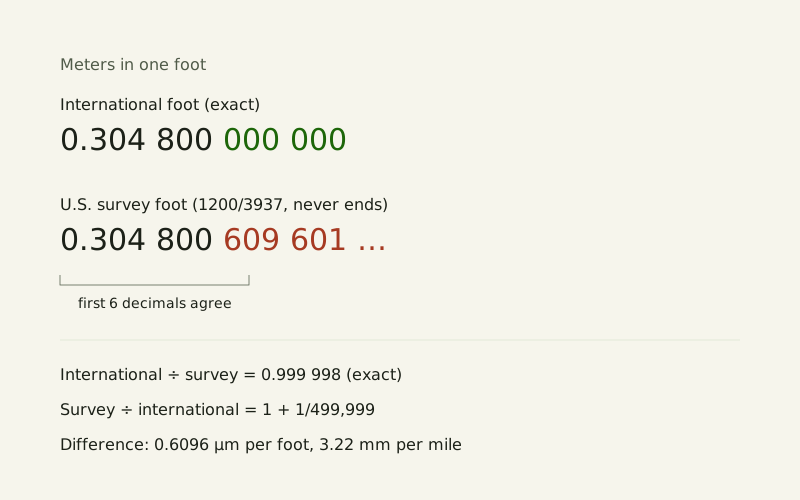
Figure: The Yardstick Almanac, CC BY 4.0
Credit line to copy
"Meters in one foot, two ways" by The Yardstick Almanac, https://theyardstickalmanac.com/units/us-survey-foot/, licensed under CC BY 4.0 (https://creativecommons.org/licenses/by/4.0/).
Data: Computed from the two foot definitions (24 FR 5348, 1959; NIST SP 811, 2008), 2026-11-01, CC BY 4.0
The 2019 Federal Register notice that opened the retirement prints this ratio as “0.999 999 8,” one 9 too many. Our exact-fraction calculation gives 0.999 998, the value in SP 811. The misprint makes the gap look ten times smaller than it is.
| Distance in feet | Survey-foot result minus international-foot result |
|---|---|
| 1 | 0.6096 µm |
| 1,000 | 0.61 mm |
| 5,280 (1 mile) | 3.22 mm |
| 100,000 | 6.10 cm |
| 1,000,000 | 0.61 m |
| 10,000,000 | 6.10 m (20.0 ft) |
For one property line, that is very little. The 2020 notice calls the 2-parts-per-million difference, “approximately 0.01 foot per mile,” “too small to be of practical consequence for the vast majority of boundary determinations.” The trouble starts with numbers in the millions, which is where survey coordinates live.
Where did a second foot come from?
Both feet trace back to one law. The act of July 28, 1866, made the metric system lawful in the United States, and its table of equivalents, reprinted in NBS Special Publication 447, lists the meter as 39.37 inches. The 1959 notice later called the act's figures “approximate equivalents,” and NIST SP 811 likewise says only that the 1866 law “gave the relationship 1 m = 39.37 in.”
The table became a definition in 1893. On April 5 that year, Thomas C. Mendenhall, superintendent of standard weights and measures in the Coast and Geodetic Survey, announced with the Treasury Secretary's approval that the international prototype meter and kilogram would be the fundamental standards. The yard and pound would be “derived therefrom in accordance with the Act of July 28, 1866.” A note in the order spells out the result as 1 yard = 3600/3937 metre (the order uses the British spelling), which makes the foot 1200/3937 meter [exact by definition].
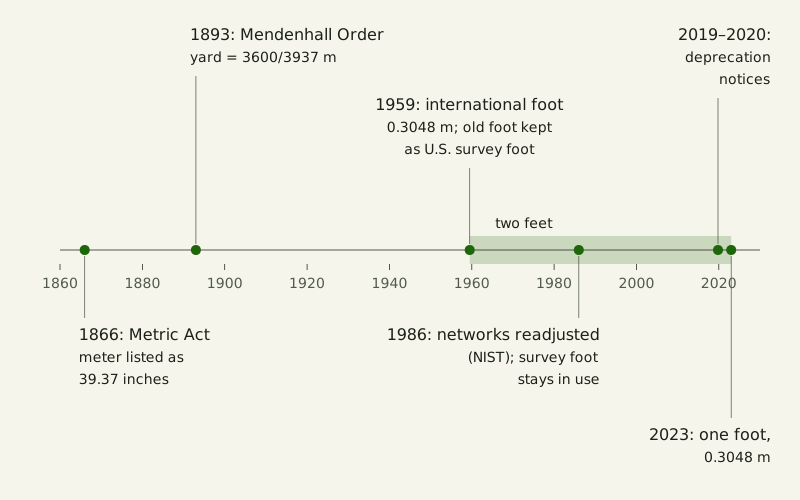
Figure: The Yardstick Almanac, CC BY 4.0
Credit line to copy
"The paper trail of the U.S. survey foot, 1866–2023" by The Yardstick Almanac, https://theyardstickalmanac.com/units/us-survey-foot/, licensed under CC BY 4.0 (https://creativecommons.org/licenses/by/4.0/).
Data: NBS SP 447, 24 FR 5348, 84 FR 55562, 85 FR 62698 and the NIST survey-foot page, read 2026-10-31 to 2026-11-01, CC BY 4.0
The documents disagree slightly about where the exact fraction began. NIST's survey-foot page says the 1893 definition was the one Congress specified in 1866, 1 foot = 1200/3937 meter. The 1866 act itself lists equivalents for use in contracts and legal proceedings, and both the 1959 notice and SP 811 describe its figure as 39.37 inches to the meter, not as a fraction of a meter. Read together, the 1866 table supplied the number and the 1893 order made it the definition.
The order also records where the new standards came from. The United States drew the meter bars numbered 21 and 27 by lot in 1889, and the seals on bar 27 were broken at the Executive Mansion on January 2, 1890. From 1893 on, according to the 1959 notice, the yard and the pound were derived from the international meter and kilogram.
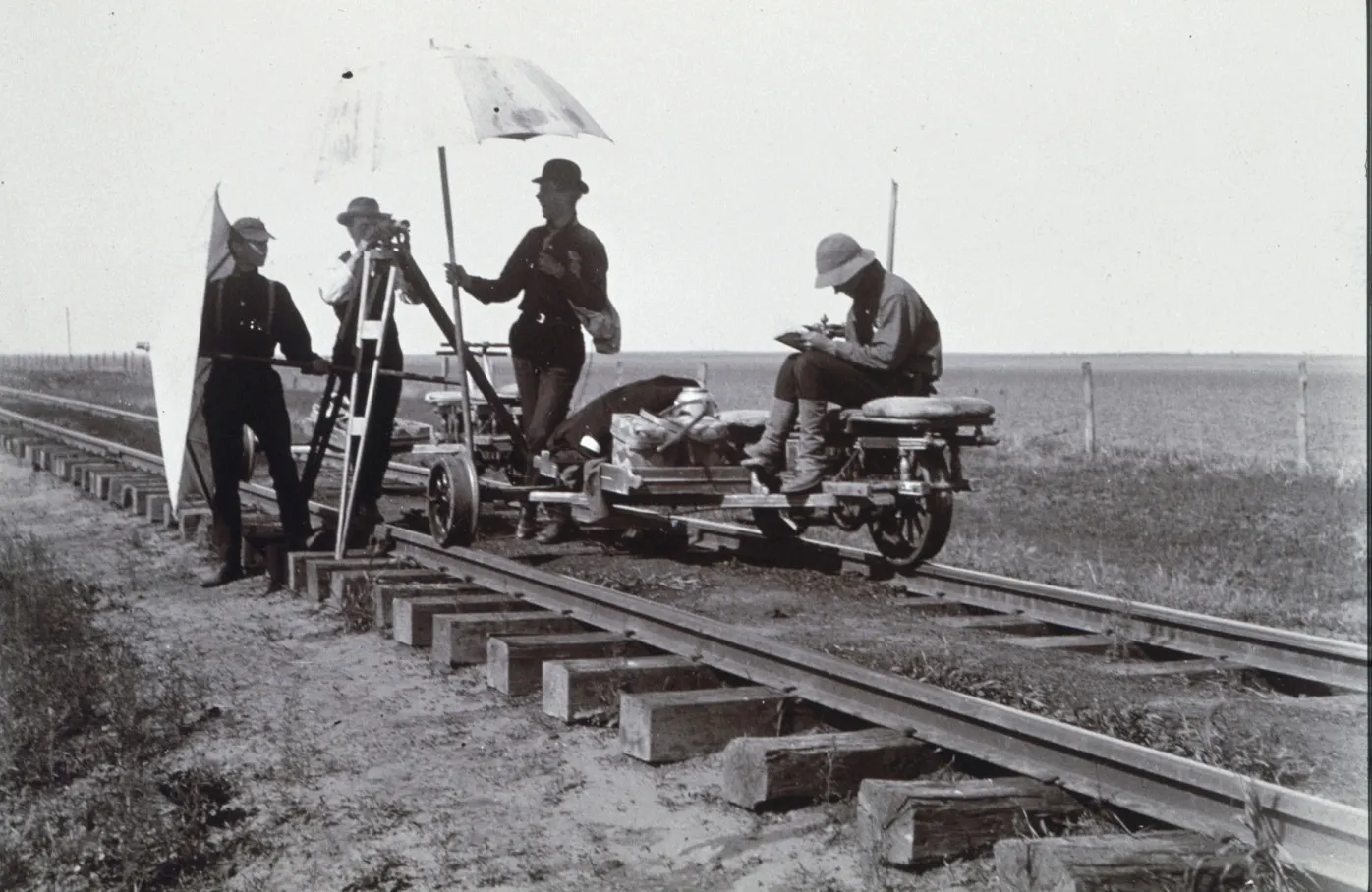
"Early level crew, taking the back sight, Oklahoma, Indian Territory, 1902 (NOAA Photo Library theb0742)" by NOAA Photo Library, John Hayford Album, public domain
Full credit
"Early level crew, taking the back sight, Oklahoma, Indian Territory, 1902 (NOAA Photo Library theb0742)" by NOAA Photo Library, John Hayford Album — https://commons.wikimedia.org/wiki/File:Theb0742_-_Flickr_-_NOAA_Photo_Library.jpg — Public domain (work of the U.S. federal government, 17 U.S.C. §105; also released by the NOAA Photo Library under CC BY 2.0)
The 39.37 figure was close but not right. SP 447 reports measurements made just before April 1893 that gave 1 U.S. yard = 0.914 399 80 meter [measured, source gives no uncertainty], or 39.370 09 inches to the meter. The observers noted that the 1866 value of 39.37 was “evidently sufficiently precise for geodetic purposes.” By our arithmetic, their measured yard sits 0.22 parts per million from the 1959 yard and 2.22 parts per million from the 1893 one.
What did the 1959 agreement change?
Effective July 1, 1959, the National Bureau of Standards and the Coast and Geodetic Survey set 1 yard = 0.9144 meter and 1 pound = 0.453 592 37 kilogram [exact by definition] (24 FR 5348). The notice says the national standards laboratories of Australia, Canada, New Zealand, South Africa and the United Kingdom would use the same values. It also notes that the inch these values imply is 25.4 millimeters, a figure the American Standards Association had approved for industrial use in 1933.
| Unit | 1893–1959 | From July 1, 1959 | Change |
|---|---|---|---|
| yard | 3600/3937 m, about 0.914 401 83 m | 0.9144 m | −2 ppm |
| foot | 1200/3937 m, about 0.304 800 61 m | 0.3048 m | −2 ppm |
| inch | 100/3937 m, about 25.400 051 mm | 25.4 mm | −2 ppm |
| pound | 1 kg = 2.20462234 lb (1894 ratio), about 0.453 592 428 kg | 0.453 592 37 kg | −0.128 ppm |
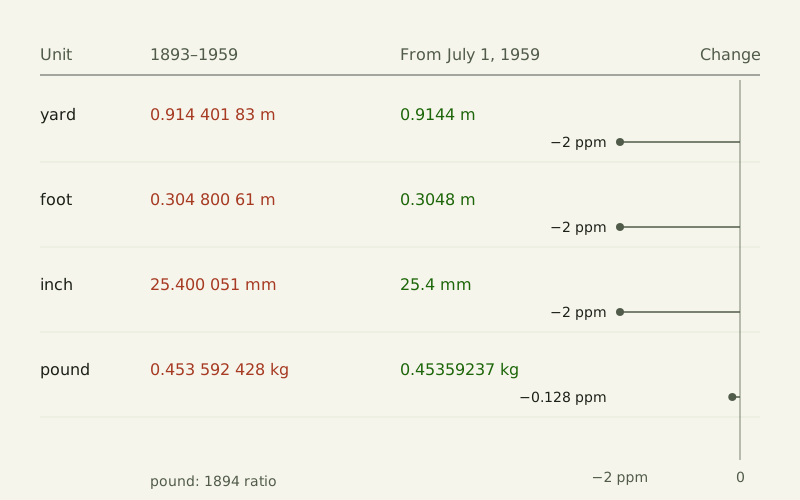
Figure: The Yardstick Almanac, CC BY 4.0
Credit line to copy
"Yard, foot, inch and pound, 1893–1959 and from 1959" by The Yardstick Almanac, https://theyardstickalmanac.com/units/us-survey-foot/, licensed under CC BY 4.0 (https://creativecommons.org/licenses/by/4.0/).
Data: Computed from 24 FR 5348 (1959) and the Mendenhall Order (1893), 2026-11-01, CC BY 4.0
So the new yard was 2 parts per million shorter than the 1893 yard [exact by definition], and the notice pointed out that measurements in the new units would read 2 parts per million higher. The pound moved by about 1 part in 10 million. The kilogram the pound now hangs on was itself redefined later; see the 2019 kilogram definition.
The exception came in one sentence. Any data in feet “derived from and published as a result of geodetic surveys within the United States” would keep the 1893 relation, and that foot “shall be referred to as the U.S. Survey Foot.” It was meant to last only until the national survey networks were readjusted, after which the 0.9144-meter yard would apply.
The same notice converted the international nautical mile of 1,852 meters to 6,076.11549 international feet, up from 6,076.10333 feet under the old ratio. Both figures match our calculation; the full story of that unit is in the nautical mile.
Why did surveyors keep the old foot until 2022?
Survey coordinates are big numbers. A fixed ratio turns big numbers into visible gaps. A State Plane coordinate system gives each point an easting and a northing on a flat grid, and the 2020 notice describes “very large coordinate values” in survey feet in many areas. The 2019 notice says the difference between the two feet can reach “tens of feet for SPCS 83 coordinates,” the State Plane Coordinate System of 1983.
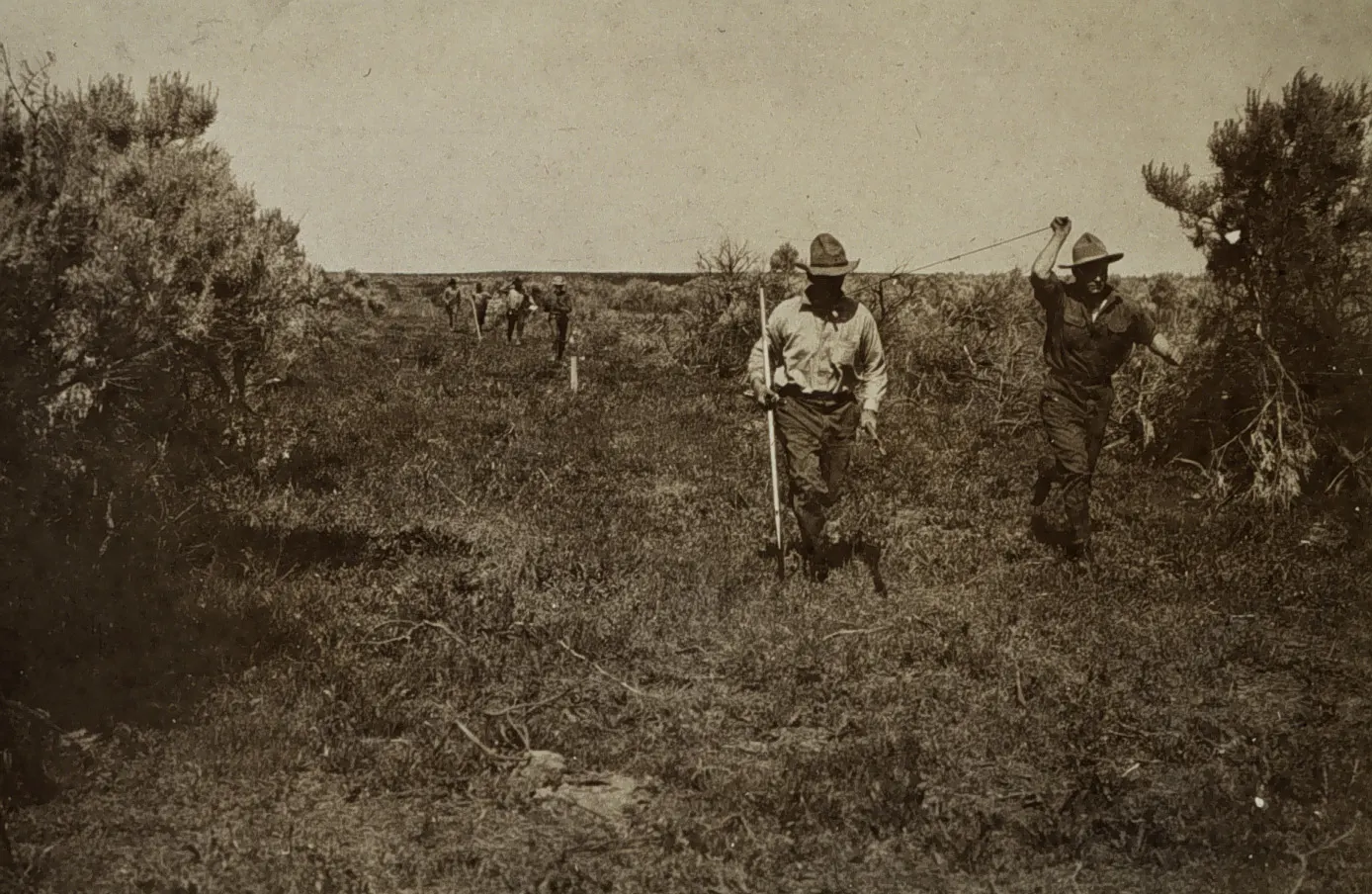
"Measuring base with Invar tape, Stanfield, Oregon (NOAA Photo Library theb1656)" by U.S. Coast and Geodetic Survey — https://commons.wikimedia.org/wiki/File:Theb1656_-_Flickr_-_NOAA_Photo_Library.jpg — Public domain (work of the U.S. federal government, 17 U.S.C. §105; also released by the NOAA Photo Library under CC BY 2.0)
A public comment printed in the 2020 notice gives a real case. Plant coordinates in international feet were forced to match State Plane coordinates in survey feet at one point, where “the State Plane easting was over 2,600,000 sft,” causing “more than 5 feet of positional error.” Our calculation agrees. Read the wrong way, 2,600,000 feet shifts a point by 5.2 feet, or 1.58 meters (rounded) [exact by definition].
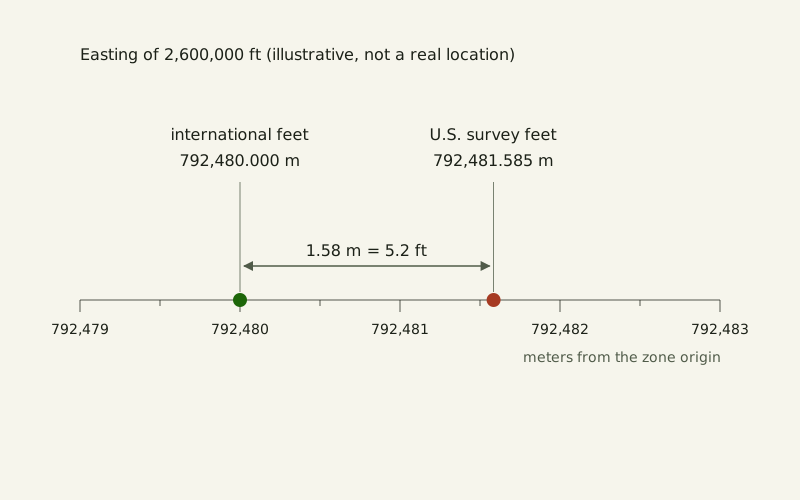
Figure: The Yardstick Almanac, CC BY 4.0
Credit line to copy
"One easting, two feet" by The Yardstick Almanac, https://theyardstickalmanac.com/units/us-survey-foot/, licensed under CC BY 4.0 (https://creativecommons.org/licenses/by/4.0/).
Data: Computed from the two foot definitions (24 FR 5348, 1959); easting from a public comment in 85 FR 62698 (2020), 2026-11-01, CC BY 4.0
The readjustment the 1959 notice waited for did happen, but the foot stayed. According to the 2019 notice, NOAA adopted the meter for the National Spatial Reference System in 1977, yet surveyors kept using the survey foot with the State Plane systems of 1927 and 1983. NIST's survey-foot page says the readjustment was completed in 1986 and that use of the survey foot persisted anyway.
State law locked it in. Of the 50 jurisdictions that had legislated SPCS 83, the 2019 notice counts 40 states that specified the survey foot, 28 by statute and 12 by Federal Register notice. Six states had adopted the international foot, and two states plus Puerto Rico and Guam had not named either. The 2020 notice lists those six as Arizona, Michigan, Montana, North Dakota, Oregon and South Carolina, which switched in the late 1980s and early 1990s.
How was the survey foot retired?
The retirement took a little over three years, from the first notice to the deprecation date. NIST and NOAA ran it as a joint action, timed to the National Geodetic Survey's planned modernization of the national coordinate system:
- October 17, 2019: 84 FR 55562 announces the decision to deprecate the survey foot on December 31, 2022, and invites comments.
- December 2, 2019: the comment period closes with 72 comments.
- July 10, 2020: 85 FR 41560 extends the review by 90 days.
- October 5, 2020: 85 FR 62698 publishes the final determination.
- December 31, 2022: the survey foot is deprecated.
- January 1, 2023: one approved foot, 0.3048 m; survey-foot values remain for historic and legacy applications.
- July 1, 2023: the National Geodetic Survey's policy for the State Plane Coordinate System of 2022 takes effect, with coordinates in meters or in feet of 0.3048 m.
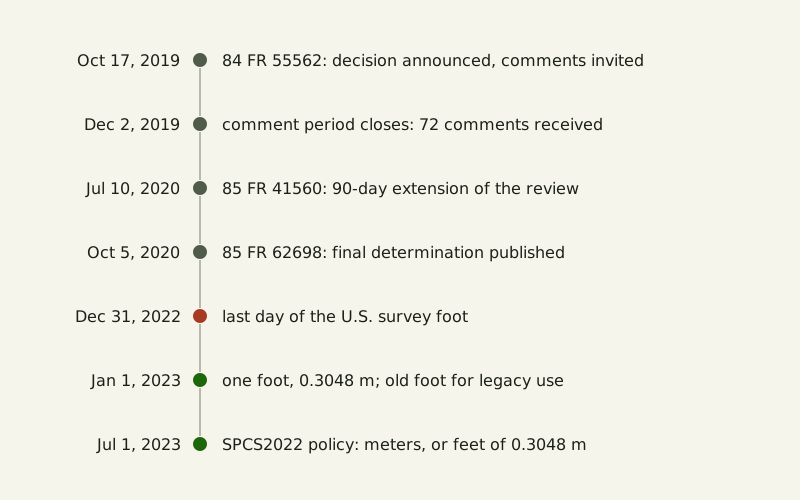
Figure: The Yardstick Almanac, CC BY 4.0
Credit line to copy
"How the U.S. survey foot was retired, 2019–2023" by The Yardstick Almanac, https://theyardstickalmanac.com/units/us-survey-foot/, licensed under CC BY 4.0 (https://creativecommons.org/licenses/by/4.0/).
Data: 84 FR 55562, 85 FR 41560, 85 FR 62698 and the NGS SPCS2022 Policy, read 2026-11-01, CC BY 4.0
The comments split, but not evenly. Of the 72 responses, 64 stated an opinion: 34 (53 percent) supported the international foot, 21 (33 percent) wanted to keep the survey foot, and 9 (14 percent) preferred dropping feet for meters. No state government opposed the change, the final notice says, and every opposing comment came from an individual except one trade association.
The notice answered the main objection, legacy data, by keeping the old foot where it already lived. The National Geodetic Survey would go on supporting the survey foot for State Plane coordinates of 1983 in states that had specified it, and for every zone of the 1927 system. It also rejected a split rule, survey feet for geospatial work and international feet for everything else, as “extremely difficult, and perhaps impossible, to apply in practice.”
Do surveyors still use the survey foot?
Yes, in old coordinate systems and old records, but not in the new one. The National Geodetic Survey's 2023 policy publishes State Plane coordinates of 2022 in meters; if it gives feet, they are 0.3048 meter, and the survey foot “will not be supported” for SPCS2022. The same section counts longitudes east from the prime meridian, 0° to 360°.
To tell which foot a coordinate uses, the 2020 notice points to the coordinate system itself, and the steps follow from what it says:
- Is it a State Plane coordinate of 2022? Then it is in meters, or in feet of 0.3048 m.
- Is it State Plane of 1927? Then it is in U.S. survey feet; the National Geodetic Survey keeps survey-foot support for every 1927 zone.
- Is it State Plane of 1983? Then it is in whichever foot the state specified, which in 2019 was the survey foot in 40 states.
- Otherwise, check the metadata. After 2022, a plain “ft” means the international foot by default.
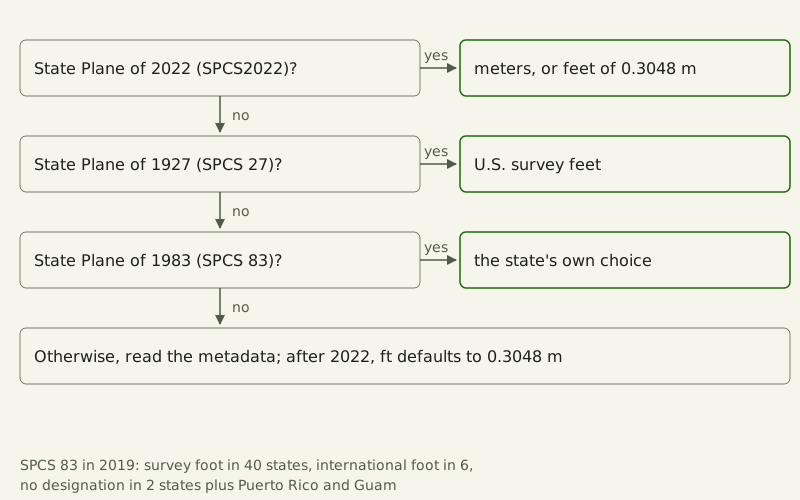
Figure: The Yardstick Almanac, CC BY 4.0
Credit line to copy
"Which foot is this coordinate in?" by The Yardstick Almanac, https://theyardstickalmanac.com/units/us-survey-foot/, licensed under CC BY 4.0 (https://creativecommons.org/licenses/by/4.0/).
Data: 85 FR 62698 (2020), 84 FR 55562 (2019) and the NGS SPCS2022 Policy, read 2026-11-01, CC BY 4.0
Where a record has to say which foot it means, the 2020 notice recommends writing “sft” for the survey foot and “ift” for the international foot. Most states had written the survey foot into statute, so each state changes over through its own legislation. The 2020 notice names Kentucky and Washington as two states whose new laws adopting the international foot took effect that year.
U.S. survey foot questions
How do you convert U.S. survey feet to meters?
Use the fraction, not 0.3048. For a length recorded in U.S. survey feet:
- Multiply the number of survey feet by 1,200.
- Divide the result by 3,937. The answer is in meters.
- For international feet instead, divide the meters by 0.3048, or divide the survey-foot figure by 0.999 998.
So 1,000 survey feet is 304.800609601 meters (rounded) [exact by definition], against 304.8 meters for 1,000 international feet. In international feet, the same length is 1,000.002000 feet.
Is the statute mile a survey mile?
It was, historically. The 2020 notice says the statute mile was defined with the U.S. survey foot but can be defined with either foot, and that definitions based on the survey foot should be avoided after December 31, 2022, except for historic and legacy applications. The 2019 notice puts the U.S. survey mile at about 1609.347 meters; the international mile is 1609.344 meters [exact by definition].
Did the change reach elevations?
Yes, for the new system. The 2020 notice says the National Geodetic Survey will not support the U.S. survey foot anywhere in the modernized National Spatial Reference System, “including for SPCS2022, elevations, or any other components of the system.” Older systems keep their survey-foot support.
Is the international foot the same as the British foot?
The 1959 values were shared. The notice lists the national standards laboratories of Australia, Canada, New Zealand, South Africa and the United Kingdom as using the same yard and pound as the United States. Even so, the 2020 notice asks writers not to call the U.S. customary system “Imperial” or “British,” because many of the traditional units in those systems differ.
Which other units changed with the foot?
Every unit built on the foot changed too, because each is a fixed number of feet. The 2020 notice lists them in its Table 1: the chain is 66 feet, the rod 16.5, the furlong 660, the mile 5,280, and the acre 43,560 square feet. Except for the mile and the square mile, these units had previously been defined only with the survey foot.
| Unit | Size in feet | With the international foot | With the survey foot | Difference |
|---|---|---|---|---|
| link | 0.66 | 0.201168 m | 0.201168402 m | 0.402 µm |
| rod | 16.5 | 5.0292 m | 5.029210058 m | 10.1 µm |
| chain | 66 | 20.1168 m | 20.116840234 m | 40.2 µm |
| furlong | 660 | 201.168 m | 201.168402337 m | 0.402 mm |
| mile | 5,280 | 1609.344 m | 1609.347218694 m | 3.22 mm |
| league | 15,840 | 4828.032 m | 4828.041656083 m | 9.66 mm |
| acre | 43,560 ft² | 4046.8564224 m² | 4046.872609874 m² | 0.0162 m² |
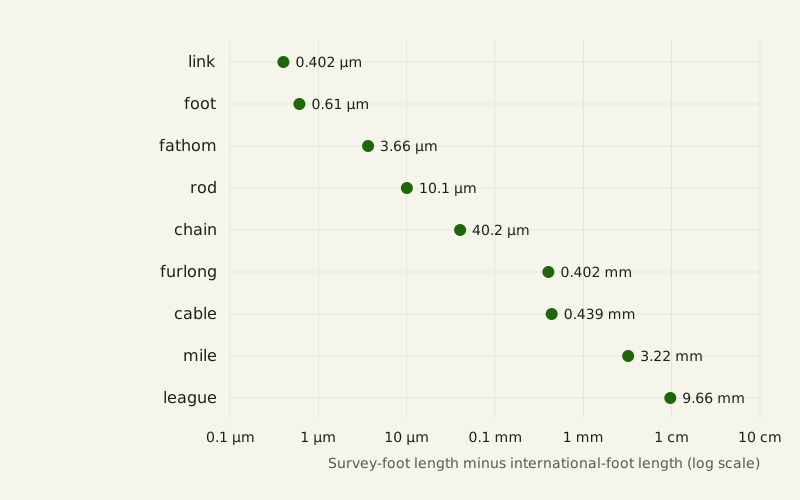
Figure: The Yardstick Almanac, CC BY 4.0
Credit line to copy
"How much longer each unit is under the survey foot" by The Yardstick Almanac, https://theyardstickalmanac.com/units/us-survey-foot/, licensed under CC BY 4.0 (https://creativecommons.org/licenses/by/4.0/).
Data: Recomputed from 85 FR 62698 (2020), Table 1, and the two foot definitions, 2026-11-01, CC BY 4.0
We recomputed all twelve rows of Table 1 with exact fractions and with a second unit library; every survey-foot value, rounded to the places the notice prints, matches its table digit for digit. For an acre, the difference is 0.0162 square meter (rounded) [exact by definition], about 25 square inches, which the notice gives as 0.000 004 acre. The notice adds that the finest precision typically used for the chain in modern surveying is three decimal places, and at that level “both definitions of the foot give the same value.”
Sources
- National Bureau of Standards and U.S. Coast and Geodetic Survey, "Refinement of Values for the Yard and the Pound," Federal Register 24, no. 128 (July 1, 1959), 5348–5349 (24 FR 5348), F.R. Doc. 59-5442. https://www.govinfo.gov/content/pkg/FR-1959-07-01/pdf/FR-1959-07-01.pdf Read: full notice
- National Institute of Standards and Technology and NOAA National Geodetic Survey, "Deprecation of the United States (U.S.) Survey Foot," notice of final determination, Federal Register 85, no. 193 (October 5, 2020), 62698–62708 (85 FR 62698), FR Doc. 2020-21902. https://www.govinfo.gov/content/pkg/FR-2020-10-05/pdf/2020-21902.pdf Read: full notice
- National Institute of Standards and Technology and NOAA National Geodetic Survey, "Deprecation of the United States (U.S.) Survey Foot," notice and request for comment, Federal Register 84, no. 201 (October 17, 2019), 55562–55565 (84 FR 55562), FR Doc. 2019-22414. https://www.govinfo.gov/content/pkg/FR-2019-10-17/pdf/2019-22414.pdf Read: full notice
- National Institute of Standards and Technology and NOAA National Geodetic Survey, "Deprecation of the United States (U.S.) Survey Foot," notice of delay in publication of final determination, Federal Register 85 (July 10, 2020), 41560 (85 FR 41560), FR Doc. 2020-14882. https://www.govinfo.gov/content/pkg/FR-2020-07-10/pdf/2020-14882.pdf Read: full notice
- Lewis V. Judson, Weights and Measures Standards of the United States, A Brief History, NBS Special Publication 447 (National Bureau of Standards, 1963, updated 1976), sections 5, 7 and 9 and Appendix 3, "The Mendenhall Order of April 5, 1893." https://nvlpubs.nist.gov/nistpubs/Legacy/SP/nbsspecialpublication447.pdf Read: sections 5, 7, 9 and Appendix 3 (full text of the Mendenhall Order)
- Ambler Thompson and Barry N. Taylor, Guide for the Use of the International System of Units (SI), NIST Special Publication 811, 2008 edition, sec. B.6, "U.S. survey foot and mile." https://nvlpubs.nist.gov/nistpubs/Legacy/SP/nistspecialpublication811e2008.pdf Read: section B.6
- NOAA National Geodetic Survey, State Plane Coordinate System of 2022 Policy, NGS 2023-1214-03, effective July 1, 2023, sec. II.E. https://geodesy.noaa.gov/INFO/Policy/files/SPCS2022-Policy.pdf Read: section II.E (input and output specifications)
- National Institute of Standards and Technology, NIST Handbook 44 (2026 edition), Appendix C, "General Tables of Units of Measurement." https://www.nist.gov/document/2026-nist-handbook-44-appendix-c Read: Appendix C, units of length, area and volume sections and their notes
- National Institute of Standards and Technology, "U.S. Survey Foot," Physical Measurement Laboratory web page. https://www.nist.gov/pml/us-surveyfoot Read: full page
Data files (computed 2026-11-01 with exact fractions from the two definitions, cross-checked against the Pint 0.26.2 unit library, BSD-3-Clause license, and against the values printed in Table 1 of 85 FR 62698; each file comes with a notes file giving its sources and license):
- Difference between the two feet, 1 ft to 10,000,000 ft (CSV, source and license notes) Data: Computed from the two foot definitions (24 FR 5348, 1959; NIST SP 811, 2008), 2026-11-01, CC BY 4.0
- Units built on the foot, under both definitions (CSV, source and license notes) Data: Recomputed from 85 FR 62698 (2020), Table 1, and the two foot definitions, 2026-11-01, CC BY 4.0
- Yard, foot, inch and pound, 1893–1959 and from 1959 (CSV, source and license notes) Data: Computed from 24 FR 5348 (1959) and the Mendenhall Order (1893), 2026-11-01, CC BY 4.0
- The paper trail of the survey foot, 1866–2023 (CSV, source and license notes) Data: Summarized from NBS SP 447, 24 FR 5348, 84 FR 55562, 85 FR 41560, 85 FR 62698 and the NGS SPCS2022 Policy, 2026-11-01, CC BY 4.0
Cite this page
The Yardstick Almanac. "U.S. Survey Foot: America Had Two Official Feet Until 2023." Published November 1, 2026. https://theyardstickalmanac.com/units/us-survey-foot/. Accessed [the date you read it].
More in Units & Standards
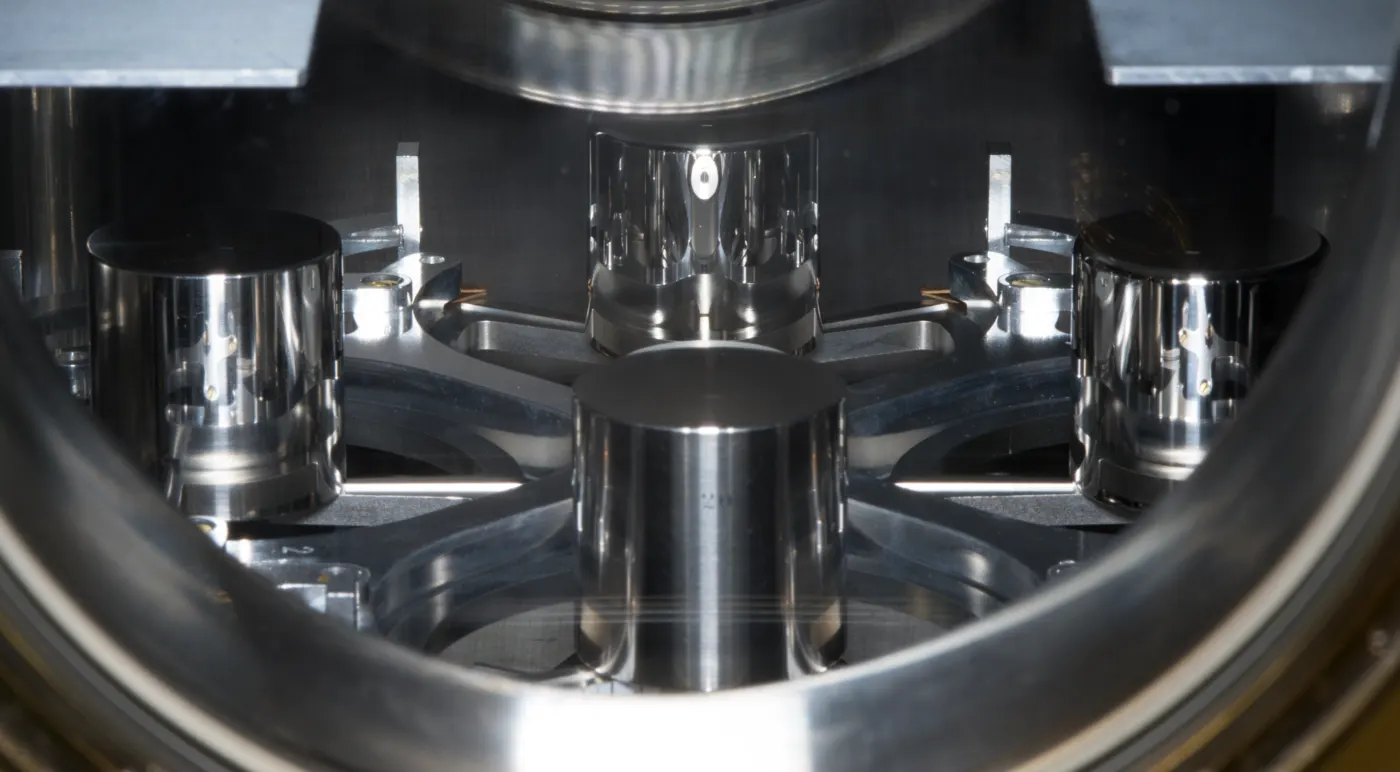
Units & Standards
Kilogram Definition: Why the 1889 Cylinder Has Uncertainty
Image credit
"K20 and Friends: four of the five U.S. national prototype kilogram artifacts, including K20 (front) and K4 (back)" by J. Lee/NIST — https://commons.wikimedia.org/wiki/File:Kilograms-pml0013_K20_and_Friends_Four_of_the_five_U.S._national_prototype_kilogram_artifacts,_including_K20_(front)_and_K4_(back).png — Public domain (work of the U.S. federal government, 17 U.S.C. §105 (photograph by J. Lee of NIST, published by NIST in 2018); Commons also marks the file with the Public Domain Mark 1.0)
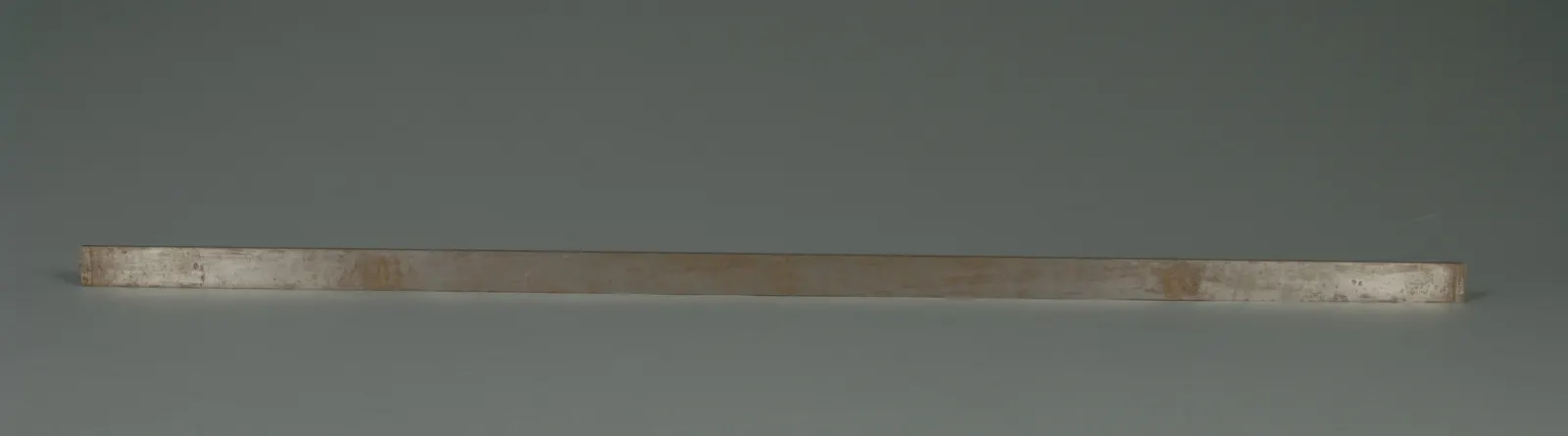
Units & Standards
Metric System in the U.S.: The Yard Is Defined by the Meter
Image credit
"Committee Meter Bar, made of platinum in 1799 (NIST Museum Collection)" by NIST Museum Collection — https://commons.wikimedia.org/wiki/File:Committee_Meter_Bar_Platinum_1799.png — Public domain (work of the U.S. federal government, 17 U.S.C. §105 (photograph from the NIST Museum Collection, source https://www.nist.gov/image/committee-meter); Commons also marks the file with the Public Domain Mark 1.0)
Units & Standards
Nautical Mile: 1,852 m, While a Minute of Latitude Varies
Image credit
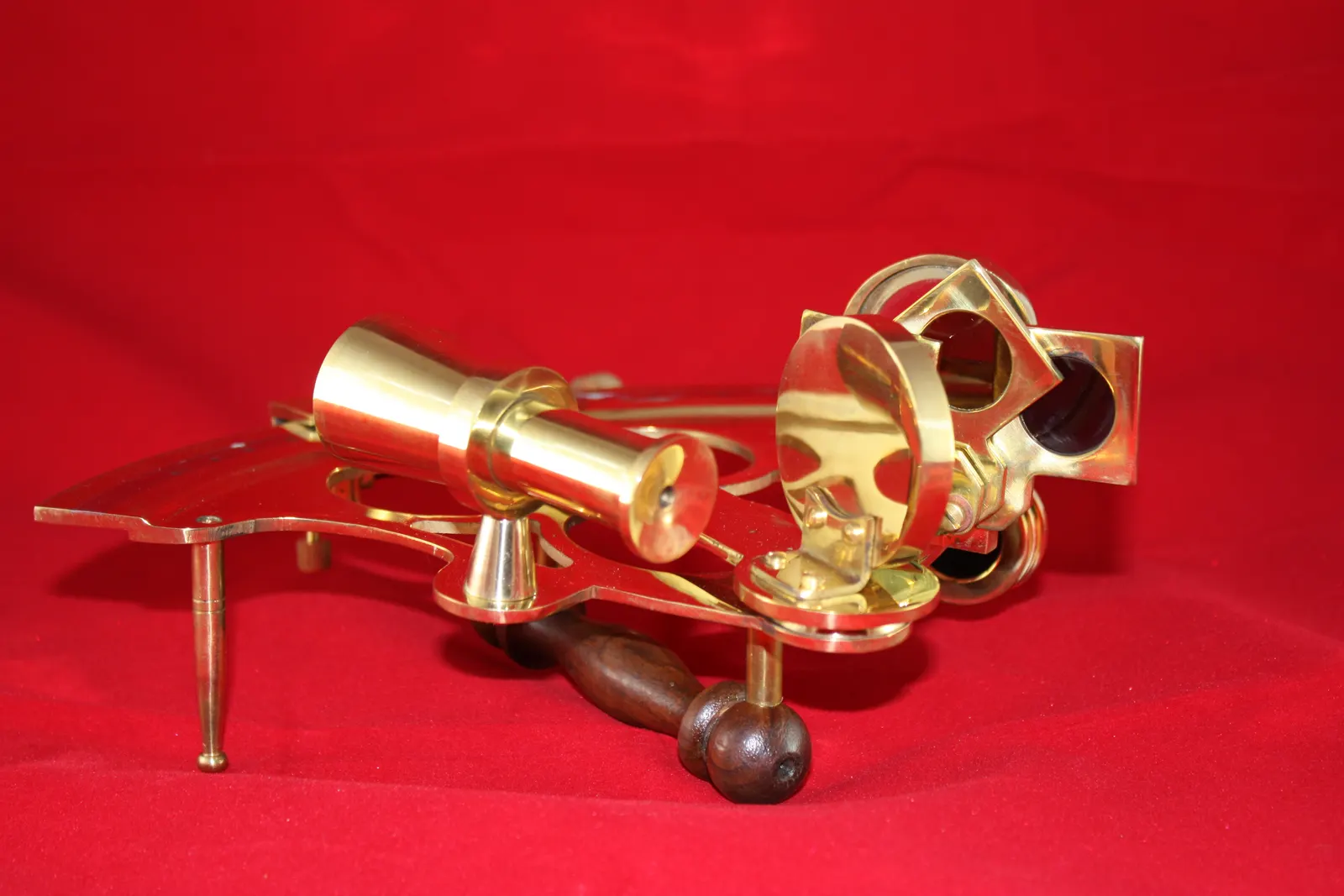
"Sextant (NPS Photo, Lewis and Clark National Historical Park)" by NPS Photo — https://commons.wikimedia.org/wiki/File:This_instrument_was_used_to_measure_the_angular_distance_between_the_moon_and_sun_or_a_star_for_determining_longitude._(1d68d331-1dd8-b71b-0bf5-2e79f90f1e7b).JPG — Public domain (work of the U.S. federal government, 17 U.S.C. §105 (Commons tag PD-USGov-NPS: material based on a work of a National Park Service employee created as part of official duties; photographer field NPS Photo, publisher U.S. National Park Service, source NPGallery); structured data: public domain in the United States, work of the federal government)
How this page is checked: Where the numbers come from explains the value tags, the source order and how every figure is recomputed.
Corrections: every substantive change is logged in What we got wrong.
Spotted an error? Email contact@theyardstickalmanac.com with the sentence and your source, or read Write in first.