Nanosecond: Light Covers About 11.8 Inches in a Vacuum
The Yardstick Almanac Published No substantive revisions
Short answer
In one nanosecond, light in a vacuum travels 0.299792458 m [exact by definition], about 11.8 inches. The Naval History and Heritage Command's catalog says Grace Hopper used wires to visualize it.
Station index 9 sections
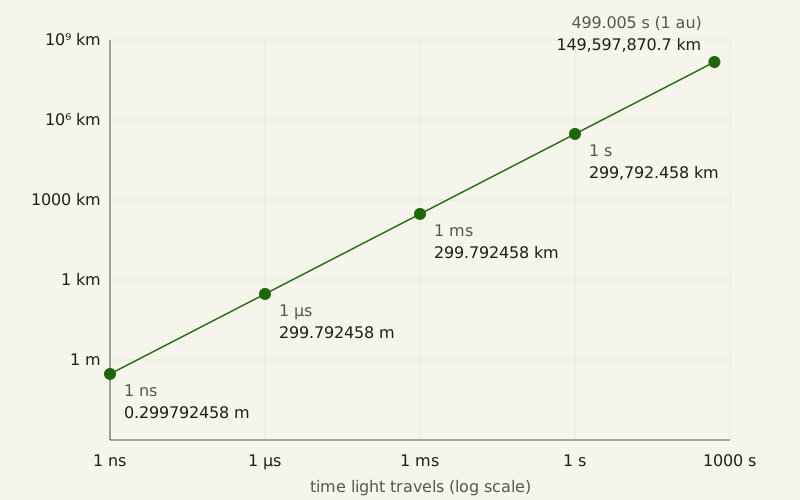
Figure: The Yardstick Almanac, CC BY 4.0
Credit line to copy
"Light-distance ladder, metric" by The Yardstick Almanac, https://theyardstickalmanac.com/scale/grace-hopper-nanosecond/, licensed under CC BY 4.0 (https://creativecommons.org/licenses/by/4.0/).
Data: Defined values from the BIPM SI Brochure, 9th ed. V4.01 (CC BY 4.0; adapted: values used in new calculations) and NIST Handbook 44-2026, Appendix C; computed 2026-11-01, CC BY 4.0
One nanosecond of light in a vacuum spans 11.8 inches, about 5 millimeters short of a foot. That length is not a measurement. The speed of light has been a fixed number since 1983, when the 17th General Conference on Weights and Measures redefined the meter, and the inch has been 2.54 centimeters since a 1959 notice in the Federal Register. A Navy catalog record says Grace Hopper used two wires “to visualize the concept of a nanosecond,” and this page keeps light in a vacuum as its yardstick, setting aside the slower signal in a wire.
Worked out from those definitions, light in a vacuum covers 0.299792458 meters in one nanosecond [exact by definition]. Rounded, that is 29.98 centimeters or 11.80 inches. A nanosecond is one billionth of a second, because the SI prefix nano means 10−9. Multiply the time by 1,000 and the distance grows by the same factor, to 299.792458 meters in a microsecond and 299.792458 kilometers in a millisecond [exact by definition].
How far does light travel in a nanosecond?
The distance is the speed of light multiplied by the time. Every input is a defined value. The SI Brochure, the reference text for the International System of Units published by the International Bureau of Weights and Measures (BIPM), gives the speed of light in vacuum as 299,792,458 meters per second [exact by definition]. NIST Handbook 44 lists 1 inch as 2.54 centimeters, 1 foot as 0.3048 meter and 1 mile as 1.609344 kilometers [exact by definition].
We computed every rung of the ladder twice: once in exact fractions, once with the Pint unit library working from its own built-in constants. The two methods agreed on all 52 values we compared. The table gives each rung in both kinds of units.
| Time | Distance, metric | Distance, U.S. units |
|---|---|---|
| 1 nanosecond | 0.299792458 m | 11.80 in (0.9836 ft) |
| 1 microsecond | 299.792458 m | 983.6 ft |
| 1 millisecond | 299.792458 km | 186.3 mi |
| 1 second | 299,792.458 km | 186,282 mi |
| 499.005 s (1 au) | 149,597,870.7 km | 92,955,807 mi |
The metric distances are exact by definition. The inches, feet and miles are rounded, because 0.299792458 divided by 0.0254 never ends; the ladder data file carries more decimals.
The charts use a log scale because the rungs sit too far apart for an ordinary axis. The top rung is 499,004,783,836 nanoseconds, about 11.7 powers of ten above the bottom one. Put the top rung at the right edge of this page on a plain axis, and the 1 ns rung would sit less than a billionth of the width from the left.
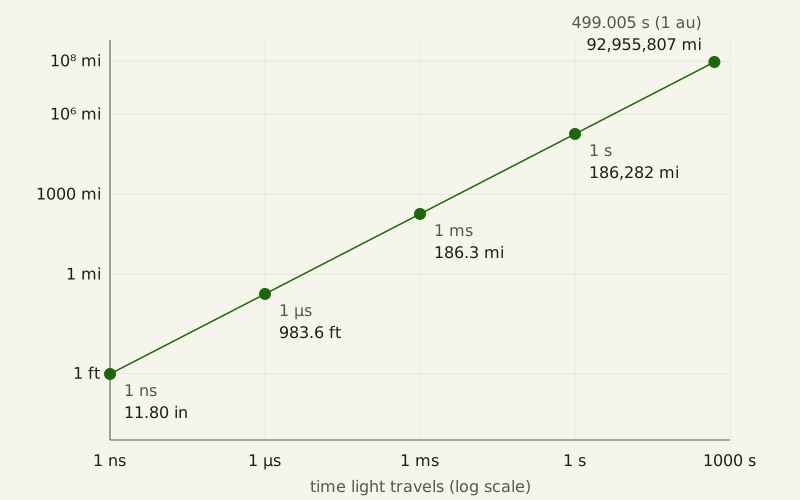
Figure: The Yardstick Almanac, CC BY 4.0
Credit line to copy
"Light-distance ladder, U.S. units" by The Yardstick Almanac, https://theyardstickalmanac.com/scale/grace-hopper-nanosecond/, licensed under CC BY 4.0 (https://creativecommons.org/licenses/by/4.0/).
Data: Defined values from the BIPM SI Brochure, 9th ed. V4.01 (CC BY 4.0; adapted: values used in new calculations) and NIST Handbook 44-2026, Appendix C; computed 2026-11-01, CC BY 4.0
How is a nanosecond defined?
A nanosecond is 10−9 second, and the second is set by an atom. The 13th General Conference on Weights and Measures, meeting in 1967 and 1968, defined the second as the duration of 9,192,631,770 periods of the radiation from one transition in the cesium-133 atom [exact by definition]. The current SI Brochure states the same rule as a fixed frequency of 9,192,631,770 hertz. (The BIPM spells the element caesium.)
Divide that count by a billion and one nanosecond holds 9.19263177 periods [exact by definition], nine full cycles and about a fifth of another. There are 1,000,000,000 nanoseconds in a second. Each one is a fixed slice of the same cesium count.
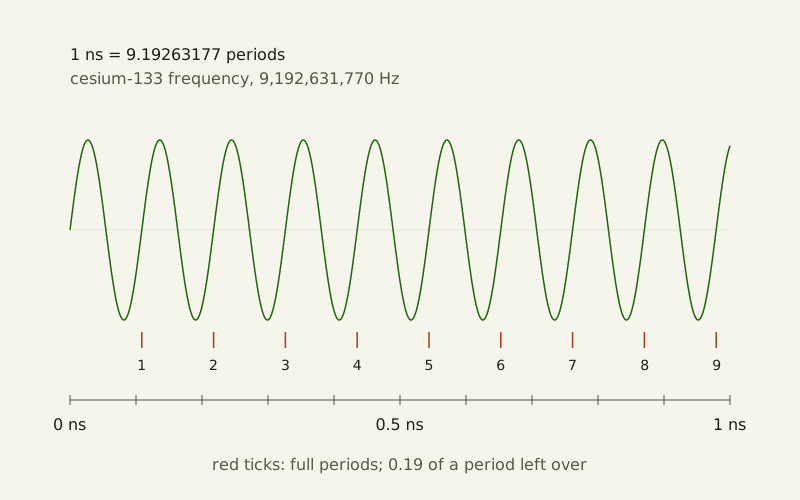
Figure: The Yardstick Almanac, CC BY 4.0
Credit line to copy
"Cesium periods in one nanosecond" by The Yardstick Almanac, https://theyardstickalmanac.com/scale/grace-hopper-nanosecond/, licensed under CC BY 4.0 (https://creativecommons.org/licenses/by/4.0/).
Data: Defined values from the BIPM SI Brochure, 9th ed. V4.01 (CC BY 4.0; adapted: values used in new calculations) and NIST Handbook 44-2026, Appendix C; computed 2026-11-01, CC BY 4.0
A billion is hard to picture. Scale it up instead. A nanosecond is to one second as one second is to about 31.7 years of 365 days [exact by definition], counted as 109 seconds divided by 31,536,000. A day of 86,400 seconds, the value the SI Brochure lists for the day, holds 86,400,000,000,000 nanoseconds [exact by definition].
How did the speed of light become a fixed number?
The 11.80 inches carries no error bar because the meter is now built from light and the cesium second. Until 1983 the speed of light was a measured quantity. The SI Brochure's appendix of past resolutions shows the chain step by step:
- 1889: the meter is a platinum-iridium prototype bar, in force until 1960.
- 1960: the 11th General Conference redefines the meter as 1,650,763.73 wavelengths of a krypton-86 line [exact by definition].
- 1967–68: the 13th General Conference defines the second by the cesium-133 transition.
- 1975: the 15th General Conference recommends c = 299,792,458 meters per second for the speed of light.
- 1983: the 17th General Conference defines the meter by the path of light, which makes that value exact.
- 2019: a revised SI, adopted by the 26th General Conference in 2018, enters into force on May 20 with c and the cesium frequency among its seven defining constants.
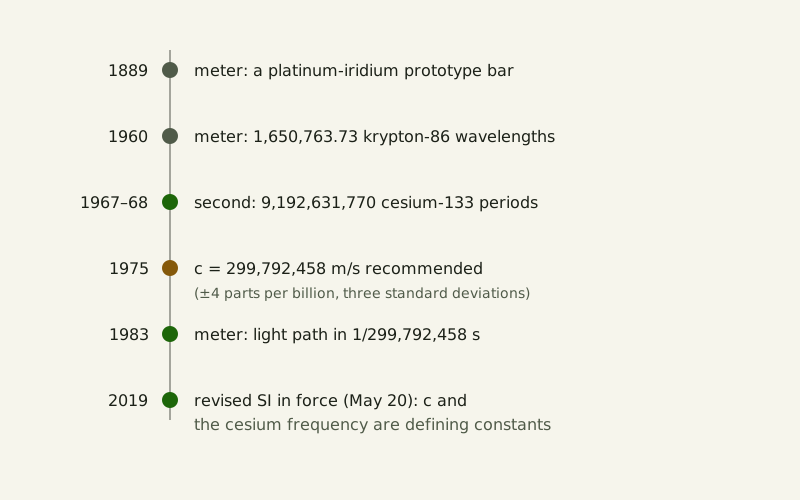
Figure: The Yardstick Almanac, CC BY 4.0
Credit line to copy
"How the meter and the second came to rest on light and cesium" by The Yardstick Almanac, https://theyardstickalmanac.com/scale/grace-hopper-nanosecond/, licensed under CC BY 4.0 (https://creativecommons.org/licenses/by/4.0/).
Data: Resolutions reprinted in the BIPM SI Brochure, 9th ed. V4.01, Appendix 1 (CC BY 4.0; adapted: dates and values condensed into a timeline); compiled 2026-11-01, CC BY 4.0
The second went atomic first. Before 1960, the SI Brochure's historical appendix says, the second was 1/86,400 of the mean solar day, and irregularities in Earth's rotation made that definition unsatisfactory. The 11th General Conference in 1960 switched to a second based on the tropical year 1900, and the cesium definition replaced it in 1967–68. A note adds that in 1997 the definition was affirmed to refer to a cesium atom at rest at a temperature of 0 kelvin.
The 1975 value was a measurement. Resolution 2 based it on laser wavelength and frequency results, with a relative uncertainty that its note gives at three standard deviations [measured, ±4 parts per billion (k=3)], matching the uncertainty in realizing the krypton meter. In 1983 Resolution 1 made the meter “the length of the path travelled by light in vacuum during a time interval of 1/299 792 458 of a second,” keeping the 1975 number unchanged.
From then on, c stopped being something to measure. Both c and the cesium frequency carried over into the 2019 SI redefinition, where the SI Brochure lists them among the seven defining constants of the system.
Why is a light-nanosecond almost a foot?
The international foot is defined as 0.3048 meter [exact by definition], and light in a vacuum covers 0.299792458 meter in a nanosecond. The difference is 5.01 millimeters, or 0.20 inch (both rounded) [exact by definition]. So a light-nanosecond is 98.4% of a foot. The rule of thumb of a foot per nanosecond overstates it by 1.67%.
Turn it around and light needs 1.017 nanoseconds to cross one foot (rounded) [exact by definition]. The table gives the crossing time for other lengths you might have on hand.
| Length | Light crossing time in a vacuum (rounded) |
|---|---|
| 1 inch | 0.085 ns |
| 1 foot | 1.017 ns |
| 1 yard | 3.050 ns |
| 1 meter | 3.336 ns |
| 1 kilometer | 3,335.641 ns |
| 1 mile | 5,368.194 ns |
The 1959 foot is defined from the meter, but the 1983 definition of the meter makes no mention of the foot. The near-match comes from arithmetic on two separate decisions; no design linked them.
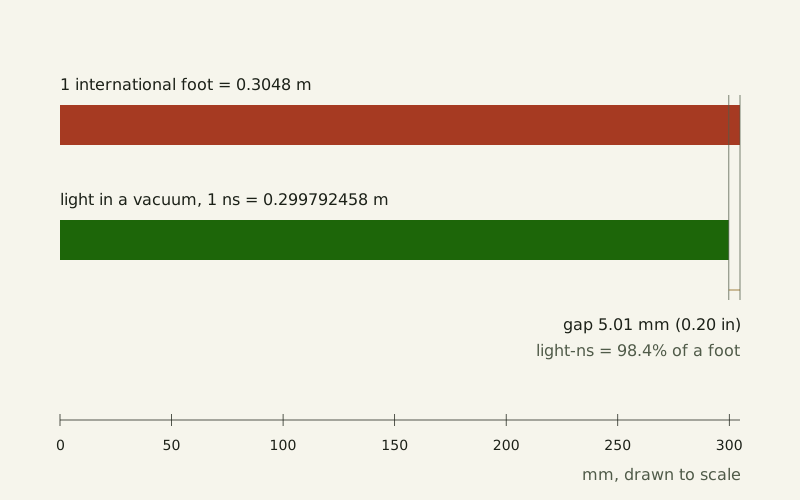
Figure: The Yardstick Almanac, CC BY 4.0
Credit line to copy
"A foot and a light-nanosecond" by The Yardstick Almanac, https://theyardstickalmanac.com/scale/grace-hopper-nanosecond/, licensed under CC BY 4.0 (https://creativecommons.org/licenses/by/4.0/).
Data: Defined values from the BIPM SI Brochure, 9th ed. V4.01 (CC BY 4.0; adapted: values used in new calculations) and NIST Handbook 44-2026, Appendix C; computed 2026-11-01, CC BY 4.0
How good are the round numbers?
Most quick figures for the speed of light are rounded, and each one is off by a known amount. We divided each rounded figure by the exact value. The foot rule is the roughest of the common ones. The metric round numbers are about 24 times closer.
| Rounded figure | Off from the exact value |
|---|---|
| 30 cm per nanosecond | +0.07% |
| 300,000 km per second | +0.07% |
| 1 foot per nanosecond | +1.67% |
| 186,000 miles per second | −0.15% |
| 8 min 20 s for light to cross 1 au | +0.20% |
A plus sign means the rounded figure is too large. For a nanosecond of light, 30 centimeters is 0.21 millimeter too long, while a foot is 5.01 millimeters too long.
What were Grace Hopper's nanosecond wires?
The Naval History and Heritage Command catalogs two wires under accession number 90-115-AG, AH, in the collection of its Curator Branch. Its catalog record, published with a photograph of the wires on Wikimedia Commons, says the two wires, one of them labeled “master,” were used by Rear Admiral Grace Hopper “to visualize the concept of a nanosecond.” The same record calls her “a pioneer in the development of computing programming in the Navy.”

"Commodore Grace M. Hopper, USN (covered)" by James S. Davis — https://commons.wikimedia.org/wiki/File:Commodore_Grace_M._Hopper,_USN_(covered).jpg — Public domain (work of the U.S. federal government, 17 U.S.C. §105)
That catalog record is the documentary trail for this section. The record also links to a Navy biography page and to a video. We could use neither as a source here.
The record does not give the length of either wire, and we do not estimate one from the photograph. Accounts of her lectures and of how many wires she handed out are not repeated here, because we found no readable primary record of them. The Navy released the portrait above under number DN-SC-84-05971, and its title gives her rank as commodore.
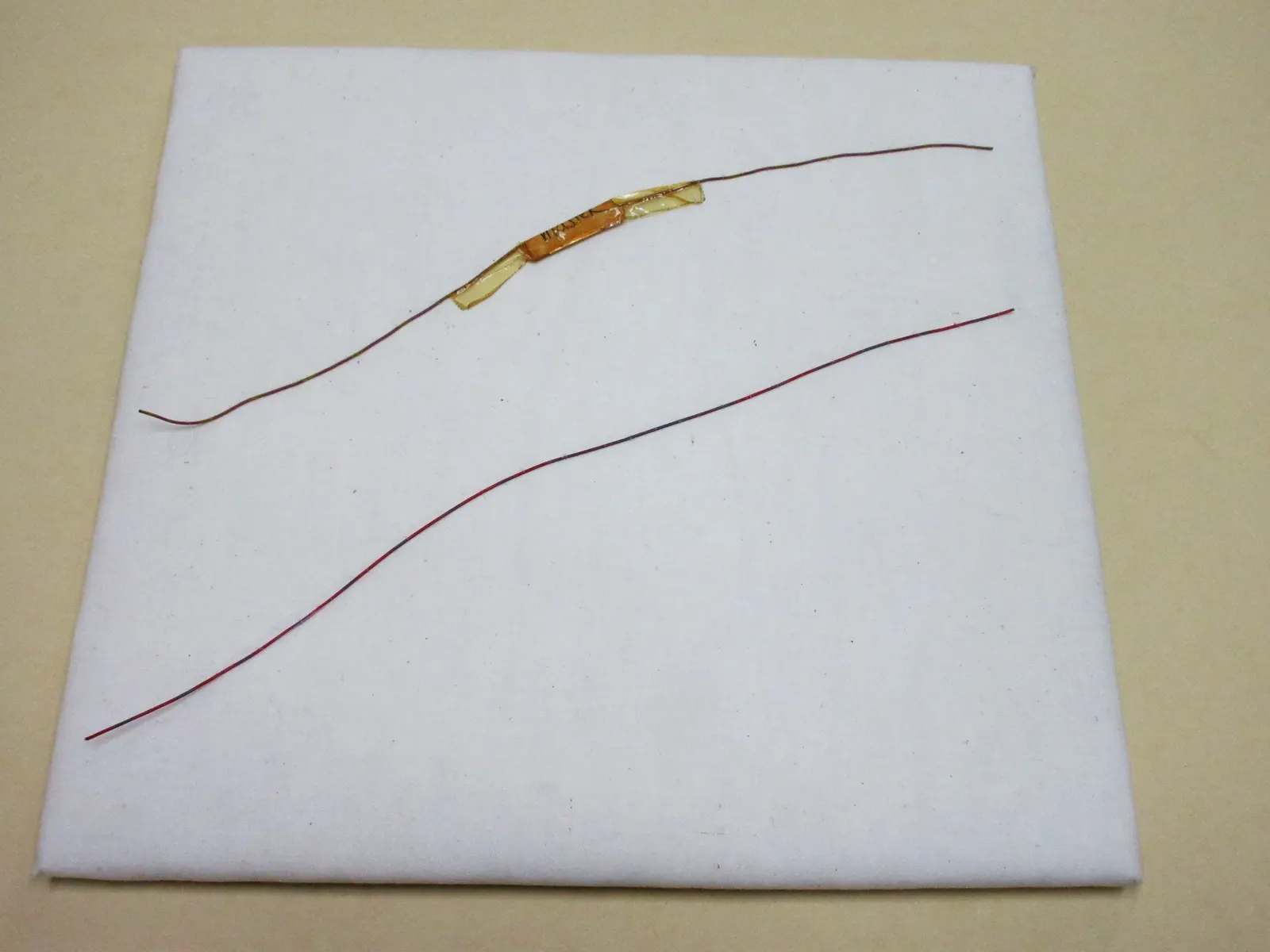
"90-115-AG, AH, Wire Nanosecond" by Naval History and Heritage Command — https://commons.wikimedia.org/wiki/File:90-115-AG,_AH,_Wire_Nanosecond_(15864510468).jpg — CC BY 2.0 (https://creativecommons.org/licenses/by/2.0/)
Is a signal in a wire as fast as light?
No. The meter's definition names light in vacuum, and the 11.80 inches on this page is that vacuum figure. A signal carried by a cable moves more slowly, and how much more slowly depends on how the cable is built. This page gives no cable number, because we found no readable source to cite for one.
That makes 11.80 inches an upper limit for one nanosecond of signal travel along any wire. A wire cut to the vacuum length shows how far light goes in a nanosecond. A signal sent down that same wire needs more than a nanosecond to reach the far end.
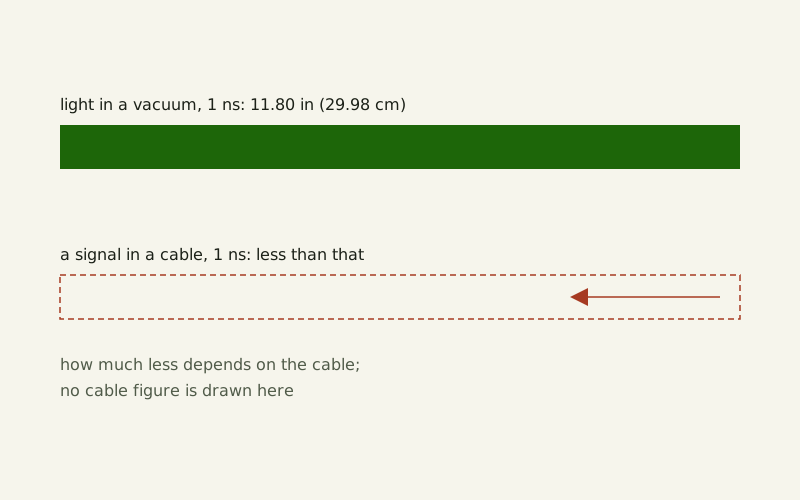
Figure: The Yardstick Almanac, CC BY 4.0
Credit line to copy
"Light in a vacuum and a signal in a cable" by The Yardstick Almanac, https://theyardstickalmanac.com/scale/grace-hopper-nanosecond/, licensed under CC BY 4.0 (https://creativecommons.org/licenses/by/4.0/).
Data: Defined values from the BIPM SI Brochure, 9th ed. V4.01 (CC BY 4.0; adapted: values used in new calculations) and NIST Handbook 44-2026, Appendix C; computed 2026-11-01, CC BY 4.0
The NHHC record says only that the wires visualized the concept of a nanosecond. It does not say whether they were cut to the vacuum distance or to the shorter distance a signal covers in cable. We do not guess.
What does a nanosecond mean for clocks and timing?
A clock rate of 1 gigahertz means 109 ticks a second, so each tick lasts one nanosecond [exact by definition] and light in a vacuum covers 11.80 inches per tick. Now take a clock that ticks 3 billion times a second, a rate of 3 gigahertz. Each tick lasts 0.333 nanosecond, and light in a vacuum covers 99.9 millimeters, about 3.9 inches, in that time (rounded) [exact by definition]. We picked 3 gigahertz as a round number for the arithmetic; it is not a measurement of any particular processor.
The same arithmetic runs the other way. Light needs 3.336 nanoseconds to cross one meter, which is about 10 ticks of that clock even in a vacuum.
Timing a signal out and back halves the distance. If light makes a round trip in one nanosecond, the far point is 14.99 centimeters, or 5.90 inches, away (rounded) [exact by definition]. So one nanosecond of timing error, on a measurement made by timing light out and back, moves the computed distance by about 15 centimeters.
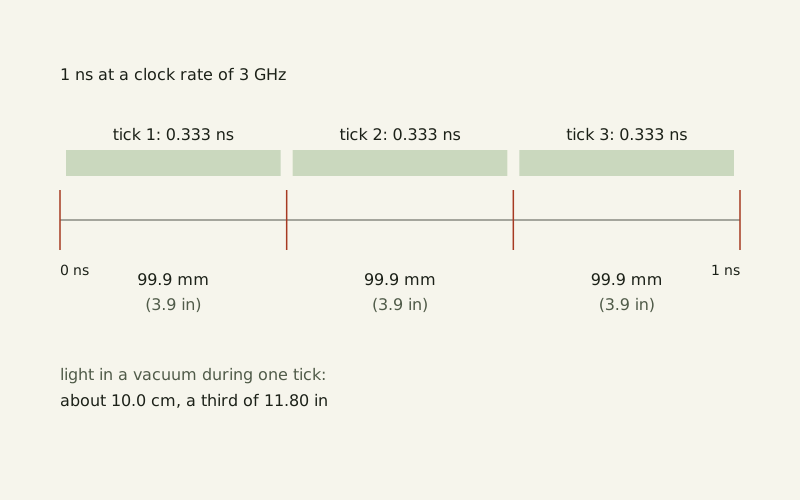
Figure: The Yardstick Almanac, CC BY 4.0
Credit line to copy
"One nanosecond at 3 GHz" by The Yardstick Almanac, https://theyardstickalmanac.com/scale/grace-hopper-nanosecond/, licensed under CC BY 4.0 (https://creativecommons.org/licenses/by/4.0/).
Data: Defined values from the BIPM SI Brochure, 9th ed. V4.01 (CC BY 4.0; adapted: values used in new calculations) and NIST Handbook 44-2026, Appendix C; computed 2026-11-01, CC BY 4.0
Nanosecond questions
How many nanoseconds are in a microsecond and a millisecond?
A microsecond holds 1,000 nanoseconds and a millisecond holds 1,000,000, because the SI prefixes micro and milli stand for 10−6 and 10−3. Light in a vacuum covers 983.6 feet in a microsecond and 186.3 miles in a millisecond (both rounded).
Is a nanosecond the smallest unit of time?
No. The SI prefix table continues past nano to pico, femto, atto, zepto, yocto, ronto and quecto, which stands for 10−30. Ronto and quecto were added by the 27th General Conference in 2022. In one picosecond, light in a vacuum covers 0.299792458 millimeter [exact by definition], a thousandth of the nanosecond figure.
Does light cover 11.8 inches in a nanosecond in air or water?
The numbers on this page are for a vacuum, the only case the SI definition fixes. Light in air or water travels more slowly, so it covers less than 11.80 inches in a nanosecond. We give no figure here, because the amount depends on the material and we did not read a source for one.
How far does light travel in a nanosecond in centimeters?
Light in a vacuum travels 29.98 centimeters in one nanosecond (rounded) [exact by definition]. Unrounded, the distance is 0.299792458 meter, because the meter is defined as the distance light covers in 1/299,792,458 of a second.
How long does light take to cross an astronomical unit?
The ladder stops at the astronomical unit, defined as 149,597,870,700 meters [exact by definition]. The SI Brochure lists it in its table of non-SI units and credits the value to Resolution B2 of the International Astronomical Union in 2012. Divided by the speed of light, it gives 499.005 seconds, or 8 minutes 19.0 seconds (both rounded) [exact by definition].
Counted in nanoseconds, that crossing takes 499,004,783,836 of them, rounded to the nearest whole one. The au is a fixed length, so this light time is a fixed number too. It is not the Sun's distance on any particular day.
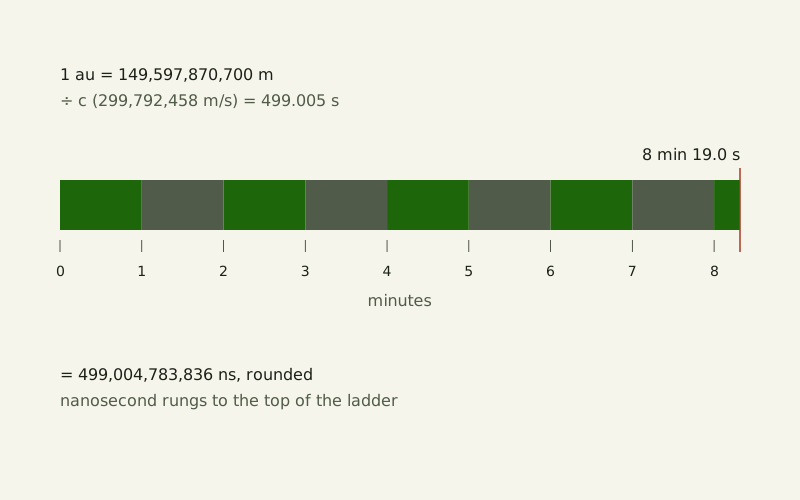
Figure: The Yardstick Almanac, CC BY 4.0
Credit line to copy
"Light time for one astronomical unit" by The Yardstick Almanac, https://theyardstickalmanac.com/scale/grace-hopper-nanosecond/, licensed under CC BY 4.0 (https://creativecommons.org/licenses/by/4.0/).
Data: Defined values from the BIPM SI Brochure, 9th ed. V4.01 (CC BY 4.0; adapted: values used in new calculations) and NIST Handbook 44-2026, Appendix C; computed 2026-11-01, CC BY 4.0
Every rung on this ladder rests on a definition, so nothing on it had to be measured. Eratosthenes' Earth circumference comes from the other kind of number, a size worked out from observation rather than fixed by a resolution.
Sources
- Bureau International des Poids et Mesures, The International System of Units (SI), 9th edition (2019), version 4.01 (June 2026), DOI 10.59161/AUEZ1291. Sec. 2.2 and pp. 126–127 (definitions of the second and the meter); Table 7 (SI prefixes); Table 8 and note (j) (astronomical unit); Appendix 1 (11th CGPM 1960 Res. 6; 13th CGPM 1967/68 Res. 1 and note; 15th CGPM 1975 Res. 2 and note; 17th CGPM 1983 Res. 1; 26th CGPM 2018, in force 20 May 2019); Appendix 4 (historical note on the second). https://www.bipm.org/documents/20126/41483022/SI-Brochure-9-EN.pdf Read: full text Text license: CC BY 4.0
- National Institute of Standards and Technology, NIST Handbook 44 – 2026, Appendix C, General Tables of Units of Measurement, pp. C-5, C-9, C-21. DOI 10.6028/NIST.HB.44-2026. https://www.nist.gov/document/2026-nist-handbook-44-appendix-c Read: full appendix
- Naval History and Heritage Command, Curator Branch, catalog record for accession 90-115-AG, AH, “Electrical Components, Wire” (Wire Nanosecond), published with the photograph on Wikimedia Commons (from the command's Flickr account, CC BY 2.0). https://commons.wikimedia.org/wiki/File:90-115-AG,_AH,_Wire_Nanosecond_(15864510468).jpg Read: full catalog description Text license: CC BY 2.0

Data files (computed 2026-11-01 in exact fractions from the defined values above, and recomputed with the Pint 0.26.2 unit library, BSD-3-Clause license, from its own constants; each file comes with a notes file giving its sources and license):
- Light-distance ladder, 1 nanosecond to 1 astronomical unit (CSV, source and license notes) Data: Defined values from the BIPM SI Brochure, 9th ed. V4.01 (CC BY 4.0; adapted: values used in new calculations) and NIST Handbook 44-2026, Appendix C; computed 2026-11-01, CC BY 4.0
- One nanosecond, compared: foot, meter, cesium periods, 3 GHz tick, 1 au (CSV, source and license notes) Data: Defined values from the BIPM SI Brochure, 9th ed. V4.01 (CC BY 4.0; adapted: values used in new calculations) and NIST Handbook 44-2026, Appendix C; computed 2026-11-01, CC BY 4.0
Cite this page
The Yardstick Almanac. "Nanosecond: Light Covers About 11.8 Inches in a Vacuum." Published November 1, 2026. https://theyardstickalmanac.com/scale/grace-hopper-nanosecond/. Accessed [the date you read it].
More in Scale & Estimation

Scale & Estimation
Born on February 29: About 214,000 U.S. Residents as of 2025
Image credit
"Der Geburtstagskuchen (The Birthday Cake)" by Eduard Geselschap — https://commons.wikimedia.org/wiki/File:Eduard_Geselschap_Der_Geburtstagskuchen_1872.jpg — Public domain (Oil on canvas by Eduard Geselschap (1814–1878), signed and dated 1872; the painter died 5 January 1878, so the work is in the public domain in the Netherlands and Germany and across the EU (life plus 70 years) and in the United States (published before 1931, per the file page). Faithful photographic reproduction of a two-dimensional public-domain work (PD-Art; EU Directive 2019/790 art. 14); the file is marked with the Public Domain Mark 1.0)
Scale & Estimation
Astronomical Unit: Exactly 149,597,870,700 Meters Since 2012
Image credit
"1882 transit of venus" by US Naval Observatory — https://commons.wikimedia.org/wiki/File:1882_transit_of_venus.jpg — Public domain (work of the U.S. federal government, 17 U.S.C. §105 (the Commons file page tags it as made by U.S. Navy staff as part of official duties); independently, an anonymous work made in 1882, so any U.S. term (at most 120 years from creation for an unpublished anonymous work) and any EU term for an anonymous work have expired)

Scale & Estimation
Eratosthenes' Earth Circumference: Pliny Says 252,000 Stadia
Image credit
"View of Aswan - Along the Nile" by Antonio Beato — https://commons.wikimedia.org/wiki/File:Antonio_Beato_-_View_of_Aswan_-_Along_the_Nile_-_1993.94_-_Cleveland_Museum_of_Art.tif — CC0 1.0 (https://creativecommons.org/publicdomain/zero/1.0/); modified: converted from the 5,000 × 3,681 px TIFF original to JPEG (quality 92, same pixel size, embedded color profile kept); no crop, retouching or color change
How this page is checked: Where the numbers come from explains the value tags, the source order and how every figure is recomputed.
Corrections: every substantive change is logged in What we got wrong.
Spotted an error? Email contact@theyardstickalmanac.com with the sentence and your source, or read Write in first.