Leap Second: 27 Through 2026, Then Continuous UTC From 2027
The Yardstick Almanac Published No substantive revisions
Short answer
As of IERS Bulletin C 72 (July 2026), UTC is 37 seconds [exact by definition] behind atomic time, 27 of them leap seconds. UTC becomes continuous on May 20, 2027.
Station index 9 sections
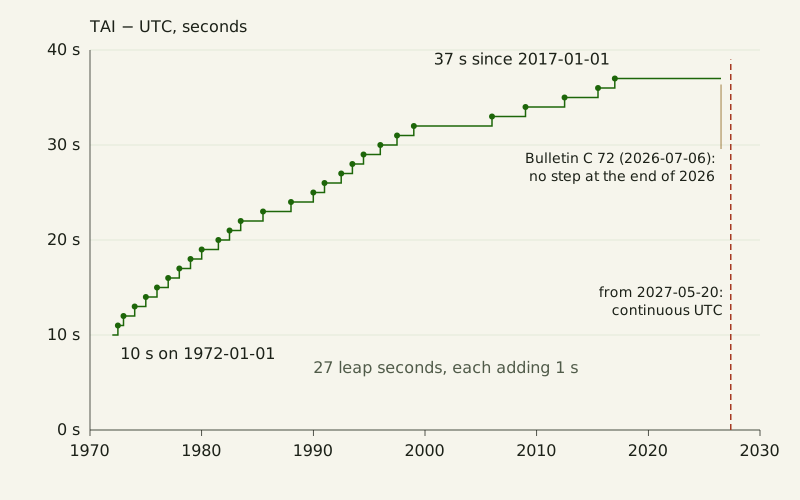
Figure: The Yardstick Almanac, CC BY 4.0
Credit line to copy
"TAI minus UTC, 1972–2026" by The Yardstick Almanac, https://theyardstickalmanac.com/calendars/leap-second/, licensed under CC BY 4.0 (https://creativecommons.org/licenses/by/4.0/).
Data: IERS Leap_Second.dat and Bulletin C (factual values), IANA leap-seconds.list (public domain) and CGPM 2026 Resolution 5 (BIPM, CC BY 4.0; adapted: date and limit restated), read 2026-11-01; computed 2026-11-01, CC BY 4.0
UTC now runs 37 seconds behind atomic time: 10 seconds from its 1972 start, 27 from leap seconds since. The count comes from Bulletin C 72 of the International Earth Rotation and Reference Systems Service (IERS), issued in Paris on July 6, 2026, which gives UTC−TAI as −37 seconds and adds no leap second at the end of 2026. Each of those 27 seconds was a periodic adjustment for what we call the remainder: the gap between clocks that count atomic seconds and a day set by Earth's turning.
A leap second is a one-second step in Coordinated Universal Time (UTC), the time scale behind civil time in most countries, to keep it within 0.9 second [exact by definition] of UT1, the time scale that follows Earth's rotation. All 27 were added at the end of June or December, between June 30, 1972, and December 31, 2016. In October 2026, Resolution 5 of the General Conference on Weights and Measures (CGPM) decided that “continuous UTC will become effective on 20 May 2027,” and that UT1 and UTC may then drift up to 3,600 seconds apart [exact by definition].
What is a leap second?
An added leap second makes one UTC day 86,401 seconds long instead of 86,400 [exact by definition]. Bulletin C 52, dated July 6, 2016, announced the most recent one and listed the order of the second markers:
- 2016 December 31, 23h 59m 59s
- 2016 December 31, 23h 59m 60s
- 2017 January 1, 0h 0m 0s
The extra second is labeled 23:59:60. That label appears only on a leap-second day. Before it, TAI−UTC was 36 seconds; after it, 37 seconds.
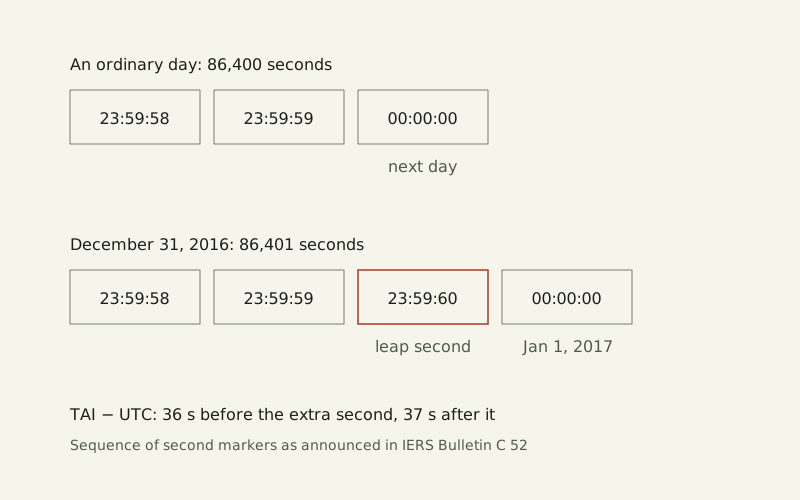
Figure: The Yardstick Almanac, CC BY 4.0
Credit line to copy
"The second markers of a leap second" by The Yardstick Almanac, https://theyardstickalmanac.com/calendars/leap-second/, licensed under CC BY 4.0 (https://creativecommons.org/licenses/by/4.0/).
Data: IERS Bulletin C 52 (2016-07-06), sequence of second markers (factual values); drawn 2026-11-01, CC BY 4.0
Every leap second so far has been positive, an added second. A negative leap second, in the words of the IERS, would be “a second removed from UTC,” and none has ever been applied. Bulletin C says leap seconds “can be introduced in UTC at the end of the months of December or June.” The IERS notes in its leap-second table that the end of March and September are second choices, and that only June and December dates have been used since 1972.
Why does UTC need extra seconds?
Two time scales pull on UTC. International Atomic Time (TAI) counts SI seconds. The CGPM's 1967 definition, quoted in its 2026 Resolution 4, made each SI second “the duration of 9 192 631 770 periods” of a radiation from the cesium-133 atom [exact by definition]; the 2018 revision kept that number. UT1 instead follows Earth's rotation, which the IERS describes as subject to “lunisolar and core-mantle torques, atmospheric and oceanic effects.”
UTC is produced by the BIPM, the International Bureau of Weights and Measures. It ticks at TAI's rate but differs from TAI only by a whole number of seconds, a rule the CGPM confirmed in 2018 and recalled in Resolution 5. Those whole seconds exist to keep UTC near UT1. Under the system in use since 1972, the CGPM's 2022 Resolution 4 explains, a leap second is applied when UT1−UTC “is predicted to approach 0.9 seconds,” following Recommendation ITU-R TF.460-6 of the International Telecommunication Union.
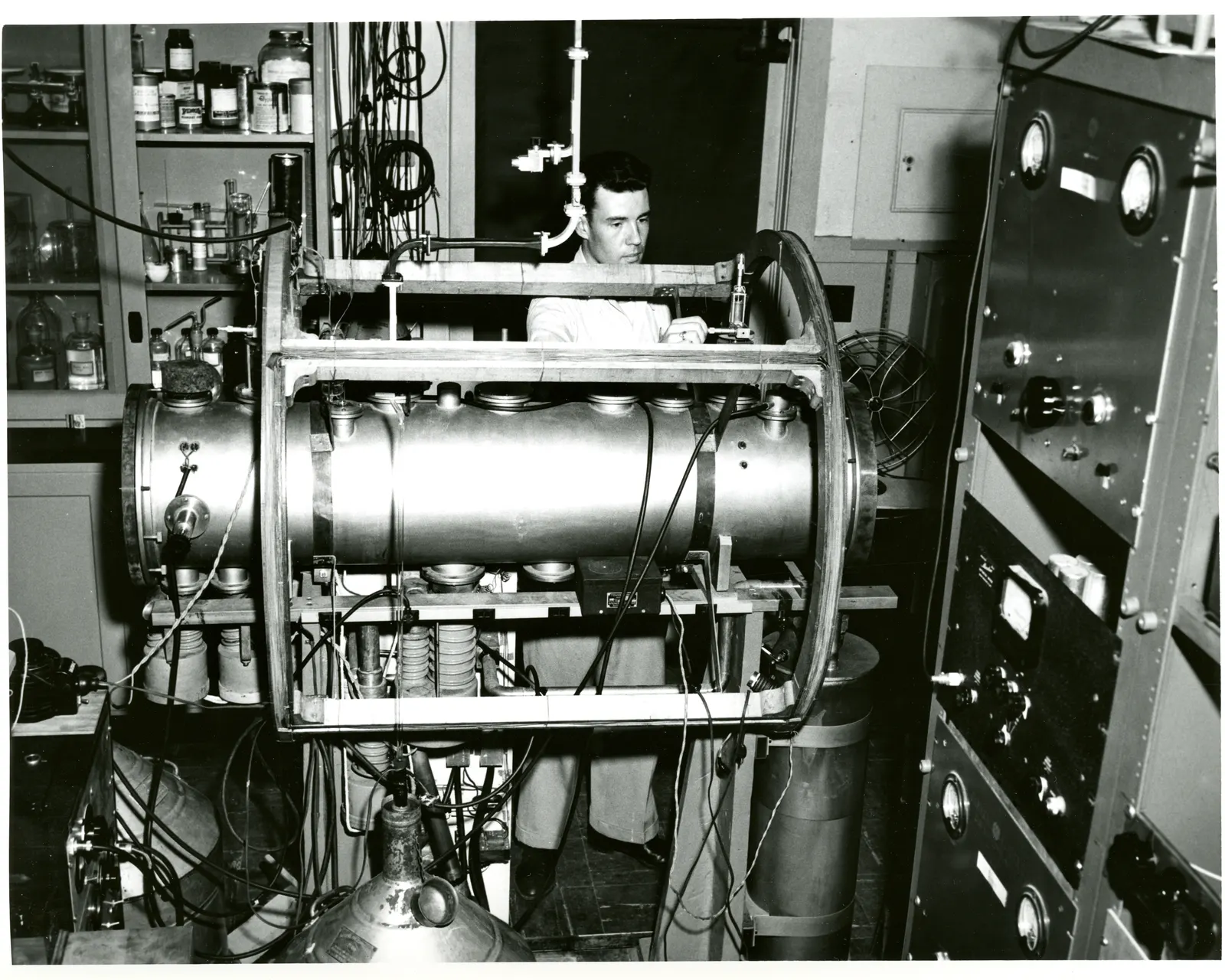
"Atomic Clock017 (atomic clock NBS-1)" by National Institute of Standards and Technology — https://commons.wikimedia.org/wiki/File:Atomic_Clock017.jpg — Public domain (work of the U.S. federal government, 17 U.S.C. §105)
The seconds were only ever added. The IERS gives two reasons in the comments of its leap-second table: “the initial choice of the value of the second (1/86400 mean solar day of the year 1820)” and “the general slowing down of the Earth's rotation.” The same comments say leap seconds came every one to two years on average until 2000, then every three to four. Our ledger matches that outline: 22 of the 27 came before 2000, and 5 after.
The cesium count makes every atomic second the same length. A nanosecond is a billionth of that second, 9.19263177 cesium periods [exact by definition], and atomic clocks keep it steadier than the planet keeps its day.
Where did the first 10 seconds come from?
UTC did not start at zero. From 1961 to 1971, the IERS history table shows, UTC ran at a slightly different rate from TAI and was nudged by 9 small steps of 0.05 or 0.1 second. By the end of 1971, that table's formula put TAI−UTC at 9.892242 seconds [exact by definition].
On January 1, 1972, UTC stepped by 0.107758 second to make the offset a round 10 seconds [exact by definition], and the rate offset ended. We computed the 1971 value from the IERS formula. The step came out the same as the 0.107758 second listed in a second IERS file, TimeSteps.history.
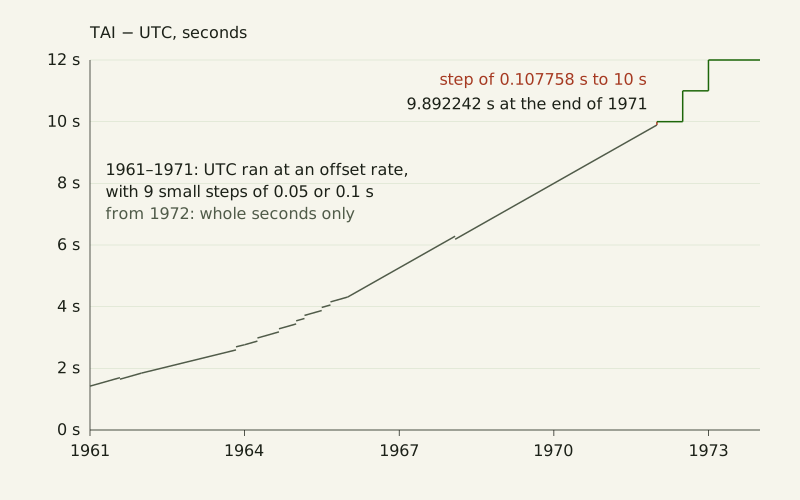
Figure: The Yardstick Almanac, CC BY 4.0
Credit line to copy
"TAI minus UTC, 1961–1973" by The Yardstick Almanac, https://theyardstickalmanac.com/calendars/leap-second/, licensed under CC BY 4.0 (https://creativecommons.org/licenses/by/4.0/).
Data: IERS UTC-TAI.history and TimeSteps.history (factual values), read 2026-11-01; computed 2026-11-01, CC BY 4.0
From that day on, UTC changed only in whole seconds. So the 37 seconds have two parts: 10 inherited from the system that ran from 1961 to 1971, and 27 leap seconds.
The ledger: every leap second since 1972
There have been 27 leap seconds [exact by definition], 11 at the end of June and 16 at the end of December. Nine fell in the 1970s, including two in 1972, then 6 in the 1980s, 7 in the 1990s, 2 in the 2000s and 3 in the 2010s. The longest gap between two leap seconds was 7 years, from December 31, 1998, to December 31, 2005; the shortest was the 184 days between the two leap seconds of 1972. Since the last one, on December 31, 2016, Bulletin C has passed over 20 possible dates in a row, from June 2017 through December 2026, without adding a second.
We read the dates from two separate tables, the IANA leap-seconds.list and the IERS Leap_Second.dat, and computed each date and weekday with two independent date routines. From 1995 on, we also checked each row against the Bulletin C that announced it. All 140 comparisons matched.
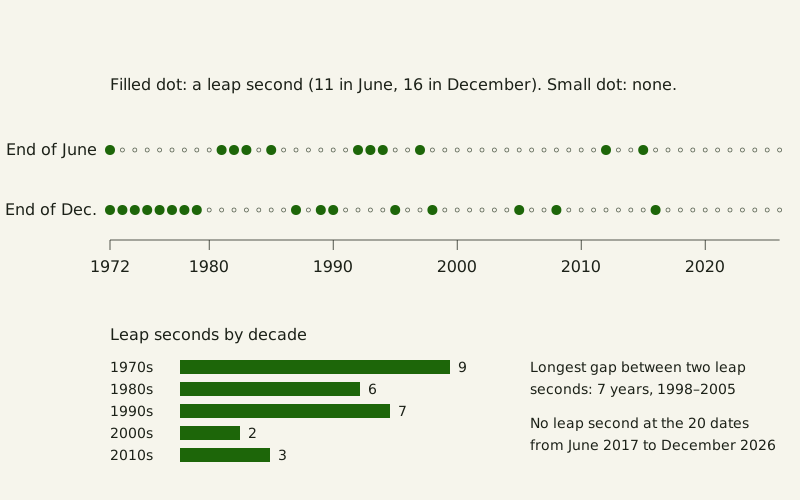
Figure: The Yardstick Almanac, CC BY 4.0
Credit line to copy
"Every leap second, by end of June and end of December, 1972–2026" by The Yardstick Almanac, https://theyardstickalmanac.com/calendars/leap-second/, licensed under CC BY 4.0 (https://creativecommons.org/licenses/by/4.0/).
Data: IERS Leap_Second.dat (factual values) and IANA leap-seconds.list (public domain), read 2026-11-01; computed 2026-11-01, CC BY 4.0
| No. | Day with the extra second (23:59:60 UTC) | Weekday | TAI − UTC after | Announcement checked |
|---|---|---|---|---|
| 1 | June 30, 1972 | Friday | 11 s | IERS tables only |
| 2 | December 31, 1972 | Sunday | 12 s | IERS tables only |
| 3 | December 31, 1973 | Monday | 13 s | IERS tables only |
| 4 | December 31, 1974 | Tuesday | 14 s | IERS tables only |
| 5 | December 31, 1975 | Wednesday | 15 s | IERS tables only |
| 6 | December 31, 1976 | Friday | 16 s | IERS tables only |
| 7 | December 31, 1977 | Saturday | 17 s | IERS tables only |
| 8 | December 31, 1978 | Sunday | 18 s | IERS tables only |
| 9 | December 31, 1979 | Monday | 19 s | IERS tables only |
| 10 | June 30, 1981 | Tuesday | 20 s | IERS tables only |
| 11 | June 30, 1982 | Wednesday | 21 s | IERS tables only |
| 12 | June 30, 1983 | Thursday | 22 s | IERS tables only |
| 13 | June 30, 1985 | Sunday | 23 s | IERS tables only |
| 14 | December 31, 1987 | Thursday | 24 s | IERS tables only |
| 15 | December 31, 1989 | Sunday | 25 s | IERS tables only |
| 16 | December 31, 1990 | Monday | 26 s | IERS tables only |
| 17 | June 30, 1992 | Tuesday | 27 s | IERS tables only |
| 18 | June 30, 1993 | Wednesday | 28 s | IERS tables only |
| 19 | June 30, 1994 | Thursday | 29 s | IERS tables only |
| 20 | December 31, 1995 | Sunday | 30 s | Bulletin C 10 |
| 21 | June 30, 1997 | Monday | 31 s | Bulletin C 13 |
| 22 | December 31, 1998 | Thursday | 32 s | Bulletin C 16 |
| 23 | December 31, 2005 | Saturday | 33 s | Bulletin C 30 |
| 24 | December 31, 2008 | Wednesday | 34 s | Bulletin C 36 |
| 25 | June 30, 2012 | Saturday | 35 s | Bulletin C 43 |
| 26 | June 30, 2015 | Tuesday | 36 s | Bulletin C 49 |
| 27 | December 31, 2016 | Saturday | 37 s | Bulletin C 52 |
How much warning did each leap second get?
About six months, for the leap seconds from 1995 on. In the eight bulletins we read, from 1995 to 2016, the time from the bulletin's date to the day with the extra second ran from 167 to 181 days. Bulletin C 16 gave the least notice: it was dated July 17, 1998, for December 31, 1998. Bulletin C 10 gave the most, dated July 3, 1995, for the end of that year.
The schedule follows from how Bulletin C works. In the words of Bulletin C 72, it “is mailed every six months, either to announce a time step in UTC, or to confirm that there will be no time step at the next possible date.” In all eight of our bulletins, a January issue announced a leap second for the end of June, and a July issue announced one for the end of December.
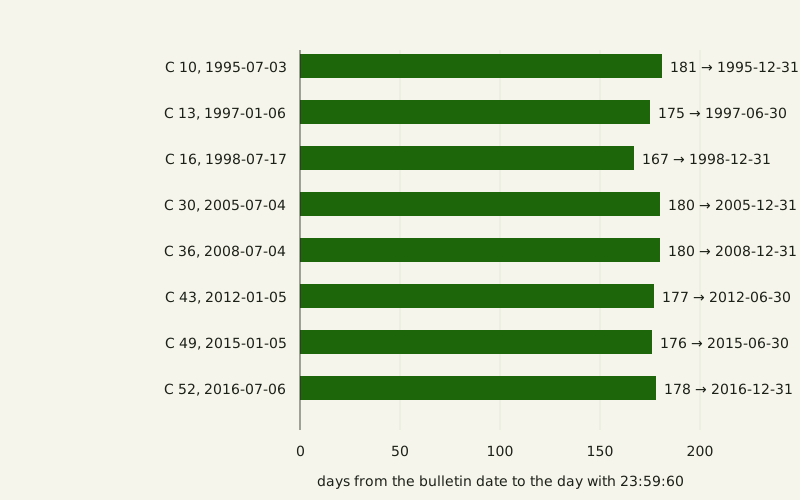
Figure: The Yardstick Almanac, CC BY 4.0
Credit line to copy
"Notice given by Bulletin C, 1995–2016" by The Yardstick Almanac, https://theyardstickalmanac.com/calendars/leap-second/, licensed under CC BY 4.0 (https://creativecommons.org/licenses/by/4.0/).
Data: IERS Bulletin C issues 10, 13, 16, 30, 36, 43, 49 and 52 (factual values); days computed 2026-11-01, CC BY 4.0
The notice was needed because no formula set the dates. Bulletin C ties each step to “the evolution of UT1-TAI,” which comes from observing Earth. The Gregorian leap day works the other way: its rule fixes every February 29 centuries ahead.
Who decided to stop the steps?
The CGPM is, in the BIPM's words, its “plenary and policy-making body and supreme authority, composed of representatives of Member States.” The decision to insert any single leap second has belonged to the IERS Earth Orientation Center at Paris Observatory. The path to continuous UTC runs through these documents:
- 2018: the 26th CGPM, in Resolution 2, stated that UTC is “the only recommended time scale for international reference and the basis of civil time in most countries,” as Resolution 5 recalls.
- 2022: the 27th CGPM, in Resolution 4, decided that the maximum value of UT1−UTC “will be increased in, or before, 2035” and asked for a draft resolution for 2026.
- March 2025: a workshop held by the Consultative Committee for Time and Frequency (CCTF) and the IERS estimated a 30% chance of a negative leap second by 2035, as Resolution 5 reports.
- July 6, 2026: Bulletin C 72 announced no leap second at the end of December 2026.
- October 13–15, 2026: the 28th CGPM, meeting in Versailles, adopted Resolution 5.
- May 20, 2027: continuous UTC takes effect.
- 2035, and no later than 2040: the end of a transition period for sending the larger UT1−UTC difference by radio where existing equipment cannot be replaced earlier, under Resolution 655 as revised at the 2023 World Radiocommunication Conference, as quoted in Resolution 5.
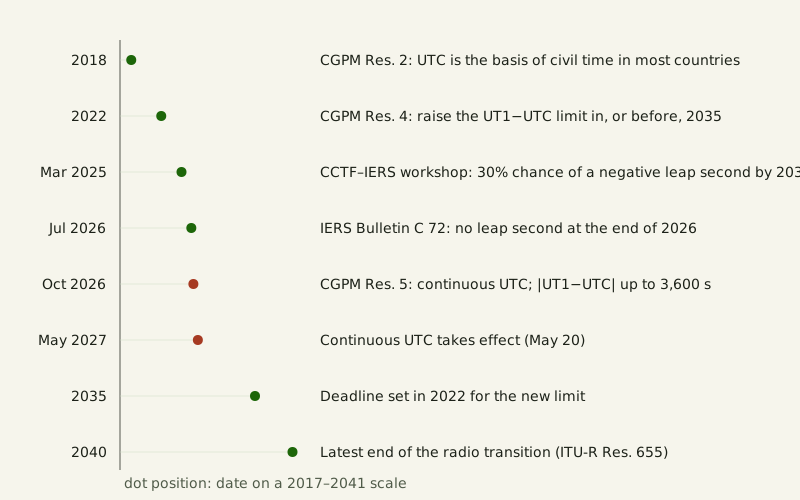
Figure: The Yardstick Almanac, CC BY 4.0
Credit line to copy
"The road to continuous UTC, 2018–2040" by The Yardstick Almanac, https://theyardstickalmanac.com/calendars/leap-second/, licensed under CC BY 4.0 (https://creativecommons.org/licenses/by/4.0/).
Data: CGPM 2022 Resolution 4 and 2026 Resolution 5 (BIPM, CC BY 4.0; adapted: dates and values condensed) and IERS Bulletin C 72 (factual values); compiled 2026-11-01, CC BY 4.0
Resolution 5 gives its reasons in plain terms. A negative leap second “has not previously been applied,” and preparing for one would cost industry an amount “estimated to be similar to their preparations for the millennium bug.” It also lists formal statements to the BIPM from the ITU's telecommunication sector, the International Union of Radio Science and the IEEE 1588 working group, asking to bring continuous UTC forward. A separate 2026 resolution, number 4, deals with the second itself and asks for a proposal for a new definition at the 29th CGPM in 2030.
What changes on May 20, 2027?
From that date, Resolution 5 says, the maximum value for |UT1−UTC| “will be 3 600 seconds (1 hour).” That is 4,000 times the 0.9-second limit that leap seconds were built around [exact by definition]. The resolution says the new limit ensures UTC's continuity “for several centuries,” and its official French text gives the same date and number.
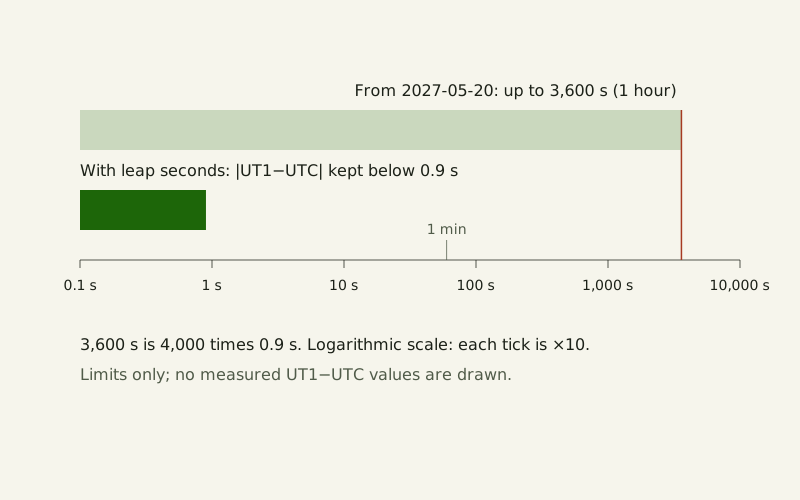
Figure: The Yardstick Almanac, CC BY 4.0
Credit line to copy
"The 0.9-second and 3,600-second limits on one scale" by The Yardstick Almanac, https://theyardstickalmanac.com/calendars/leap-second/, licensed under CC BY 4.0 (https://creativecommons.org/licenses/by/4.0/).
Data: CGPM 2022 Resolution 4 and 2026 Resolution 5 (BIPM, CC BY 4.0; adapted: limits drawn on a scale), IANA leap-seconds.list comments (public domain); compiled 2026-11-01, CC BY 4.0
UT1 does not go away. The resolution notes that users of UT1 can find UT1−UTC in satellite-navigation messages and in internet services run by the IERS and national metrology institutes. It does not say when or how an hour of difference would be settled.
Resolution 5 also points out that, because of the choice of time zone, civil time already differs from local apparent solar time by more than an hour in many countries, and daylight saving time regularly adds changes of an hour. Solar time is local: it shifts with longitude, counted from the prime meridian.
Two dates sit side by side here. Bulletin C 72 rules out a leap second at the end of December 2026, and Bulletin C has only ever used the ends of June and December. June 30, 2027, falls 41 days after continuous UTC takes effect on Thursday, May 20, 2027.
Leap second questions
When was the last leap second?
The last leap second was added on December 31, 2016, a Saturday, at 23:59:60 UTC. It took TAI−UTC from 36 to 37 seconds from January 1, 2017, and as of Bulletin C 72 none has followed.
Are leap seconds being abolished?
Resolution 5 does not use that word. It decides that “continuous UTC will become effective on 20 May 2027” and sets the maximum |UT1−UTC| at 3,600 seconds. Earth's rotation and UT1 stay as they are; what changes is the 0.9-second limit that set off each leap second.
What happens to computers during a leap second?
The CGPM's resolutions describe the problem rather than a fix. The 2022 resolution says operators of digital networks and satellite navigation systems “have developed and applied different methods to introduce the leap second, which do not follow any agreed standards.” The 2026 resolution adds that such workarounds lead to inconsistent timing between systems; this page gives no system settings.
How do you read the leap-seconds.list file?
The IANA time-zone database distributes the leap-second table as leap-seconds.list, prepared by the IERS. Each data line gives a time and an offset: the time is an NTP timestamp, the number of seconds since the start of 1900, and the offset is TAI−UTC from that moment.
The last line reads 3692217600 and 37. Divided by 86,400, the timestamp is 42,734 days after the start of 1900, which the file's own formula turns into Modified Julian Day 57754, January 1, 2017. The copy updated through Bulletin C 72 expires on June 28, 2027.
Has a leap second ever been removed?
No: all 27 added a second. The IERS comments in leap-seconds.list call a negative leap second “unlikely,” while Resolution 5 cites a March 2025 workshop estimate of a 30% chance by 2035 [contested]. We can think of the two as a closure error between two benchmarks: the IERS comment carries no date, and the workshop figure is from March 2025.
Does a leap second change the date or the week?
No. The extra second is the last second of the day, so the date still turns over once at 0h UTC. Day counts and ISO week numbers go on as before.
Who argues for keeping leap seconds?
Position: ending frequent leap seconds is the right direction. Loosening the tie between civil time and Earth's rotation costs less than the risk each inserted second poses to systems that count time. The limit of this position is civil clocks; it does not deny that astronomers and navigators need UT1, which stays available.
The objection we could read in full is a leap-second page by Steve Allen on the ucolick.org server, last revised in August 2018. He argues that simply dropping leap seconds would change the meaning of “day” so that it is “not related to the sun in the sky.” He also writes that some older telescopes never had to tell UT1 and UTC apart, so “Discontinuing leap seconds requires a fundamental change in their operational procedures.”
His page predates both CGPM resolutions. We found no readable published objection to Resolution 5 itself. Resolution 5 records one cost openly: the code radio stations use to broadcast UT1−UTC is being studied for updates to carry the larger difference, and the ITU resolution it quotes allows a transition period until 2035, and no later than 2040, where existing equipment cannot be replaced earlier.
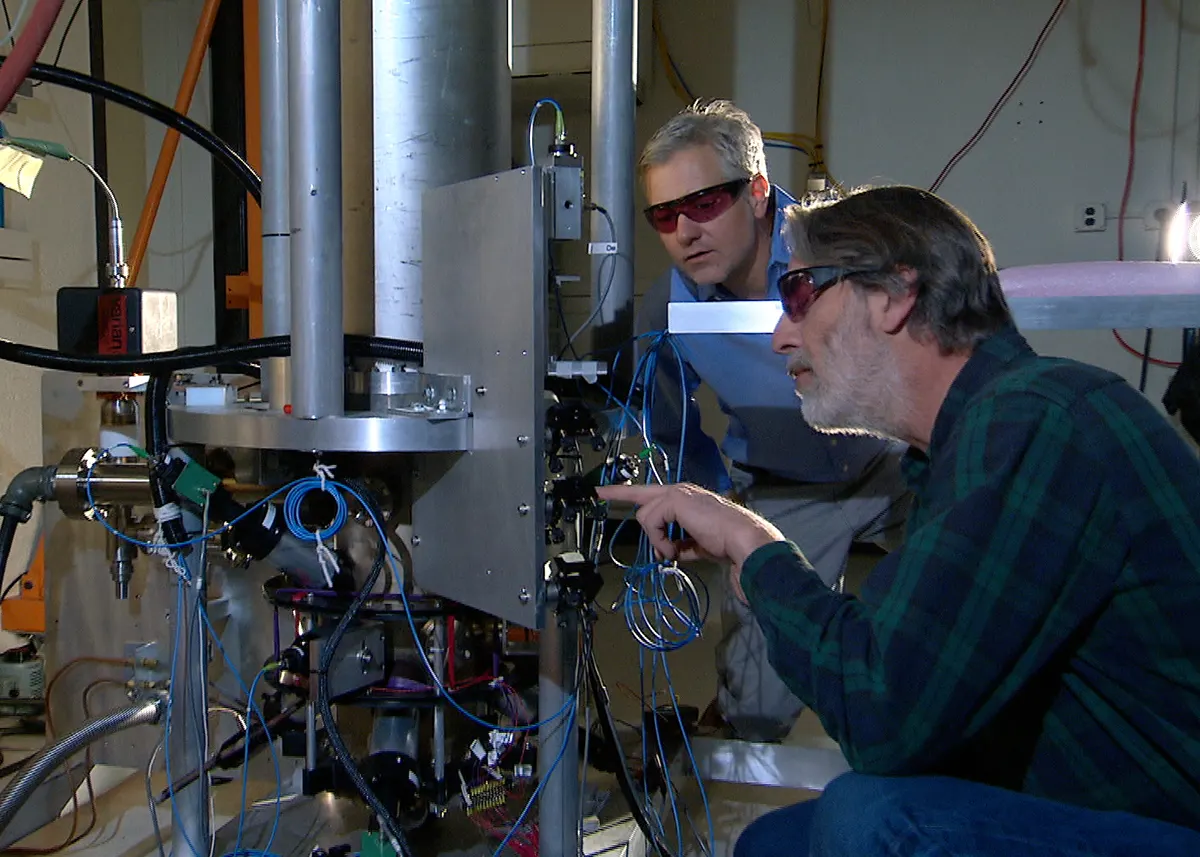
"NIST-F2 cesium fountain atomic clock" by National Institute of Standards and Technology — https://commons.wikimedia.org/wiki/File:NIST-F2_cesium_fountain_atomic_clock.jpg — Public domain (work of the U.S. federal government, 17 U.S.C. §105)
Sources
- General Conference on Weights and Measures (CGPM), 28th meeting (Versailles, 13–15 October 2026), Resolution 5, On the technical actions needed to ensure the continuity of UTC, DOI 10.59161/CGPM2026RES5E. English text; the official version is the French text, also read. https://www.bipm.org/en/cgpm-2026/resolution-5 Read: full text Text license: CC BY 4.0
- General Conference on Weights and Measures (CGPM), 27th meeting (2022), Resolution 4, On the use and future development of UTC, DOI 10.59161/CGPM2022RES4E; Proceedings of the 27th CGPM (2022), 2024, p. 398. Official version is the French text. https://www.bipm.org/en/-/resolution-cgpm-27-4 Read: full text Text license: CC BY 4.0
- General Conference on Weights and Measures (CGPM), 28th meeting (2026), Resolution 4, On the future definition of the second, DOI 10.59161/CGPM2026RES4E. Official version is the French text. https://www.bipm.org/en/cgpm-2026/resolution-4 Read: full text Text license: CC BY 4.0
- International Earth Rotation and Reference Systems Service (IERS), Earth Orientation Center, Paris Observatory, Bulletin C 72, Paris, 6 July 2026. https://hpiers.obspm.fr/iers/bul/bulc/bulletinc.dat Read: full text
- IERS, Bulletin C nos. 10 (3 July 1995), 13 (6 January 1997), 16 (17 July 1998), 30 (4 July 2005), 36 (4 July 2008), 43 (5 January 2012), 49 (5 January 2015) and 52 (6 July 2016), the issues announcing the leap seconds from 1995 to 2016. https://hpiers.obspm.fr/iers/bul/bulc/ Read: full text of each issue
- IERS Earth Orientation Center, Leap_Second.dat, updated through Bulletin C 72 (July 2026), file expires 28 June 2027. https://hpiers.obspm.fr/iers/bul/bulc/Leap_Second.dat Read: full file
- IERS Earth Orientation Center, UTC-TAI.history and TimeSteps.history (offsets and step adjustments of UTC, 1961–2017). https://hpiers.obspm.fr/iers/bul/bulc/UTC-TAI.history Read: full file (both files)
- IANA Time Zone Database, leap-seconds.list, prepared by the IERS Earth Orientation Center (Paris Observatory), updated through IERS Bulletin C 72, expires 28 June 2027. https://data.iana.org/time-zones/tzdb/leap-seconds.list Read: full file, including the IERS comments Text license: CC0 1.0
- Steve Allen, “Future of Leap Seconds” (leap-second page on the ucolick.org server), revision dated 2018-08-09 in the page source. https://www.ucolick.org/~sla/leapsecs/ Read: full text
Data files (dates and offsets read from the IANA and IERS leap-second tables and recomputed with two independent date routines, one of them the convertdate 2.5.1 library, MIT license; each file comes with a notes file giving its sources and license):
- Leap-second ledger, 1972–2027, with the announcing Bulletin C from 1995 (CSV, source and license notes) Data: IERS Leap_Second.dat and Bulletin C (factual values), IANA leap-seconds.list (public domain) and CGPM 2026 Resolution 5 (BIPM, CC BY 4.0; adapted: date and limit restated), read 2026-11-01; computed 2026-11-01, CC BY 4.0
- TAI−UTC formulas before 1972 (CSV, source and license notes) Data: IERS UTC-TAI.history and TimeSteps.history (factual values), read 2026-11-01; computed 2026-11-01, CC BY 4.0
Cite this page
The Yardstick Almanac. "Leap Second: 27 Through 2026, Then Continuous UTC From 2027." Published November 1, 2026. https://theyardstickalmanac.com/calendars/leap-second/. Accessed [the date you read it].
More in Calendars & Time
Calendars & Time
Leap Year Isn't Every 4 Years: Why 2100 Skips February 29
Image credit
"An Election Entertainment, Plate I: Four Prints of an Election" by William Hogarth — https://commons.wikimedia.org/wiki/File:An_Election_Entertainment,_Plate_I-_Four_Prints_of_an_Election_MET_DP827052.jpg — CC0 1.0 (https://creativecommons.org/publicdomain/zero/1.0/)
Calendars & Time
Old Style vs New Style Dates: Feb 11, 1731 Was Feb 22, 1732
Image credit
"George Washington (Gibbs-Channing-Avery Portrait)" by Gilbert Stuart — https://commons.wikimedia.org/wiki/File:George_Washington_MET_DT62.jpg — CC0 1.0 (https://creativecommons.org/publicdomain/zero/1.0/)
Calendars & Time
ISO Week Number: 71 of Every 400 Years Have a Week 53
Illustration credit
Illustration: The Yardstick Almanac. Generated schematic illustration — not a photograph or historical record. © The Yardstick Almanac, all rights reserved.
How this page is checked: Where the numbers come from explains the value tags, the source order and how every figure is recomputed.
Corrections: every substantive change is logged in What we got wrong.
Spotted an error? Email contact@theyardstickalmanac.com with the sentence and your source, or read Write in first.