Astronomical Unit: Exactly 149,597,870,700 Meters Since 2012
The Yardstick Almanac Published No substantive revisions
Short answer
Since 2012 the astronomical unit has been defined as 149,597,870,700 meters [exact by definition]. NIST's 2008 guide still listed it as a measured value, 9 meters shorter.
Station index 4 sections
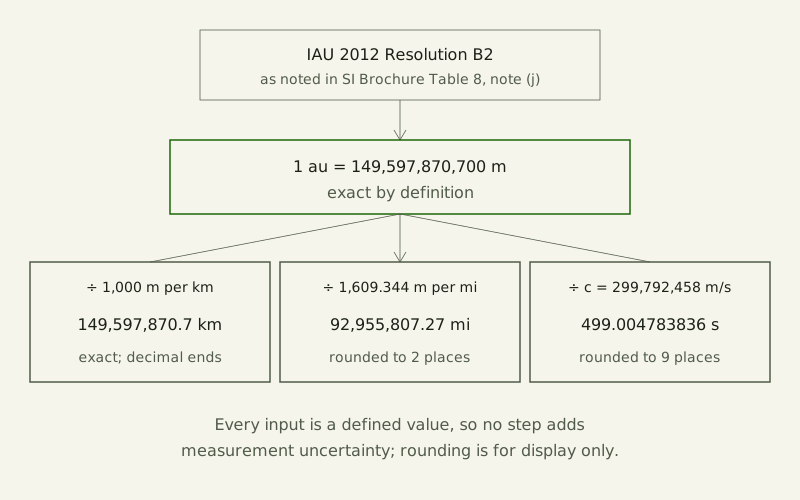
Figure: The Yardstick Almanac, CC BY 4.0
Credit line to copy
"From the resolution to kilometers, miles and light time" by The Yardstick Almanac, https://theyardstickalmanac.com/scale/astronomical-unit/, licensed under CC BY 4.0 (https://creativecommons.org/licenses/by/4.0/).
Data: Defined values from the BIPM SI Brochure, 9th ed. V4.01 (CC BY 4.0; adapted: values used in new calculations) and NIST Handbook 44-2026, Appendix C; computed 2026-11-01, CC BY 4.0
NIST's 2008 guide to the SI put the astronomical unit 9 meters short of the value fixed in 2012. NIST Special Publication 811 listed 149,597,870,691 meters with a standard uncertainty of 6 meters [measured, u = 6 m]. The SI Brochure, the BIPM's reference text for SI units, lists 1 au = 149,597,870,700 m [exact by definition]; a note says the unit was “Defined by Resolution B2 of the XXVIII General Assembly of the International Astronomical Union in 2012.” Those 9 meters are this page's remainder, our name for what a convention leaves unmatched; the sources we could read do not say whether the gap is rounding or measurement error.
In more familiar units, 1 au is 149,597,870.7 kilometers [exact by definition] and 92,955,807.27 miles (rounded) [exact by definition]. Light in a vacuum crosses it in 499.004783836 seconds (rounded) [exact by definition], or 8 minutes 19.0 seconds, because the speed of light is a defined constant too. No new measurement can move these numbers. The only choice left is how many decimals you print.
What does “exact” mean for the astronomical unit?
The SI Brochure, version 4.01 of June 2026, places the astronomical unit in Table 8, titled “Non-SI units.” Its row gives a length with no uncertainty attached: 1 au = 149,597,870,700 m [exact by definition]. The meter itself rests on the speed of light, 299,792,458 meters per second [exact by definition], and the Brochure states that the numerical values of the seven defining constants “have no uncertainty.” So the au in meters needs no measurement at all.
Table 8 is not a list of SI units. The Brochure introduces it by noting that some non-SI units are widely used, and “It is therefore important to recall the values of these non-SI units in terms of SI units.” NIST's 2008 table for the au carried a longer title: “Non-SI Units accepted for use with the SI by the CIPM and this Guide, whose values in SI units are obtained experimentally.” The au is still a non-SI unit; what it lost is the second half of that 2008 title.
The same table shows what a measured entry looks like. The dalton, equal to 1/12 of the mass of a free carbon-12 atom at rest in its ground state, is listed as 1.660 539 068 92(52) × 10−27 kg [measured, u = 52 in the last two digits], the 2022 CODATA recommended value. The electronvolt made the same move as the au: its note says that after the 26th CGPM fixed the elementary charge in 2018, “this conversion factor has been exact.”
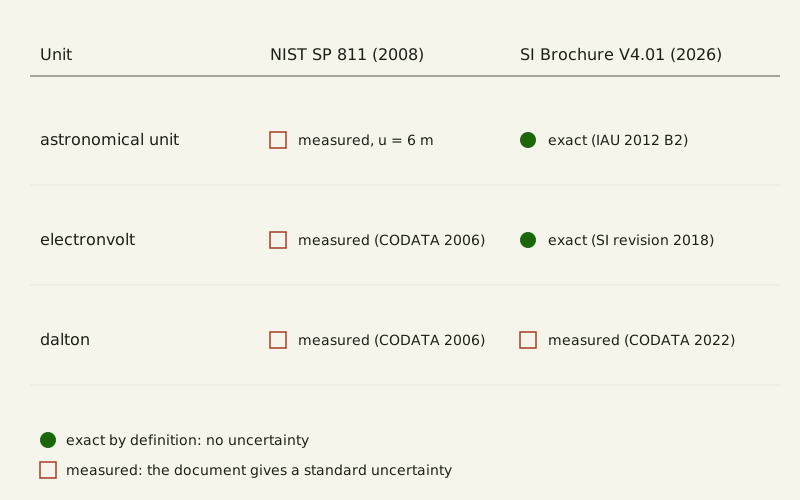
Figure: The Yardstick Almanac, CC BY 4.0
Credit line to copy
"Measured or exact: three non-SI units in 2008 and 2026" by The Yardstick Almanac, https://theyardstickalmanac.com/scale/astronomical-unit/, licensed under CC BY 4.0 (https://creativecommons.org/licenses/by/4.0/).
Data: Entries from NIST SP 811 (2008) and the BIPM SI Brochure, 9th ed. V4.01 (CC BY 4.0; adapted: three Table 8 rows restated with their notes); compiled 2026-11-01, CC BY 4.0
| Unit | NIST SP 811 (2008) | SI Brochure V4.01 (2026) |
|---|---|---|
| Astronomical unit | 1.495 978 706 91(6) × 1011 m, measured | 149 597 870 700 m, exact |
| Electronvolt | 1.602 176 487(40) × 10−19 J, measured | 1.602 176 634 × 10−19 J, exact |
| Dalton (unified atomic mass unit) | 1.660 538 782(83) × 10−27 kg, measured | 1.660 539 068 92(52) × 10−27 kg, measured |
How was the astronomical unit known before 2012?
In 2008 the au was still a measured quantity. The 2008 edition of NIST Special Publication 811 lists the au in Table 7, among units whose “values in SI units must be obtained from experiment and, therefore, are not known exactly.” Its note defines the unit by an orbit rather than by meters: the radius of an idealized circular orbit around the Sun for a particle “moving with a mean motion of 0.017 202 098 95 radians per day (known as the Gaussian constant).”
The meters came from measurement. The guide gives 1.495 978 706 91(6) × 1011 m, which is 149,597,870,691 m [measured, u = 6 m], and cites the IERS Conventions 2003 for it. In NIST's notation, the digits in parentheses are the standard uncertainty in the last places.
The 2012 value sits 9 meters above it, 1.5 times that standard uncertainty. The 2008 relative uncertainty was 4.0 × 10⁻¹¹. Even the symbol differed: the 2008 guide wrote ua, where the current SI Brochure writes au.
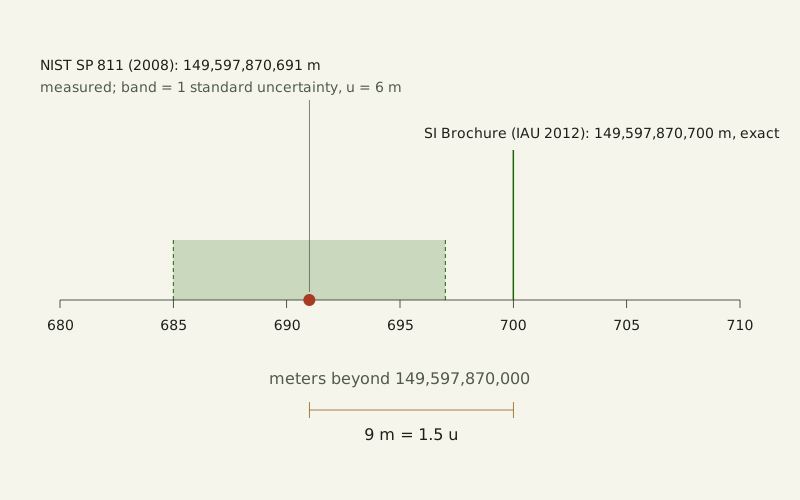
Figure: The Yardstick Almanac, CC BY 4.0
Credit line to copy
"The 2008 measured value against the 2012 defined value" by The Yardstick Almanac, https://theyardstickalmanac.com/scale/astronomical-unit/, licensed under CC BY 4.0 (https://creativecommons.org/licenses/by/4.0/).
Data: Entries from NIST SP 811 (2008) and the BIPM SI Brochure, 9th ed. V4.01 (CC BY 4.0; adapted: three Table 8 rows restated with their notes); compiled 2026-11-01, CC BY 4.0
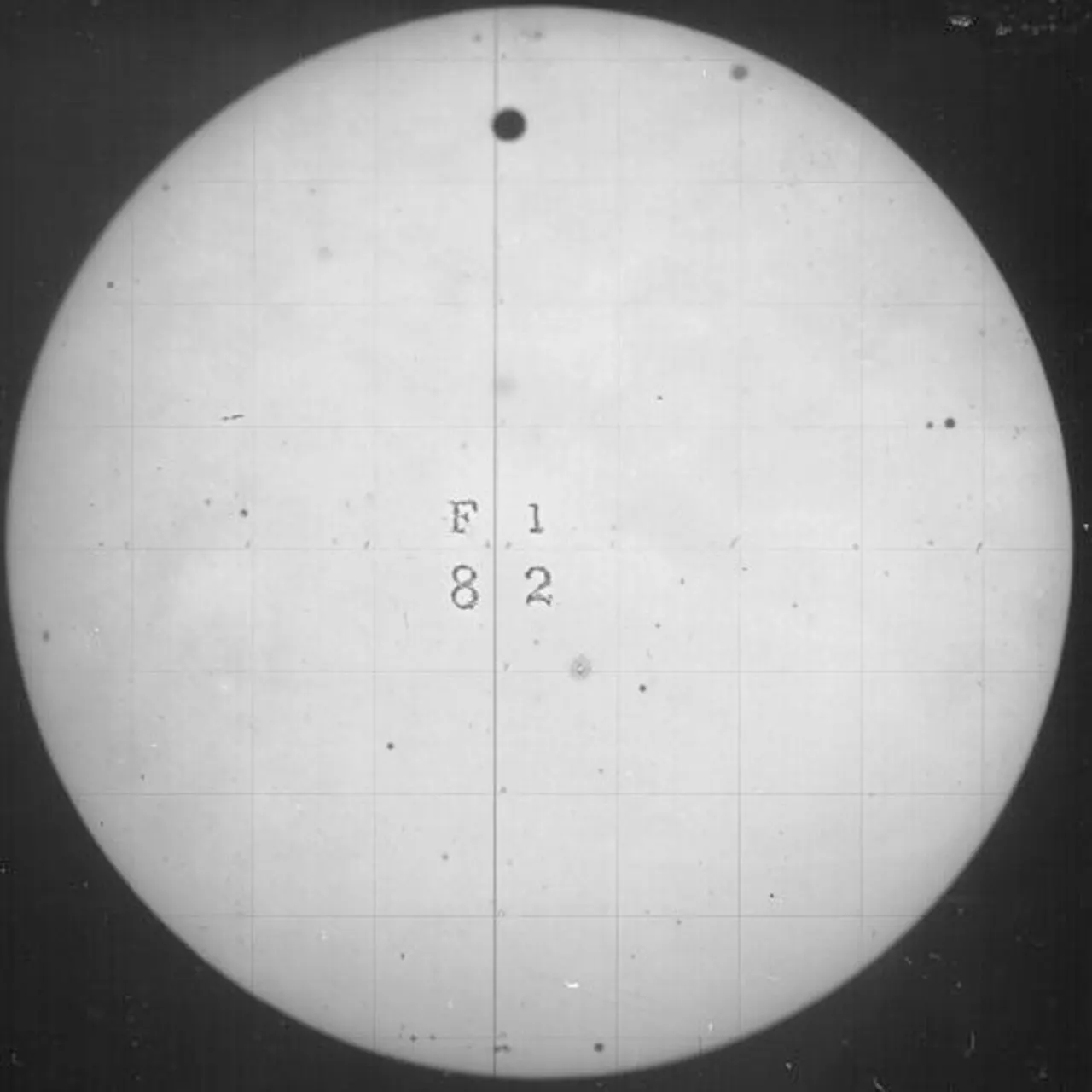
The photograph below is a plate that its Wikimedia Commons description calls “one of the handful of remaining photographic plates of the US Naval Observatory’s expeditions to observe the 1882 transit of Venus.” We found no readable record of what number, if any, this plate fed into. So this page ties the plate to no particular value of the au.
"1882 transit of venus" by US Naval Observatory, public domain
Full credit
"1882 transit of venus" by US Naval Observatory — https://commons.wikimedia.org/wiki/File:1882_transit_of_venus.jpg — Public domain (work of the U.S. federal government, 17 U.S.C. §105 (the Commons file page tags it as made by U.S. Navy staff as part of official duties); independently, an anonymous work made in 1882, so any U.S. term (at most 120 years from creation for an unpublished anonymous work) and any EU term for an anonymous work have expired)
Is 1 au the distance from Earth to the Sun?
Not by definition. NIST's 2008 guide described the unit as “approximately equal to the mean Earth-Sun distance,” and the current SI Brochure entry gives only the meters. The distance between Earth and the Sun on a given date is a separate quantity, and this page gives no figure for it.
Because the au is now a fixed number of meters, a better measurement of any distance in the solar system changes how many au that distance is, not the size of the au. Any measurement error stays with the distance being measured; the unit carries none.
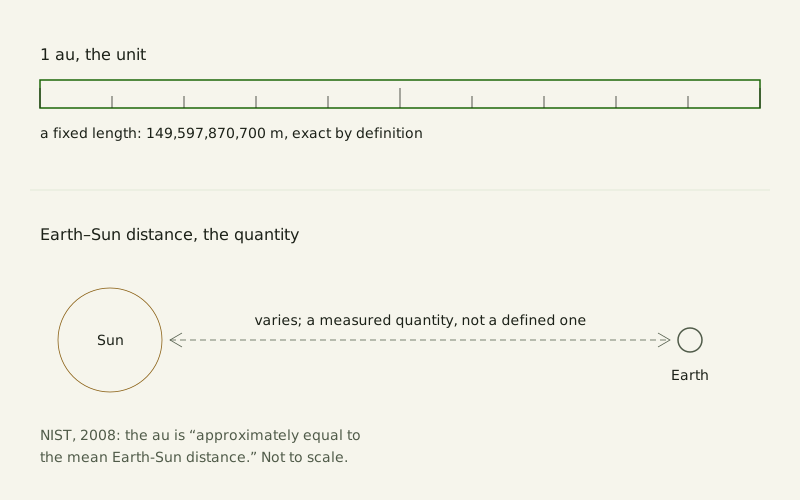
Figure: The Yardstick Almanac, CC BY 4.0
Credit line to copy
"The unit and the Earth–Sun distance" by The Yardstick Almanac, https://theyardstickalmanac.com/scale/astronomical-unit/, licensed under CC BY 4.0 (https://creativecommons.org/licenses/by/4.0/).
Data: Entries from NIST SP 811 (2008) and the BIPM SI Brochure, 9th ed. V4.01 (CC BY 4.0; adapted: three Table 8 rows restated with their notes); compiled 2026-11-01, CC BY 4.0
How far is 1 au in kilometers, miles and light time?
Every conversion starts from defined values, so every result is exact; only the decimals you print are a choice. We computed each one twice, once in exact fractions and once with the Pint unit library working from its own unit definitions. The two agreed on all 7 values.
| Quantity | Value | How it was derived |
|---|---|---|
| Kilometers | 149,597,870.7 km [exact by definition] | meters ÷ 1,000; the decimal ends |
| International miles | 92,955,807.27 mi (rounded) [exact by definition] | meters ÷ 1,609.344; the decimal never ends |
| Light time | 499.004783836 s (rounded) [exact by definition] | meters ÷ 299,792,458 m/s; the decimal never ends |
| Light time, minutes | 8 min 19.0 s (rounded) | whole minutes of 60 s, then the rest |
The mile is defined as 1.609344 kilometers [exact by definition] in Appendix C of NIST Handbook 44, which traces the 1959 foot and its multiples to a notice in the Federal Register. Where a decimal never ends, the printed value is rounded. That rounding is a display choice, not an uncertainty.
Round figures are a different matter. Calling 1 au 150 million kilometers overstates it by 402,129.3 km, about 0.27%; 93 million miles overstates it by 44,192.73 mi (rounded), about 0.048%. Both errors belong to the shorthand, not to the unit. Compare Eratosthenes' Earth circumference, a distance given in a unit whose length in meters is the open question.
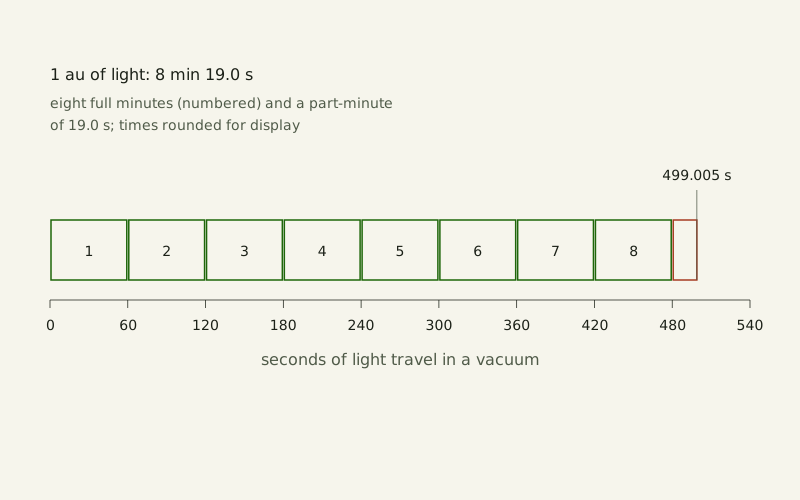
Figure: The Yardstick Almanac, CC BY 4.0
Credit line to copy
"Light time for one astronomical unit, in minutes" by The Yardstick Almanac, https://theyardstickalmanac.com/scale/astronomical-unit/, licensed under CC BY 4.0 (https://creativecommons.org/licenses/by/4.0/).
Data: Defined values from the BIPM SI Brochure, 9th ed. V4.01 (CC BY 4.0; adapted: values used in new calculations) and NIST Handbook 44-2026, Appendix C; computed 2026-11-01, CC BY 4.0
Sources
- Bureau International des Poids et Mesures, The International System of Units (SI), 9th edition (2019), version 4.01 (June 2026), DOI 10.59161/AUEZ1291. Sec. 1.2 (p. 122); Table 1 (p. 124); sec. 2.3.1 (p. 127); sec. 4 and Table 8, “Non-SI units” (p. 140), with notes (i), (j) and (l) (p. 141). https://www.bipm.org/documents/20126/41483022/SI-Brochure-9-EN.pdf Read: full text Text license: CC BY 4.0
- Ambler Thompson and Barry N. Taylor, Guide for the Use of the International System of Units (SI), NIST Special Publication 811, 2008 edition (March 2008; 2nd printing November 2008), National Institute of Standards and Technology. Sec. 5.1.2 (p. 8) and Table 7 with notes (a)–(d) (p. 9). https://nvlpubs.nist.gov/nistpubs/Legacy/SP/nistspecialpublication811e2008.pdf Read: full text
- National Institute of Standards and Technology, NIST Handbook 44 – 2026, Appendix C, General Tables of Units of Measurement, pp. C-5 and C-21. DOI 10.6028/NIST.HB.44-2026. https://www.nist.gov/document/2026-nist-handbook-44-appendix-c Read: full appendix
- Wikimedia Commons, File:1882 transit of venus.jpg, description and licensing (author: US Naval Observatory; date December 1882). https://commons.wikimedia.org/wiki/File:1882_transit_of_venus.jpg Read: full file description

The text of IAU Resolution B2 (2012) itself could not be located; this page relies on note (j) to Table 8 of the SI Brochure for the resolution.
Data files (values transcribed from the SI Brochure and NIST SP 811 and checked against their full text; conversions computed in exact fractions and recomputed with the Pint 0.26.2 unit library, BSD-3-Clause license, from its own unit definitions; each file comes with a notes file giving its sources and license):
- The astronomical unit in meters, kilometers, miles and light time (CSV, source and license notes) Data: Defined values from the BIPM SI Brochure, 9th ed. V4.01 (CC BY 4.0; adapted: values used in new calculations) and NIST Handbook 44-2026, Appendix C; computed 2026-11-01, CC BY 4.0
- Measured or exact: the au, electronvolt and dalton in 2008 and 2026 (CSV, source and license notes) Data: Entries from NIST SP 811 (2008) and the BIPM SI Brochure, 9th ed. V4.01 (CC BY 4.0; adapted: three Table 8 rows restated with their notes); compiled 2026-11-01, CC BY 4.0
Cite this page
The Yardstick Almanac. "Astronomical Unit: Exactly 149,597,870,700 Meters Since 2012." Published November 1, 2026. https://theyardstickalmanac.com/scale/astronomical-unit/. Accessed [the date you read it].
More in Scale & Estimation

Scale & Estimation
Nanosecond: Light Covers About 11.8 Inches in a Vacuum
Image credit
"Commodore Grace M. Hopper, USN (covered)" by James S. Davis — https://commons.wikimedia.org/wiki/File:Commodore_Grace_M._Hopper,_USN_(covered).jpg — Public domain (work of the U.S. federal government, 17 U.S.C. §105)

Scale & Estimation
Born on February 29: About 214,000 U.S. Residents as of 2025
Image credit
"Der Geburtstagskuchen (The Birthday Cake)" by Eduard Geselschap — https://commons.wikimedia.org/wiki/File:Eduard_Geselschap_Der_Geburtstagskuchen_1872.jpg — Public domain (Oil on canvas by Eduard Geselschap (1814–1878), signed and dated 1872; the painter died 5 January 1878, so the work is in the public domain in the Netherlands and Germany and across the EU (life plus 70 years) and in the United States (published before 1931, per the file page). Faithful photographic reproduction of a two-dimensional public-domain work (PD-Art; EU Directive 2019/790 art. 14); the file is marked with the Public Domain Mark 1.0)

Scale & Estimation
Eratosthenes' Earth Circumference: Pliny Says 252,000 Stadia
Image credit
"View of Aswan - Along the Nile" by Antonio Beato — https://commons.wikimedia.org/wiki/File:Antonio_Beato_-_View_of_Aswan_-_Along_the_Nile_-_1993.94_-_Cleveland_Museum_of_Art.tif — CC0 1.0 (https://creativecommons.org/publicdomain/zero/1.0/); modified: converted from the 5,000 × 3,681 px TIFF original to JPEG (quality 92, same pixel size, embedded color profile kept); no crop, retouching or color change
How this page is checked: Where the numbers come from explains the value tags, the source order and how every figure is recomputed.
Corrections: every substantive change is logged in What we got wrong.
Spotted an error? Email contact@theyardstickalmanac.com with the sentence and your source, or read Write in first.