Old Style vs New Style Dates: Feb 11, 1731 Was Feb 22, 1732
The Yardstick Almanac Published No substantive revisions
Short answer
Old Style dates follow the Julian calendar, and in England before 1752 the legal year began March 25. So February 11, 1731, Old Style, is February 22, 1732, New Style.
Station index 8 sections
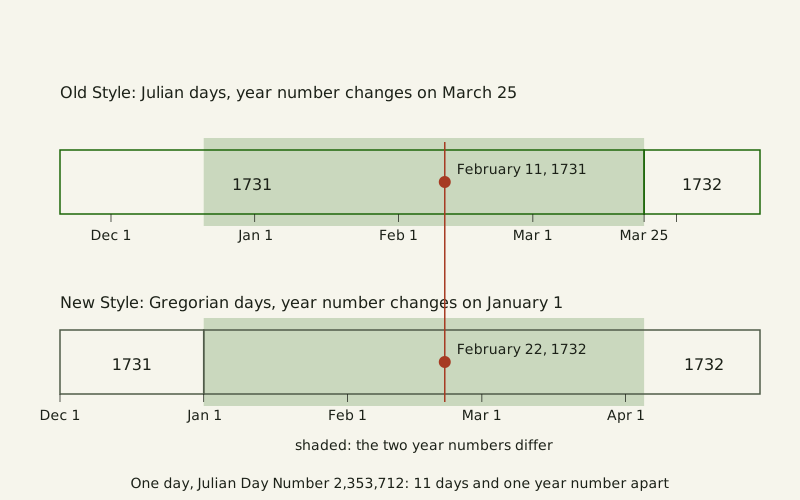
Figure: The Yardstick Almanac, CC BY 4.0
Credit line to copy
"One day, two year numbers: winter 1731–1732, Old Style and New Style" by The Yardstick Almanac, https://theyardstickalmanac.com/calendars/old-style-new-style-dates/, licensed under CC BY 4.0 (https://creativecommons.org/licenses/by/4.0/).
Data: Dates computed 2026-11-01 with two independent date routines from Calendar; Washington Irving, Life of George Washington, vol. 1; CC BY 4.0
February 11, 1731, Old Style, is February 22, 1732, New Style: 11 days [exact by definition] and one year number apart. As Irving's 1855 biography records, George Washington “was born on the 22d of February (11th, O. S.), 1732.” The 1731 comes instead from England's Calendar (New Style) Act 1750: under the old reckoning the year “beginneth on the twenty-fifth day of March,” so mid-February still counted as the previous year. Two separate things moved at the switch: the day count, which had drifted with the Julian calendar's extra leap days, a periodic adjustment for what we call the remainder, and the day the year number changed.
Old Style (O.S.) means a date on the Julian calendar, and in England and its colonies before 1752 it also usually means a year that began on March 25. New Style (N.S.) means the Gregorian calendar with the year starting January 1. To convert a British date from March 1700 to September 2, 1752, add 11 days, and for January 1 to March 24, if the year was numbered from March 25, also add 1 to the year. The Julian day February 11 plus 11 is February 22, and 1731 becomes 1732 [exact by definition].
What do Old Style and New Style mean?
The labels name two independent choices. One is the calendar rule that counts the days: Julian, with a leap day every fourth year, or Gregorian, which skips three century leap days in every 400 years. The other is the day on which the year number goes up by one. In England before 1752 the Julian rule and a March 25 New Year went together, and the 1750 Act changed both: the year start on January 1, 1752, and the day count that September.
That is why one day can be written four ways. The table lists them for the day Irving gives for Washington's birth; the day number in the last column is the Julian Day Number, the running day count astronomers use to label days (Explanatory Supplement, sec. 15.1.10).
| Written as | Day count | Year number changes on | Julian Day Number |
|---|---|---|---|
| February 11, 1731 | Julian | March 25 (English legal year) | 2,353,712 |
| February 11, 1731/2 | Julian | both numbers written | 2,353,712 |
| February 11 (O.S.), 1732 | Julian | January 1 | 2,353,712 |
| February 22, 1732 | Gregorian | January 1 | 2,353,712 |
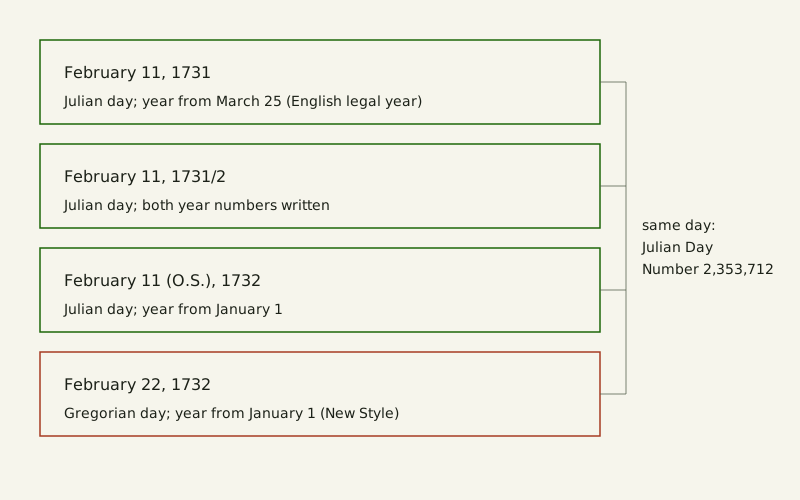
Figure: The Yardstick Almanac, CC BY 4.0
Credit line to copy
"Four ways to write February 22, 1732" by The Yardstick Almanac, https://theyardstickalmanac.com/calendars/old-style-new-style-dates/, licensed under CC BY 4.0 (https://creativecommons.org/licenses/by/4.0/).
Data: Dates computed 2026-11-01 with two independent date routines from Calendar; Washington Irving, Life of George Washington, vol. 1; CC BY 4.0
Irving's form is the third row: an Old Style day with a New Style year. A mixed form like his means a date marked O.S. tells you about the day count, but not necessarily about the year. When a source writes only 1731 or 1732 for a date between January 1 and March 24, check which year start it uses before you convert.
Why did England start the year on March 25?
The Explanatory Supplement to the Astronomical Almanac says Julius Caesar set January 1 as the start of the year, but other conventions “flourished at different times and places” in medieval Europe (sec. 15.3.4). It names March 1, March 25 and December 25 as the most popular alternatives, and notes that Christendom often used March 25 (sec. 15.1.10). The Supplement gives an example of the trouble: February 28, 998, in a city that began its year on March 1 was the same day as February 28, 999, in a city that began on January 1.
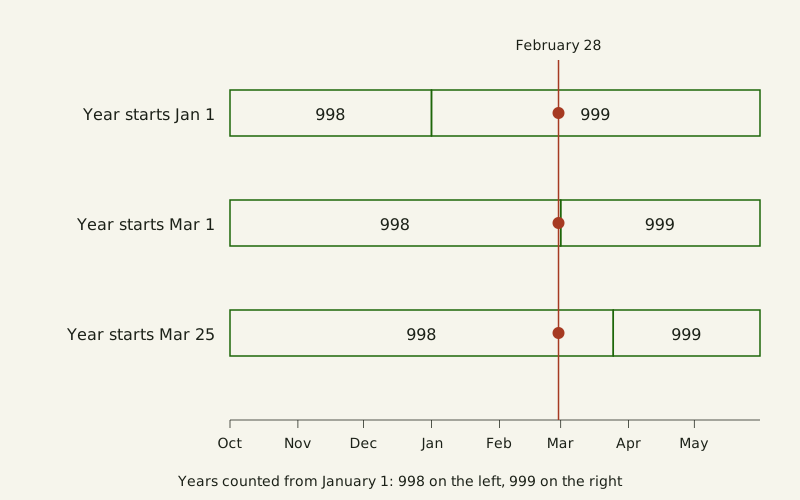
Figure: The Yardstick Almanac, CC BY 4.0
Credit line to copy
"One February day under three year starts" by The Yardstick Almanac, https://theyardstickalmanac.com/calendars/old-style-new-style-dates/, licensed under CC BY 4.0 (https://creativecommons.org/licenses/by/4.0/).
Data: Dates computed 2026-11-01 with two independent date routines from Explanatory Supplement to the Astronomical Almanac, ch. 15, sec. 15.1.10, 15.3.4, 15.3.5, 15.4.1, 15.4.2; Calendar; CC BY 4.0
England's own reason for dropping March 25 is written into the 1750 Act. Its preamble says the old reckoning was “attended with divers inconveniences,” because it differed from the usage of neighboring nations, from the legal method in Scotland and from common usage across the kingdom. As a result, it says, “frequent mistakes are occasioned in the dates of deeds and other writings.” The act does not say why March 25 had been chosen in the first place, and we leave that question there.
The window where the two year numbers disagree is January 1 through March 24. That is 83 days in a common year and 84 in a leap year [exact by definition]. Modern week numbering has its own version of this year-boundary question, covered in ISO week numbers.
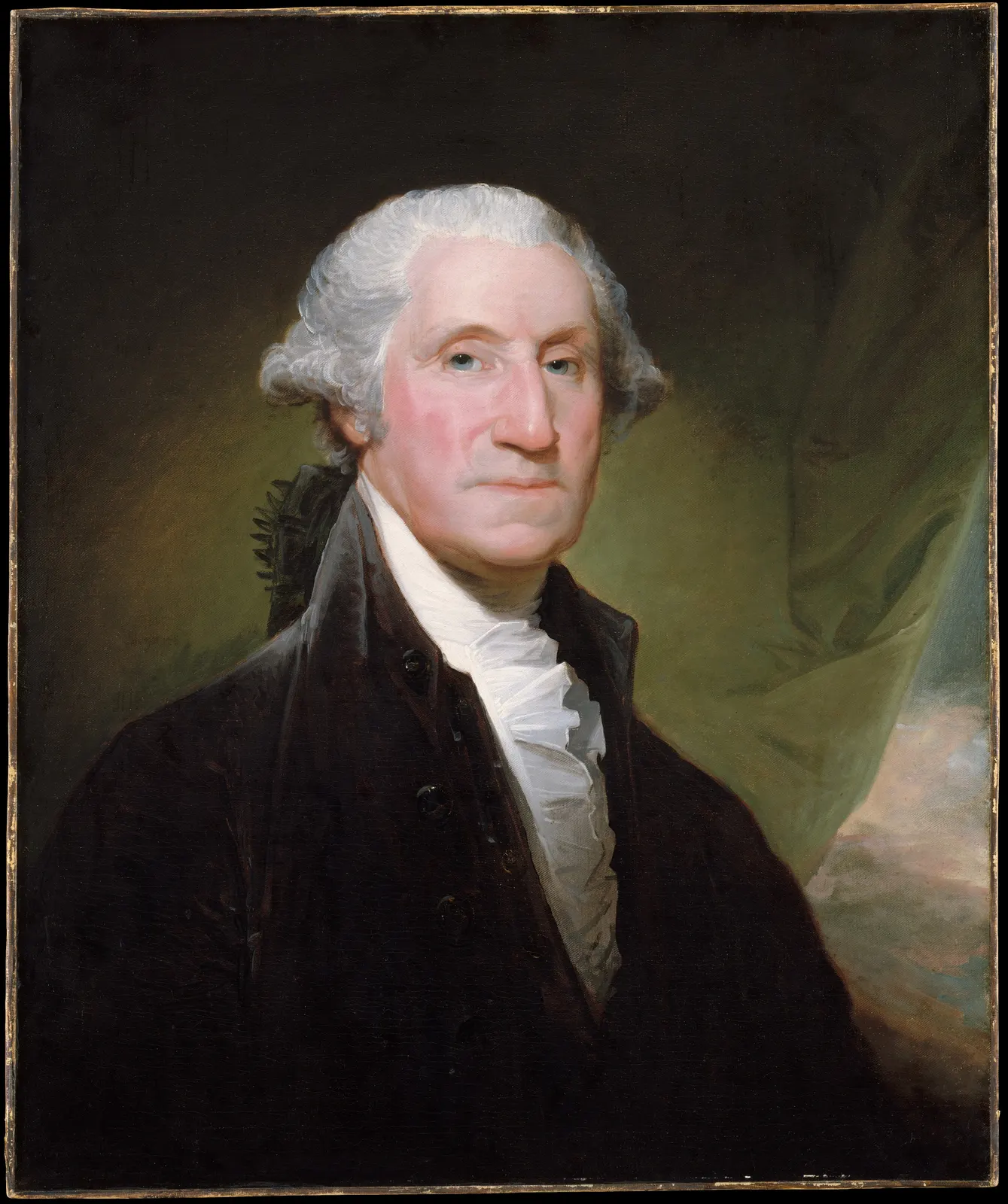
Was George Washington born in 1731 or 1732?
Both numbers name the same day. Neither is wrong under its own rule. Irving's biography gives the Gregorian date, February 22, 1732, with the Julian day, February 11, in parentheses. We could not read a primary record of the birth, such as a family register, so the date on this page rests on that 1855 account and no earlier document.
"George Washington (Gibbs-Channing-Avery Portrait)" by Gilbert Stuart — https://commons.wikimedia.org/wiki/File:George_Washington_MET_DT62.jpg — CC0 1.0 (https://creativecommons.org/publicdomain/zero/1.0/)
The 1731 follows from the act, not from Irving. Section 1 ended the March 25 reckoning “in and throughout all his Majesty's dominions and countries in Europe, Asia, Africa, and America,” which included Virginia. Under that reckoning the Julian day February 11 fell before March 25, so it belonged to the year 1731. Converting through the Julian Day Number gives Gregorian February 22, 1732, a Friday; two independent date routines give the same answer.
The two familiar forms answer different questions. February 22, 1732, is the date on today's calendar. February 11, 1731, is how the same day was numbered under the rules in force in the colony at the time, by the act's description.
How do you convert an Old Style date to New Style?
For a date written in Britain or its colonies before September 14, 1752, the conversion has two independent parts: the year and the day. The steps below work for any Julian date from October 5, 1582, to the end of 2099.
- Fix the year number. If the date falls between January 1 and March 24 and was written under the March 25 reckoning, use the later year: February 11, 1731 (or 1731/2) becomes 1732.
- Find the days to add from the table below, using the Julian date: 10, 11, 12 or 13.
- Read the Julian month and day as if they were a Gregorian date and count forward that many days on the Gregorian calendar. February 11 plus 11 days is February 22.
- One exception: February 29 in 1700, 1800 and 1900 exists only on the Julian calendar, so read those three days from the table.
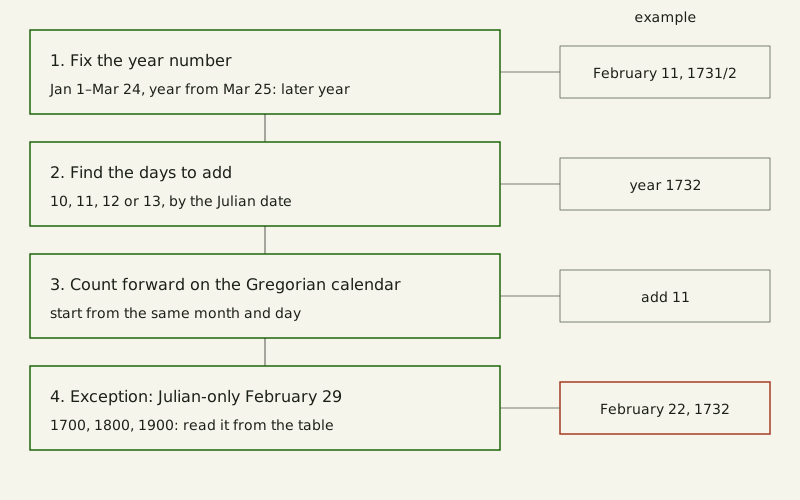
Figure: The Yardstick Almanac, CC BY 4.0
Credit line to copy
"Converting an Old Style date in four steps" by The Yardstick Almanac, https://theyardstickalmanac.com/calendars/old-style-new-style-dates/, licensed under CC BY 4.0 (https://creativecommons.org/licenses/by/4.0/).
Data: Dates computed 2026-11-01 with two independent date routines from Calendar; Explanatory Supplement to the Astronomical Almanac, ch. 15, sec. 15.1.10, 15.3.4, 15.3.5, 15.4.1, 15.4.2; CC BY 4.0
| Days to add | First Julian date | Last Julian date | First Gregorian date |
|---|---|---|---|
| 10 | October 5, 1582 | February 28, 1700 | October 15, 1582 |
| 11 | February 29, 1700 | February 28, 1800 | March 11, 1700 |
| 12 | February 29, 1800 | February 28, 1900 | March 12, 1800 |
| 13 | February 29, 1900 | February 28, 2100 | March 13, 1900 |
| 14 | February 29, 2100 | February 28, 2200 | March 14, 2100 |
We checked the shortcut in step 3 against a full conversion through the Julian Day Number for every Julian date from October 5, 1582, to December 31, 2099. All 188,919 dates matched, with only the three Julian-only leap days set aside. For British documents the useful rows are the first two, since Britain left the Julian calendar in 1752.
Like the U.S. survey foot and the international foot, the two counts sat side by side for decades, and a reader who does not ask which one is in use can be off without noticing. The day-by-day table in the Data files below covers every Julian date from January 1, 1700, to September 2, 1752.
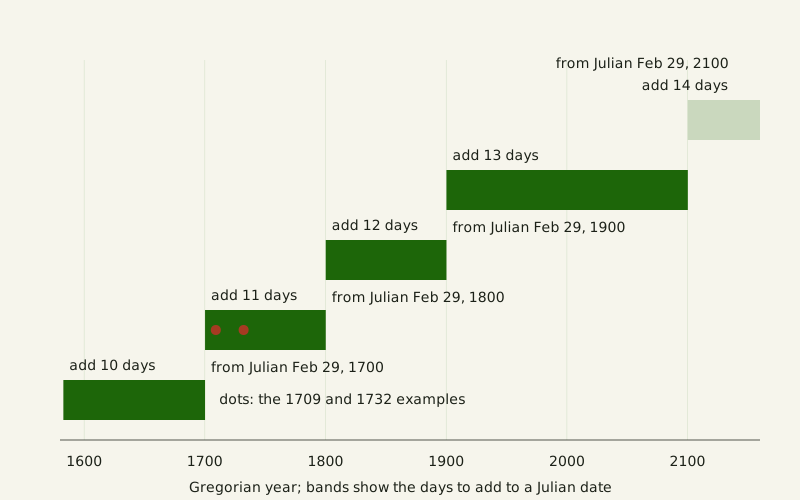
Figure: The Yardstick Almanac, CC BY 4.0
Credit line to copy
"Days to add to a Julian date, 1582–2100" by The Yardstick Almanac, https://theyardstickalmanac.com/calendars/old-style-new-style-dates/, licensed under CC BY 4.0 (https://creativecommons.org/licenses/by/4.0/).
Data: Dates computed 2026-11-01 with two independent date routines from Explanatory Supplement to the Astronomical Almanac, ch. 15, sec. 15.1.10, 15.3.4, 15.3.5, 15.4.1, 15.4.2; CC BY 4.0
Why convert through a day count?
A running count of days avoids month lengths altogether. The Julian Day Number gives every day a whole number: in the Supplement's examples, Saturday, January 1, 2000, is day 2,451,545, and Monday, January 1, 4713 BC on the Julian calendar is day 0 (sec. 15.1.10). Convert the Old Style date to its day number with the Julian rule, then read that number back with the Gregorian rule, and the leap-day exceptions take care of themselves.
The name is a near miss. According to the Supplement, Joseph Scaliger, in a 1583 work, built a 7,980-year Julian Period from three cycles of 28, 19 and 15 years, so called because it was based on the Julian calendar year. Nineteenth-century astronomers, the Supplement adds, turned it into a count of days. The Julian Day Number is a day count, not a calendar, and it labels Gregorian dates as readily as Julian ones.
Why are some dates written as 1708/9?
Some dates were written with both year numbers. A memorial tablet to John Etty, a carpenter, in All Saints, North Street, York, gives his death as “the 28 of Ian:” with the year written 170, then an 8 above a 9. Read as 1708/9, that is the Julian date January 28 in the year 1708 by the March 25 reckoning, or 1709 counted from January 1.
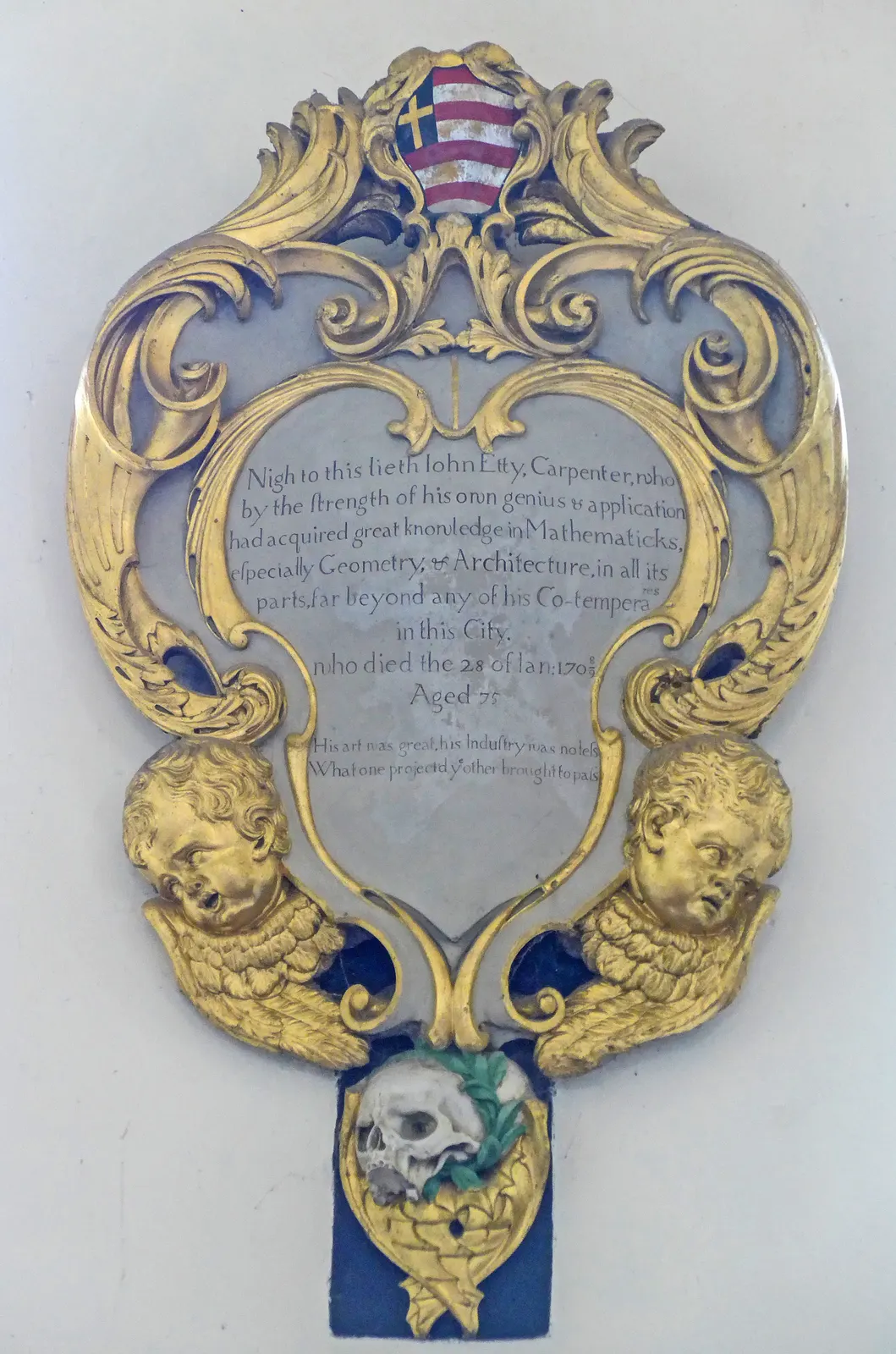
"Memorial to John Etty" by Tim Green — https://commons.wikimedia.org/wiki/File:Memorial_to_John_Etty_(18373251064).jpg — CC BY 2.0 (https://creativecommons.org/licenses/by/2.0/)
Converted with the steps above, that day is February 8, 1709, on the Gregorian calendar [exact by definition]: the year from the lower figure, then 11 days added. A dual year removes the year question but not the day question. The tablet's January 28 is still a Julian day, so the 11 days have to be added either way.
The form is only needed for January 1 through March 24, when the two year numbers differ. From March 25 on, the legal year and the January year carry the same number.
Where do the switch dates come from?
Each row below names its source and the area it covers. A switch date is a fact about a place and a document, so the table lists three switches with their sources rather than a single date for “the Gregorian calendar.”
| Where | Last Julian date | First Gregorian date | Dates skipped | Source |
|---|---|---|---|---|
| Places on the papal schedule of 1582 | October 4, 1582 | October 15, 1582 | 10 | Explanatory Supplement, sec. 15.4.1 |
| France | December 9, 1582 | December 20, 1582 | 10 | Edict of Henry III, Côte-d'Or archives, B 12083 |
| Britain and its colonies | September 2, 1752 | September 14, 1752 | 11 | Calendar (New Style) Act 1750, s. 1 |
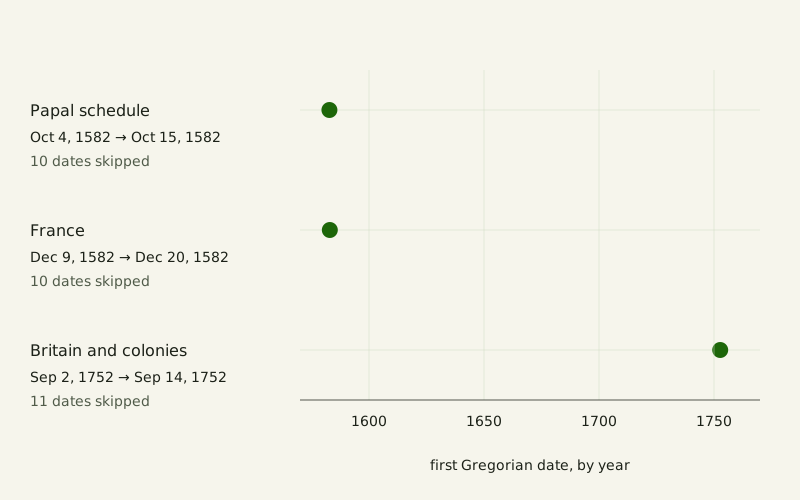
Figure: The Yardstick Almanac, CC BY 4.0
Credit line to copy
"Three Gregorian switch dates" by The Yardstick Almanac, https://theyardstickalmanac.com/calendars/old-style-new-style-dates/, licensed under CC BY 4.0 (https://creativecommons.org/licenses/by/4.0/).
Data: Dates computed 2026-11-01 with two independent date routines from Explanatory Supplement to the Astronomical Almanac, ch. 15, sec. 15.1.10, 15.3.4, 15.3.5, 15.4.1, 15.4.2; Archives départementales de la Côte-d'Or, B 12083, transcription of the 1582 edict; Calendar; CC BY 4.0
The first row applies only where the reform took effect on the schedule of the papal bull Inter gravissimas; the Supplement says Protestant states accepted it “one by one” over the following centuries. France ran on its own timetable. The royal edict, in the copy the Parlement of Burgundy registered under a November 1582 heading, orders that the day after December 9 be counted as the 20th throughout the kingdom.
Section 1 of the act also told clerks how to date documents. Deeds, notes and other writings made on or after January 1, 1752, were to “bear date according to the said new method,” so British records from 1752 on carry January year numbers, and from September 14, 1752, Gregorian days.
Where the March 25 reckoning was in use, as in England and its colonies, the switch also changed the year start, so the legal years around the change had odd lengths. Scotland is the exception: the preamble says the March 25 reckoning differed “from the legal method of computation in Scotland.”
Counted from the act, the English legal year 1751 ran from March 25 to December 31, 1751: 282 days [exact by definition]. The year 1752 then began on January 1 and, with September 3 to 13 left out, had 355 days [exact by definition].
The preamble gives the calendar reason too. It says the spring equinox, which fell on or about March 21 at the Council of Nicaea in 325, “now happens on the ninth or tenth day of the same month.” The Supplement puts the equinox's return to about March 21 in 1583, where the papal schedule was followed.
Old Style and New Style questions
What does O.S. mean after a date?
O.S. marks a date in the Julian count of days. In British and colonial records it often also means a year that began on March 25, but later writers, Irving among them, sometimes pair an O.S. day with a January year. N.S. marks the Gregorian count with a January 1 year start.
When did England and the American colonies switch to New Style?
Under section 1 of the Calendar (New Style) Act 1750, the year 1752 began on January 1, and September 2, 1752, was followed by September 14. The act applied to all the British dominions, including the colonies in America.
Do dates after September 1752 need converting?
Not for Britain and its colonies. From September 14, 1752, their dates are already Gregorian, with the year starting on January 1. If a later date is marked O.S., find out which place's calendar the writer meant; that place's switch date is not in this page's table.
Is Washington's birthday February 11 or February 22?
Irving's 1855 biography gives February 22, 1732, and notes February 11 as the Old Style day. They are the same day on two calendars. February 22 is the Gregorian date, the one that matches today's calendar.
Which leap days did only the Julian calendar have?
The gap between the two calendars grew by one day each time the Julian calendar had a February 29 that the Gregorian calendar skipped. That happened in 1700, 1800 and 1900, the century years not divisible by 400. Julian February 29, 1700, is Gregorian March 11, 1700 [exact by definition], and from that day on the gap was 11 days instead of 10.
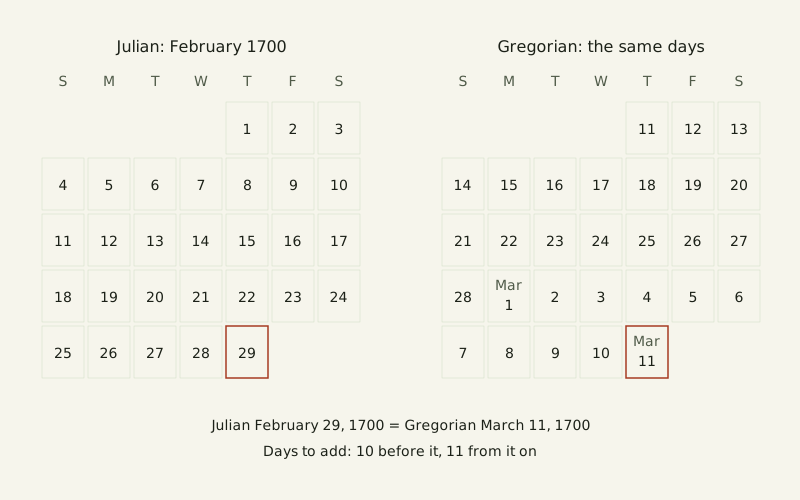
Figure: The Yardstick Almanac, CC BY 4.0
Credit line to copy
"February 1700 on the Julian and Gregorian calendars" by The Yardstick Almanac, https://theyardstickalmanac.com/calendars/old-style-new-style-dates/, licensed under CC BY 4.0 (https://creativecommons.org/licenses/by/4.0/).
Data: Dates computed 2026-11-01 with two independent date routines from Explanatory Supplement to the Astronomical Almanac, ch. 15, sec. 15.1.10, 15.3.4, 15.3.5, 15.4.1, 15.4.2; CC BY 4.0
In England that extra day carried an odd year number. Because it fell before March 25, the Julian February 29, 1700, belonged to the legal year 1699, or 1699/1700 in the dual form. So the 11-day rule for British dates starts on a day that the English legal reckoning numbered 1699. Calendars are not the only timekeeping that inserts units to stay in step: leap seconds were added to UTC from 1972 to keep it near the time set by Earth's turning.
The Julian calendar keeps its every-fourth-year rule, so the gap keeps growing. The next Julian-only leap day is February 29, 2100, which is Gregorian March 14, 2100; from then until the next Julian-only leap day, in 2200, the gap is 14 days.
Sources
- Calendar (New Style) Act 1750 (24 Geo. 2 c. 23), introductory text (preamble). legislation.gov.uk, The National Archives. https://www.legislation.gov.uk/apgb/Geo2/24/23/introduction Read: full text of the preamble (revised version) Text license: Open Government Licence v3.0
- Calendar (New Style) Act 1750 (24 Geo. 2 c. 23), section 1. legislation.gov.uk, The National Archives. https://www.legislation.gov.uk/apgb/Geo2/24/23/section/1. Read: full text of section 1 (revised version) Text license: Open Government Licence v3.0
- Archives départementales de la Côte-d'Or, B 12083: Parlement de Bourgogne, registration of edicts (heading dated November 1582), edict of Henry III removing ten days from the year 1582; transcription, Atelier du chancelier Rolin, paleography group, document 8 (2009–2010). https://archinoe.net/v2/site/AD21/Apprendre/Atelier_du_chancelier_Rolin/Paleographie/Groupe_debutants/Documents_etudies_en_2009-2010/Document_8_-_Retranchement_de_dix_jours_sur_lannee_1582 Read: full transcription
- E. G. Richards, "Calendars," chapter 15 of S. E. Urban and P. K. Seidelmann (eds.), Explanatory Supplement to the Astronomical Almanac (University Science Books); online reprint, U.S. Naval Observatory. Sections 15.1.10, 15.3.4, 15.3.5, 15.4.1, 15.4.2. https://aa.usno.navy.mil/downloads/c15_usb_online.pdf Read: full chapter
- Washington Irving, Life of George Washington, vol. 1 (New York, 1855), chapter 1. Project Gutenberg eBook https://www.gutenberg.org/ebooks/7002 Read: full text of volume 1 (birth passage used)
Contains public sector information licensed under the Open Government Licence v3.0.
Data files (computed 2026-11-01 with integer Julian Day Number arithmetic, cross-checked against the convertdate 2.5.1 Python package, MIT license, and for dates from 1583 on against Python's datetime module; each file comes with a notes file giving its sources and license):
- Old Style to New Style, every day from 1700 to September 2, 1752 (CSV, source and license notes) Data: Year-start rule from the Calendar (New Style) Act 1750, s. 1 (Open Government Licence v3.0); leap rules from the Explanatory Supplement, sec. 15.3.5 and 15.4.2; computed 2026-11-01 with two independent date routines, CC BY 4.0
- Days to add to a Julian date, 1582 to 2200 (CSV, source and license notes) Data: Leap rules from the Explanatory Supplement, sec. 15.3.5 and 15.4.2 (single values); computed day by day 2026-11-01, CC BY 4.0
- Three switch dates, with sources (CSV, source and license notes) Data: Explanatory Supplement sec. 15.4.1 (single value), Côte-d'Or archives B 12083 (facts) and Calendar (New Style) Act 1750 s. 1 (Open Government Licence v3.0); consecutive days checked 2026-11-01, CC BY 4.0
Cite this page
The Yardstick Almanac. "Old Style vs New Style Dates: Feb 11, 1731 Was Feb 22, 1732." Published November 1, 2026. https://theyardstickalmanac.com/calendars/old-style-new-style-dates/. Accessed [the date you read it].
More in Calendars & Time
Calendars & Time
Leap Year Isn't Every 4 Years: Why 2100 Skips February 29
Image credit
"An Election Entertainment, Plate I: Four Prints of an Election" by William Hogarth — https://commons.wikimedia.org/wiki/File:An_Election_Entertainment,_Plate_I-_Four_Prints_of_an_Election_MET_DP827052.jpg — CC0 1.0 (https://creativecommons.org/publicdomain/zero/1.0/)

Calendars & Time
Leap Second: 27 Through 2026, Then Continuous UTC From 2027
Image credit
"Atomic Clock017 (atomic clock NBS-1)" by National Institute of Standards and Technology — https://commons.wikimedia.org/wiki/File:Atomic_Clock017.jpg — Public domain (work of the U.S. federal government, 17 U.S.C. §105)
Calendars & Time
ISO Week Number: 71 of Every 400 Years Have a Week 53
Illustration credit
Illustration: The Yardstick Almanac. Generated schematic illustration — not a photograph or historical record. © The Yardstick Almanac, all rights reserved.
How this page is checked: Where the numbers come from explains the value tags, the source order and how every figure is recomputed.
Corrections: every substantive change is logged in What we got wrong.
Spotted an error? Email contact@theyardstickalmanac.com with the sentence and your source, or read Write in first.