Leap Year Isn't Every 4 Years: Why 2100 Skips February 29
The Yardstick Almanac Published No substantive revisions
Short answer
In the Gregorian calendar, a year divisible by 4 is a leap year unless it is a century year not divisible by 400: 2000 was, 1900 and 2100 are not.
Station index 10 sections
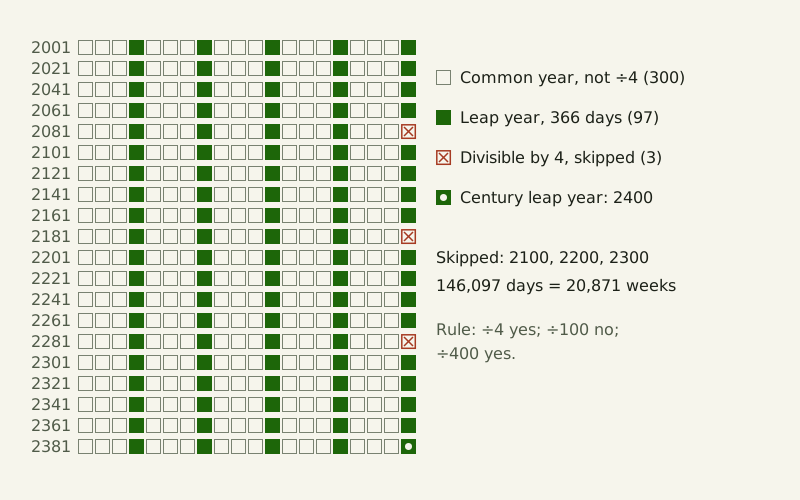
Figure: The Yardstick Almanac, CC BY 4.0
Credit line to copy
"One Gregorian cycle: 2001–2400" by The Yardstick Almanac, https://theyardstickalmanac.com/calendars/gregorian-leap-year-rule/, licensed under CC BY 4.0 (https://creativecommons.org/licenses/by/4.0/).
Data: Computed from the Gregorian and Julian leap-year rules (Explanatory Supplement to the Astronomical Almanac, ch. 15, sec. 15.4.2 and 15.3.5), 2026-11-01, CC BY 4.0
Of the 100 years divisible by four in each 400-year Gregorian cycle, three get no February 29. The rule comes from Inter gravissimas, the papal bull Pope Gregory XIII signed on February 24, 1582. Century years are leap years only if they also divide by 400, so 2000 had a February 29, 1900 did not, and 2100 will not. The leap days and the three skips together are a periodic adjustment for what we call the remainder: the fraction of a day per year that a calendar of 365 whole days leaves over.
A leap year has 366 days instead of 365, and the extra day is February 29, just before March 1. After 2024, leap years keep coming every four years, through 2028 and 2032 and on to 2096. Then 2100 breaks the run, the first skipped leap day since 1900.
The skips exist because the year the calendar is meant to track is not 365.25 days long. The Explanatory Supplement to the Astronomical Almanac defines the tropical year as the time the Sun's average position on its yearly path takes to advance a full 360 degrees. It puts the mean tropical year, that period averaged over several years, at 365.24219 days for the year 2000 [measured, source gives no uncertainty]. A plain every-four-years rule averages 365.25 days [exact by definition], which runs about 11 minutes long each year [estimate, range 11.0–11.3 min] by our subtraction against the two year lengths the Supplement gives for 2000.
What is the leap year rule, step by step?
The Supplement states the civil rule in one sentence (sec. 15.4.2): a year “exactly divisible by 4” is a leap year, except century years, which are leap years only if they are also divisible by 400. In practice that is three checks, run in order:
- Does the year divide evenly by 4? If not, it is a common year of 365 days.
- Does it divide evenly by 100? If not, it is a leap year of 366 days.
- Does it divide evenly by 400? If so, it is a leap year. If not, it is a common year.
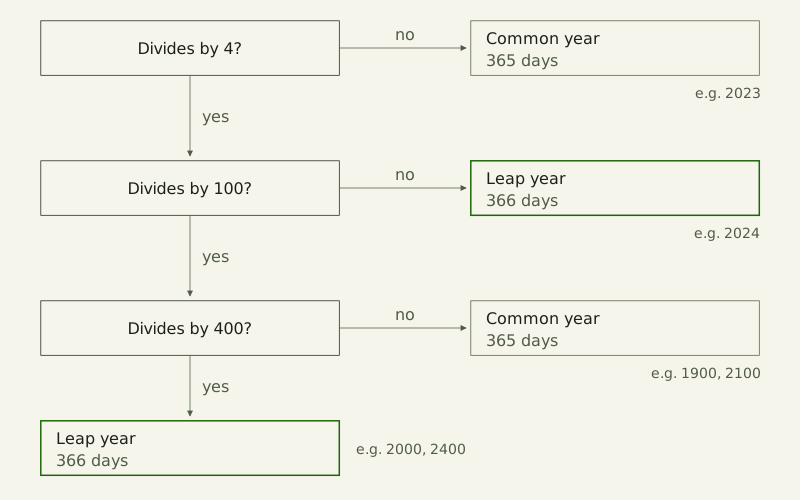
Figure: The Yardstick Almanac, CC BY 4.0
Credit line to copy
"The leap-year rule in three checks" by The Yardstick Almanac, https://theyardstickalmanac.com/calendars/gregorian-leap-year-rule/, licensed under CC BY 4.0 (https://creativecommons.org/licenses/by/4.0/).
Data: Gregorian leap-year rule (Explanatory Supplement to the Astronomical Almanac, ch. 15, sec. 15.4.2), 2026-11-01, CC BY 4.0
Microsoft's support page for Excel walks through the same three checks and offers a spreadsheet formula of its own. Written as three nested tests, with the year in cell B2, the checks look like this:
=IF(MOD(B2,4)<>0, "common", IF(MOD(B2,100)<>0, "leap", IF(MOD(B2,400)=0, "leap", "common")))
For 1900 this returns “common”, and Microsoft's page notes that its formula also reports 1900 as not a leap year. Keep that result in mind for the spreadsheet story further down.
Only the century test ever overturns the four-year pattern, and it rarely fires. In a 400-year cycle, 100 years pass the first check and 4 of those are century years. Only 1 century year passes the third check, which leaves 97 leap years [exact by definition].
Why isn't every fourth year enough?
The four-year rule is Julius Caesar's. According to the Supplement, Caesar took the advice of the Alexandrian astronomer Sosigenes, padded the year 46 BC (year −45 in astronomers' numbering) with 90 extra days to put the months back in season, then set one extra day every four years. That gave an average year of 365.25 days.
The rule did not start cleanly. After Caesar's death, Roman officials inserted the extra day every third year instead of every fourth. Augustus corrected the count in 9 BC, though the Supplement calls the details of his fix uncertain.
Even when applied correctly, 365.25 days runs long. The Supplement says the Julian calendar let the spring equinox fall back from March 21 by one day in about 130 years [estimate, range 128–131 years]; dividing one day by the overshoot against its two year lengths for 2000 gives 128 and 131. By the 16th century, it says, the equinox had shifted to March 11.
The March 21 date came from church practice. The early church based its Easter calculation on the Julian calendar, following the Council of Nicaea in 325, and assumed the equinox fell on March 21. If we hold the year fixed at the 2000 values, the Julian overshoot adds up to about 9.8 days [estimate, range 9.6–9.8 days] between 325 and 1582, close to the 10 days the reform would remove.
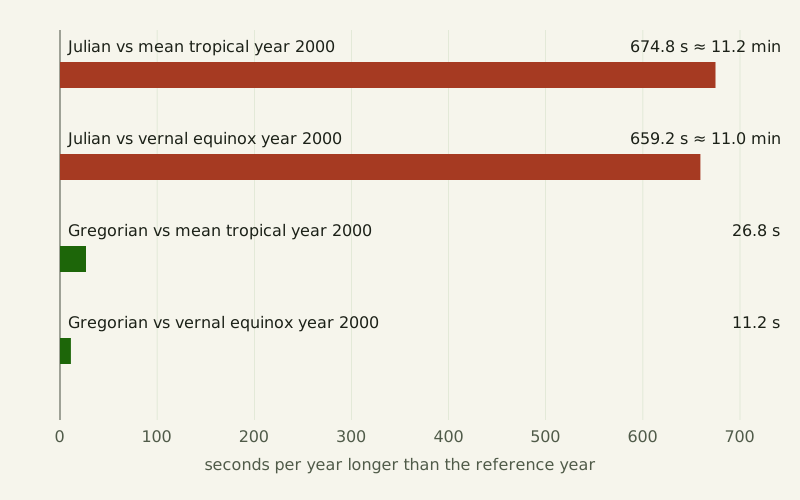
Figure: The Yardstick Almanac, CC BY 4.0
Credit line to copy
"Calendar year minus reference year" by The Yardstick Almanac, https://theyardstickalmanac.com/calendars/gregorian-leap-year-rule/, licensed under CC BY 4.0 (https://creativecommons.org/licenses/by/4.0/).
Data: Computed from the leap-year rules and the AD 2000 year lengths quoted from the Explanatory Supplement to the Astronomical Almanac, ch. 15 (Table 15.1, sec. 15.1.12), 2026-11-01, CC BY 4.0
Where did the leap day go before February 29?
Caesar's extra day was not February 29. The Romans counted days backward from three markers in each month, the first being the Kalends, the first of the month. The Supplement says the leap day sat between February 23 and the day the Romans called the sixth before the Kalends of March, and was written bis VI Kal. Mar., that sixth day counted twice.
Years with the doubled day were called bissextile years, a word Britain's 1750 calendar law still uses alongside “leap years.” In the Supplement's account, a uniform standard for recording dates came only with the spread of the Gregorian calendar, and the leap day became February 29 instead of the day after February 23.
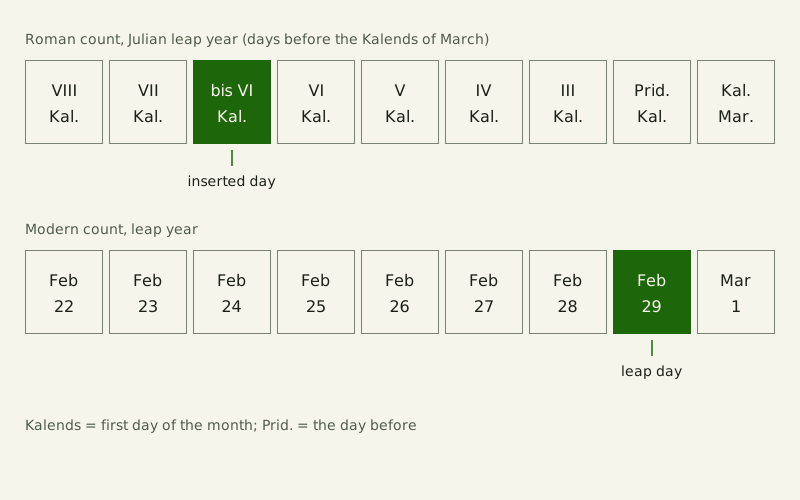
Figure: The Yardstick Almanac, CC BY 4.0
Credit line to copy
"Where the leap day sat: Roman and modern counts" by The Yardstick Almanac, https://theyardstickalmanac.com/calendars/gregorian-leap-year-rule/, licensed under CC BY 4.0 (https://creativecommons.org/licenses/by/4.0/).
Data: Roman day names from the Explanatory Supplement to the Astronomical Almanac, ch. 15, sec. 15.3.2–15.3.4, 2026-11-01, CC BY 4.0
Where did the 400-year rule come from?
Pope Gregory XIII set up a commission after he took office in 1572. It adopted a proposal by Aloysius Lilius (1510–1576), and a report written by Christopher Clavius (1537–1612) led to Inter gravissimas in 1582. The bull deleted 10 days [exact by definition], changed the leap rule and brought in a new method for calculating the date of Easter.
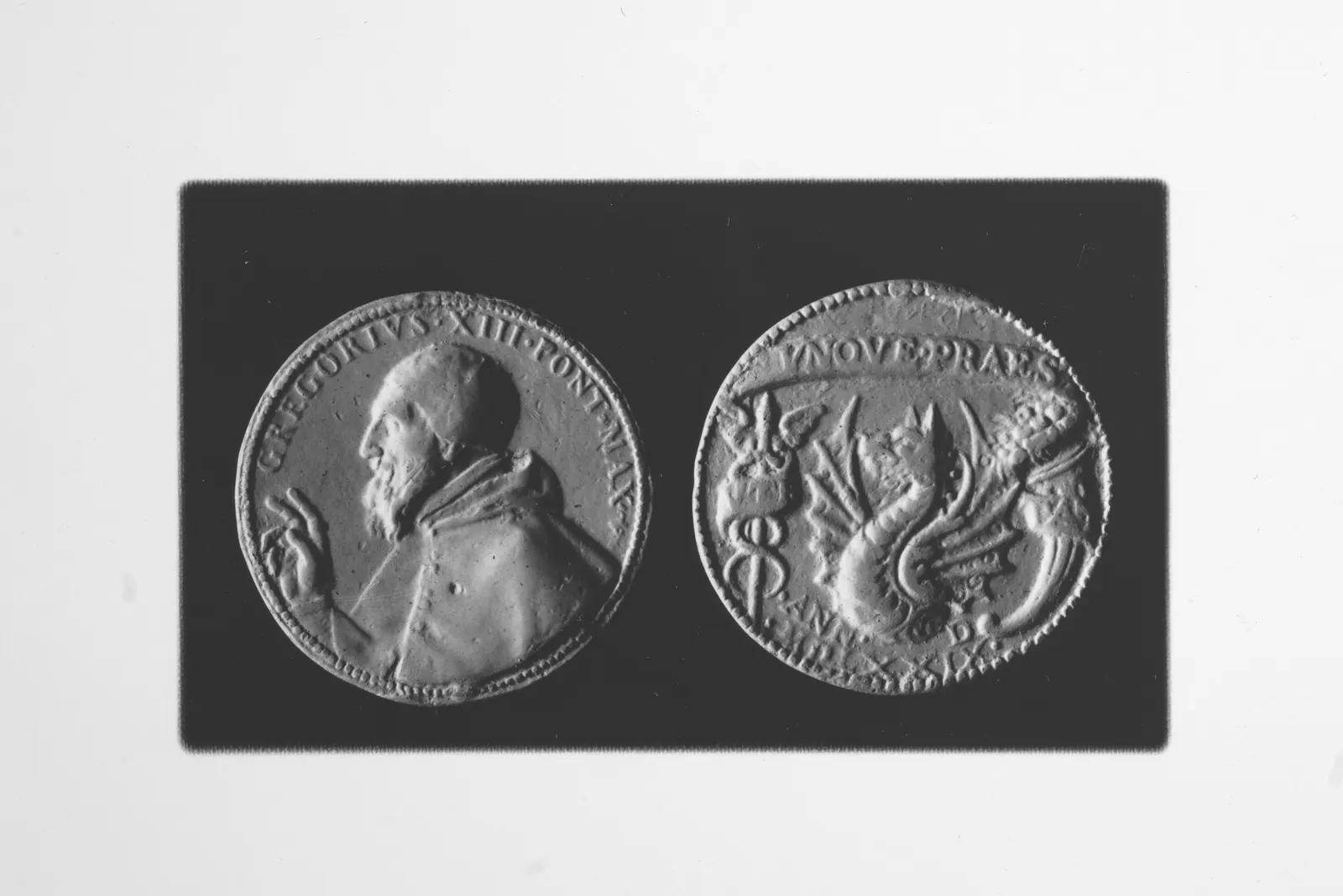
"Pope Gregory XIII (Ugo Buoncompagni, 1502–1585, pope 1572), Promulger of the Gregorian Calendar" by Giovanni V. Melon — https://commons.wikimedia.org/wiki/File:Pope_Gregory_XIII_(Ugo_Buoncompagni,_1502%E2%80%931585,_pope_1572),_Promulger_of_the_Gregorian_Calendar_MET_13987.jpg — CC0 1.0 (https://creativecommons.org/publicdomain/zero/1.0/)
The deletion caught up on drift that had already built up. Where the bull's schedule was followed, Thursday, October 4, 1582, was followed by Friday, October 15, and the spring equinox of 1583 came back to about March 21. We checked both weekdays with two separate date routines.
The rule change slowed the drift still to come. Three fewer leap days per 400 years gives 146,097 days per cycle [exact by definition], an average year of 365.2425 days [exact by definition]. Because 146,097 divides evenly by 7, the cycle is exactly 20,871 weeks [exact by definition], so the calendar repeats, date for date and weekday for weekday, every 400 years.
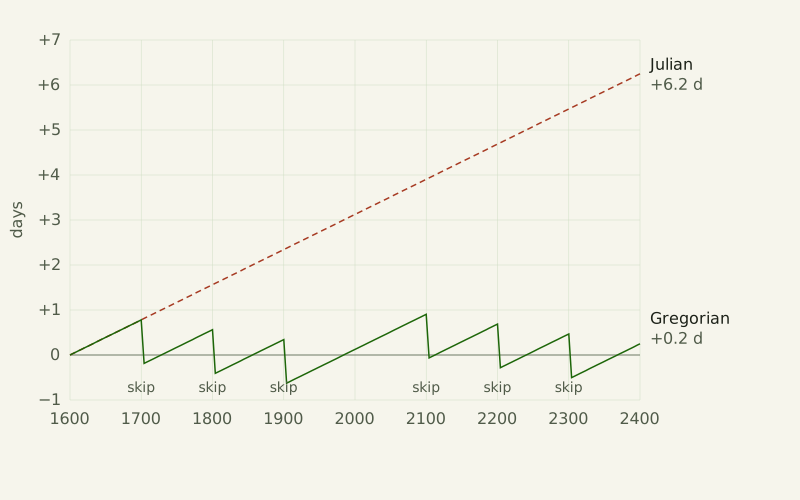
Figure: The Yardstick Almanac, CC BY 4.0
Credit line to copy
"Drift against a fixed year, 1600–2400" by The Yardstick Almanac, https://theyardstickalmanac.com/calendars/gregorian-leap-year-rule/, licensed under CC BY 4.0 (https://creativecommons.org/licenses/by/4.0/).
Data: Computed from the leap-year rules and the AD 2000 year lengths quoted from the Explanatory Supplement to the Astronomical Almanac, ch. 15 (Table 15.1, sec. 15.1.12), 2026-11-01, CC BY 4.0
Why did Britain and America skip 11 days, not 10?
Britain held out until 1752. The Calendar (New Style) Act 1750 applied “throughout all his Majesty's dominions and countries in Europe, Asia, Africa, and America,” which took in the American colonies. It ordered that the day after September 2, 1752, be called September 14, “omitting for that time only the eleven intermediate nominal days of the common calendar.”
The gap had grown because of 1700. That year was a leap year under the Julian rule but not the Gregorian one, so once the Julian calendar passed its February 29, 1700, the two calendars stood 11 days apart [exact by definition] instead of 10. In Britain and the colonies, Wednesday, September 2, 1752, was followed by Thursday, September 14.
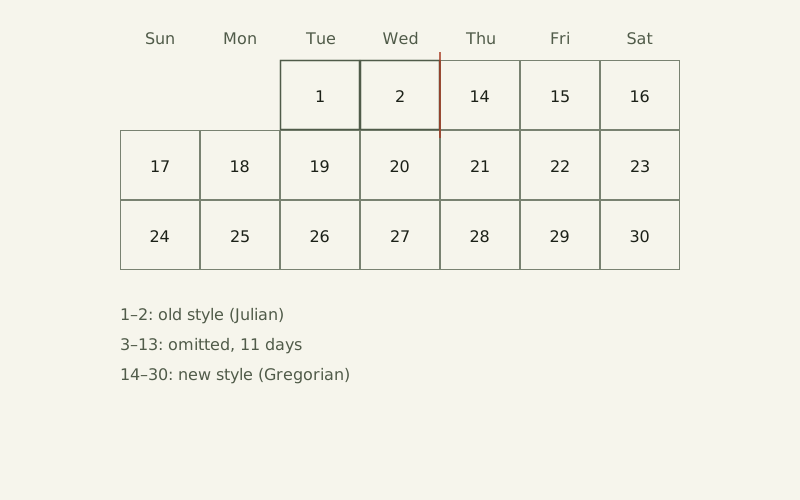
Figure: The Yardstick Almanac, CC BY 4.0
Credit line to copy
"September 1752 in Britain and its colonies" by The Yardstick Almanac, https://theyardstickalmanac.com/calendars/gregorian-leap-year-rule/, licensed under CC BY 4.0 (https://creativecommons.org/licenses/by/4.0/).
Data: Dates from the Calendar (New Style) Act 1750, s. 1; weekdays computed 2026-11-01, CC BY 4.0
Section 2 of the act then wrote out the century rule by name. It lists 1800, 1900, 2100, 2200 and 2300 as common years, and 2000, 2400 and 2800 as leap years, “whereof the year of our Lord two thousand shall be the first.” So a British law from the 1750s already says 2100 gets no February 29.
The same act's Section 1 dropped the old reckoning that began the year on March 25, so January 1, 1752, became the first day of 1752. The Supplement adds a detail for U.S. readers: the Gregorian calendar has been the official calendar of the United Kingdom since 1752, but not of the United States, “which has no official calendar.”
Which leap-year claims don't hold up?
| Claim | Where it appears | What the documents say |
|---|---|---|
| 1900 was a leap year | Lotus 1-2-3's date system, kept in Excel for compatibility (Microsoft Learn) | Century years need to divide by 400 (Explanatory Supplement, sec. 15.4.2; Calendar Act 1750, s. 2). 1900 had no February 29. |
| 365.2425 days is the length of a sidereal year | A Microsoft Learn support page, “Method to determine whether a year is a leap year,” describes it that way | 365.2425 is the calendar's own average, 146,097 ÷ 400. The Supplement puts the mean tropical year at 365.24219 days for 2000; a sidereal year is a different period, and the chapter gives no value for it. |
| Crowds rioted over the 11 lost days in 1752 | Described as a “popular belief” by the Explanatory Supplement | The Supplement says “there is no evidence for riots in protest at this,” citing Poole (1998). |

"An Election Entertainment, Plate I: Four Prints of an Election" by William Hogarth — https://commons.wikimedia.org/wiki/File:An_Election_Entertainment,_Plate_I-_Four_Prints_of_an_Election_MET_DP827052.jpg — CC0 1.0 (https://creativecommons.org/publicdomain/zero/1.0/)
Why does Excel think February 29, 1900, existed?
Microsoft documents this one itself. When Lotus 1-2-3 first came out, it assumed 1900 was a leap year, and Microsoft Multiplan and Excel made the same assumption so they could use Lotus's serial date system. Microsoft says correcting it now would move almost all dates in current worksheets back by one day and change what functions such as WEEKDAY return.
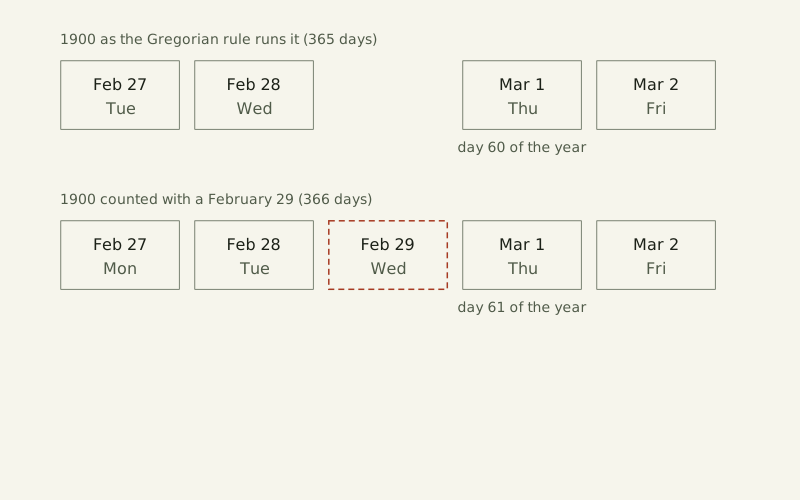
Figure: The Yardstick Almanac, CC BY 4.0
Credit line to copy
"1900 with and without February 29" by The Yardstick Almanac, https://theyardstickalmanac.com/calendars/gregorian-leap-year-rule/, licensed under CC BY 4.0 (https://creativecommons.org/licenses/by/4.0/).
Data: Computed from the Gregorian leap-year rule, 2026-11-01, CC BY 4.0
Leaving it alone costs less, in Microsoft's account: WEEKDAY returns wrong values for dates before March 1, 1900, and that is the only problem. If you work with early-1900 dates, check weekdays against a second tool. Microsoft notes that Excel handles every other year correctly, including the century year 2100.
How many leap years are in 400 years?
The count is 97 [exact by definition], and it is the same in every cycle. February 29 makes up 97 of every 146,097 days, or one day in 1,506.15 (146,097 ÷ 97, rounded) [exact by definition]. A single century holds 24 or 25 leap years, depending on whether its last year divides by 400.
Because each cycle is a whole number of weeks, the weekday pattern is fixed too. We counted all 4,800 thirteenths in one cycle: the 13th falls on a Friday 688 times [exact by definition], more than on any other weekday, while Thursday and Saturday get 684 each. February 29 is spread unevenly as well, landing on Monday and Wednesday 15 times each and on Tuesday, Thursday and Sunday 13 times each.
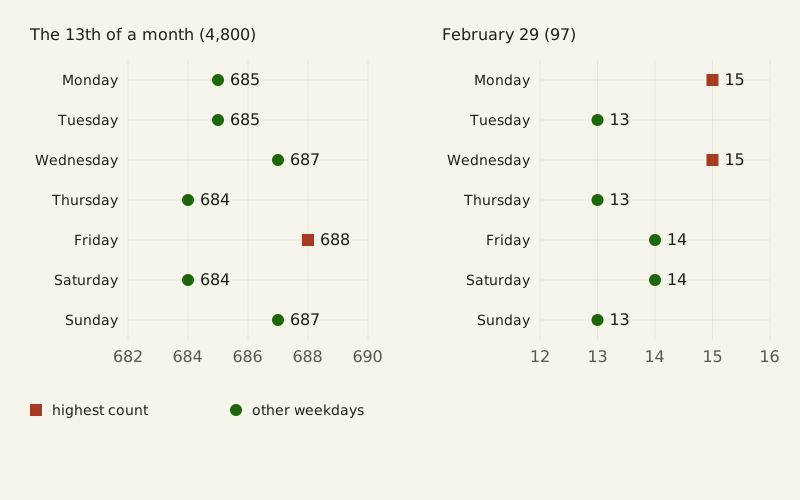
Figure: The Yardstick Almanac, CC BY 4.0
Credit line to copy
"Weekdays are not evenly shared" by The Yardstick Almanac, https://theyardstickalmanac.com/calendars/gregorian-leap-year-rule/, licensed under CC BY 4.0 (https://creativecommons.org/licenses/by/4.0/).
Data: Computed from the Gregorian and Julian leap-year rules (Explanatory Supplement to the Astronomical Almanac, ch. 15, sec. 15.4.2 and 15.3.5), 2026-11-01, CC BY 4.0
Friday leads Thursday by 4 out of 4,800. That edge exists only because the 400-year cycle is locked to the 7-day week.
How accurate is the Gregorian calendar?
It depends on which year you hold it against. Against the mean tropical year for 2000, 365.24219 days, the calendar's 365.2425 days run about 27 seconds long each year [estimate, range 26.4–27.2 s]. But the Supplement notes that the Gregorian calendar is tied to the vernal equinox year, which it puts at 365.24237 days in 2000 [measured, source gives no uncertainty]. Against that, the overshoot is about 11 seconds [estimate, range 10.8–11.7 s].
When will the calendar be a full day off?
Both ranges come from treating the published values as rounded to five decimal places. Turn the gaps into “years until one day off” and you get about 3,200 years [estimate, range 3,175–3,279 years] or about 7,700 [estimate, range 7,407–8,000 years]. The Supplement gives both kinds of answer: one section says about 3,000 years against the vernal equinox year, another says about 8,000 [contested].
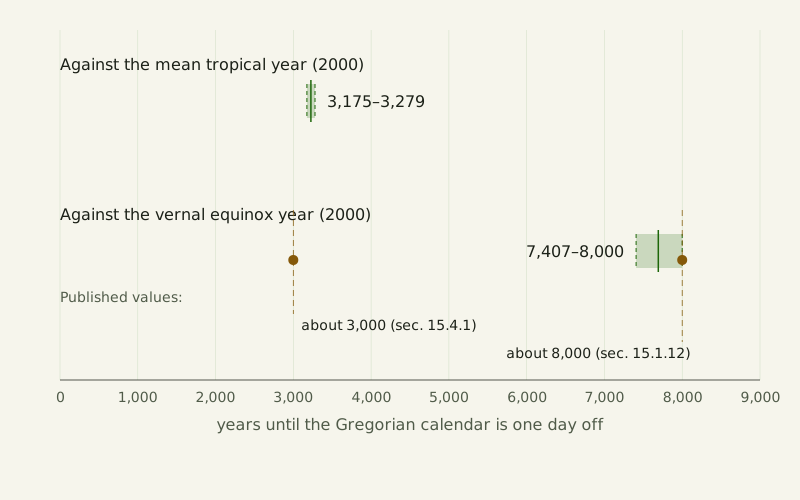
Figure: The Yardstick Almanac, CC BY 4.0
Credit line to copy
"Years until the Gregorian calendar is a day off" by The Yardstick Almanac, https://theyardstickalmanac.com/calendars/gregorian-leap-year-rule/, licensed under CC BY 4.0 (https://creativecommons.org/licenses/by/4.0/).
Data: Computed from the leap-year rules and the AD 2000 year lengths quoted from the Explanatory Supplement to the Astronomical Almanac, ch. 15 (Table 15.1, sec. 15.1.12), 2026-11-01, CC BY 4.0
We can think of that as a closure error, the surveyor's name for two legs of a measured loop that should meet and don't. The 3,000 figure is close to what the tropical-year gap gives, and the 8,000 figure matches the equinox-year value printed in the same chapter. Both, the Supplement says, assume the year stays the same length.
It doesn't. The Supplement's own table has the mean tropical year at 365.24222 days in 1500 and 365.24219 in 2000 [measured, source gives no uncertainty], and it calls its year-length formula an approximation included only for illustration. It also notes that the proposals it cites for sharpening the rule, from Delambre (1821) and Herschel (1849), did not account for the slowly changing lengths of the year and the day.
Position: the 1582 rule is good enough to leave alone. Its error is about 11 to 27 seconds a year, depending on which reference year is used, and the Supplement's table shows the target itself moving by 0.00003 days between 1500 and 2000. The day has its own drift problem, which belongs on a separate page: leap seconds. The year lengths above are counted in days of 86,400 SI seconds, as the Supplement specifies; how that second is defined is covered in the 2019 SI redefinition.
Leap year questions
When is the next leap year after 2024?
The next leap years after 2024 are 2028, 2032 and 2036, and the run continues every four years through 2096. Then 2100 is skipped, because it is a century year that does not divide by 400. The four-year pattern resumes with 2104. The next century year that is a leap year is 2400, the same status 2000 had.
Why was 2000 a leap year but 1900 was not?
Both are century years, so both face the third check: does the year divide evenly by 400? 2000 does, so it kept its February 29, while 1900 does not and was a common year of 365 days. The same test makes 2100, 2200 and 2300 common years and 2400 a leap year. Britain's 1750 calendar act lists all of these years by name.
How many leap years are in a century?
A century has 24 or 25 leap years. From 2001 through 2100 there are 24, because 2100 is skipped. From 2301 through 2400 there are 25, because 2400 divides by 400 and keeps its leap day. Over a full 400-year cycle the total is 97, giving an average year of 365.2425 days.
From 1901 through 2099 every fourth year is a leap year, so February 29 comes once in every 1,461 days [exact by definition]; how many people are born on February 29 works through who has that birthday.
Does the United States have an official calendar?
According to the Explanatory Supplement to the Astronomical Almanac, it does not. The Supplement says the Gregorian calendar has been the official calendar of the United Kingdom since 1752, but not of the United States, which has no official calendar. The American colonies switched in 1752 under the British act, when Wednesday, September 2, was followed by Thursday, September 14.
Which century years are leap years?
The table lists every century year from 1600 to 2400. The last column shows how many days the Julian calendar trails the Gregorian one, starting from Julian March 1 of that year; the full table to 2800 is in the century-years CSV.
| Century year | Gregorian | Julian | Julian trails by |
|---|---|---|---|
| 1600 | leap | leap | 10 days |
| 1700 | common | leap | 11 days |
| 1800 | common | leap | 12 days |
| 1900 | common | leap | 13 days |
| 2000 | leap | leap | 13 days |
| 2100 | common | leap | 14 days |
| 2200 | common | leap | 15 days |
| 2300 | common | leap | 16 days |
| 2400 | leap | leap | 16 days |
The current 13-day gap holds until Gregorian March 13, 2100. From March 15, 2100, which is March 1 on the Julian calendar, the gap is 14 days.
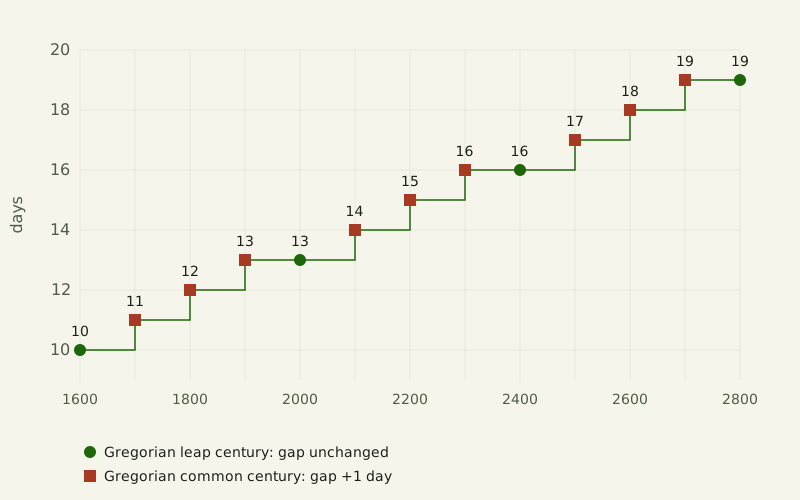
Figure: The Yardstick Almanac, CC BY 4.0
Credit line to copy
"The Julian gap, century by century" by The Yardstick Almanac, https://theyardstickalmanac.com/calendars/gregorian-leap-year-rule/, licensed under CC BY 4.0 (https://creativecommons.org/licenses/by/4.0/).
Data: Computed from the Gregorian and Julian leap-year rules (Explanatory Supplement to the Astronomical Almanac, ch. 15, sec. 15.4.2 and 15.3.5), 2026-11-01, CC BY 4.0
Sources
- E. G. Richards, "Calendars," chapter 15 of S. E. Urban and P. K. Seidelmann (eds.), Explanatory Supplement to the Astronomical Almanac (University Science Books); online reprint, U.S. Naval Observatory. Sections 15.1.1, 15.1.3, Table 15.1, 15.1.12, 15.3.2–15.3.5, 15.4.1–15.4.2. https://aa.usno.navy.mil/downloads/c15_usb_online.pdf Read: full chapter
- Calendar (New Style) Act 1750 (24 Geo. 2 c. 23), section 1. legislation.gov.uk, The National Archives. https://www.legislation.gov.uk/apgb/Geo2/24/23/section/1. Read: full text of section 1 (revised version) Text license: Open Government Licence v3.0
- Calendar (New Style) Act 1750 (24 Geo. 2 c. 23), section 2. legislation.gov.uk, The National Archives. https://www.legislation.gov.uk/apgb/Geo2/24/23/section/2 Read: full text of section 2 (revised version) Text license: Open Government Licence v3.0
- Microsoft Learn, "Excel incorrectly assumes that the year 1900 is a leap year" (last updated 2026-03-30). https://learn.microsoft.com/en-us/troubleshoot/microsoft-365-apps/excel/wrongly-assumes-1900-is-leap-year Read: full page
- Microsoft Learn, "Method to determine whether a year is a leap year" (last updated 2026-03-25). https://learn.microsoft.com/en-us/troubleshoot/microsoft-365-apps/excel/determine-a-leap-year Read: full page
Contains public sector information licensed under the Open Government Licence v3.0. Data files (computed 2026-11-01 with integer Julian Day Number arithmetic, cross-checked against the convertdate 2.5.1 Python package, MIT license, and for dates from 1583 on against Python's datetime module; each file comes with a notes file giving its sources and license):
- 400-year cycle, 2001–2400 (CSV, source and license notes) Data: Computed from the Gregorian and Julian leap-year rules (Explanatory Supplement to the Astronomical Almanac, ch. 15, sec. 15.4.2 and 15.3.5), 2026-11-01, CC BY 4.0
- Weekday counts of the 13th and of February 29 (CSV, source and license notes) Data: Computed from the Gregorian and Julian leap-year rules (Explanatory Supplement to the Astronomical Almanac, ch. 15, sec. 15.4.2 and 15.3.5), 2026-11-01, CC BY 4.0
- Drift against a fixed year, 1600–2400 (CSV, source and license notes) Data: Computed from the leap-year rules and the AD 2000 year lengths quoted from the Explanatory Supplement to the Astronomical Almanac, ch. 15 (Table 15.1, sec. 15.1.12), 2026-11-01, CC BY 4.0
- Calendar year vs. reference year lengths (CSV, source and license notes) Data: Computed from the leap-year rules and the AD 2000 year lengths quoted from the Explanatory Supplement to the Astronomical Almanac, ch. 15 (Table 15.1, sec. 15.1.12), 2026-11-01, CC BY 4.0
- Century years 1600–2800 and the Julian gap (CSV, source and license notes) Data: Computed from the Gregorian and Julian leap-year rules (Explanatory Supplement to the Astronomical Almanac, ch. 15, sec. 15.4.2 and 15.3.5), 2026-11-01, CC BY 4.0
Cite this page
The Yardstick Almanac. "Leap Year Isn't Every 4 Years: Why 2100 Skips February 29." Published November 1, 2026. https://theyardstickalmanac.com/calendars/gregorian-leap-year-rule/. Accessed [the date you read it].
More in Calendars & Time

Calendars & Time
Leap Second: 27 Through 2026, Then Continuous UTC From 2027
Image credit
"Atomic Clock017 (atomic clock NBS-1)" by National Institute of Standards and Technology — https://commons.wikimedia.org/wiki/File:Atomic_Clock017.jpg — Public domain (work of the U.S. federal government, 17 U.S.C. §105)
Calendars & Time
Old Style vs New Style Dates: Feb 11, 1731 Was Feb 22, 1732
Image credit
"George Washington (Gibbs-Channing-Avery Portrait)" by Gilbert Stuart — https://commons.wikimedia.org/wiki/File:George_Washington_MET_DT62.jpg — CC0 1.0 (https://creativecommons.org/publicdomain/zero/1.0/)
Calendars & Time
ISO Week Number: 71 of Every 400 Years Have a Week 53
Illustration credit
Illustration: The Yardstick Almanac. Generated schematic illustration — not a photograph or historical record. © The Yardstick Almanac, all rights reserved.
How this page is checked: Where the numbers come from explains the value tags, the source order and how every figure is recomputed.
Corrections: every substantive change is logged in What we got wrong.
Spotted an error? Email contact@theyardstickalmanac.com with the sentence and your source, or read Write in first.