ISO Week Number: 71 of Every 400 Years Have a Week 53
The Yardstick Almanac Published No substantive revisions
Short answer
ISO weeks start on Monday, and week 1 holds the year's first Thursday. Most years have 52 weeks; 71 in every 400 have a week 53 [exact by definition], 2026 among them.
Station index 5 sections
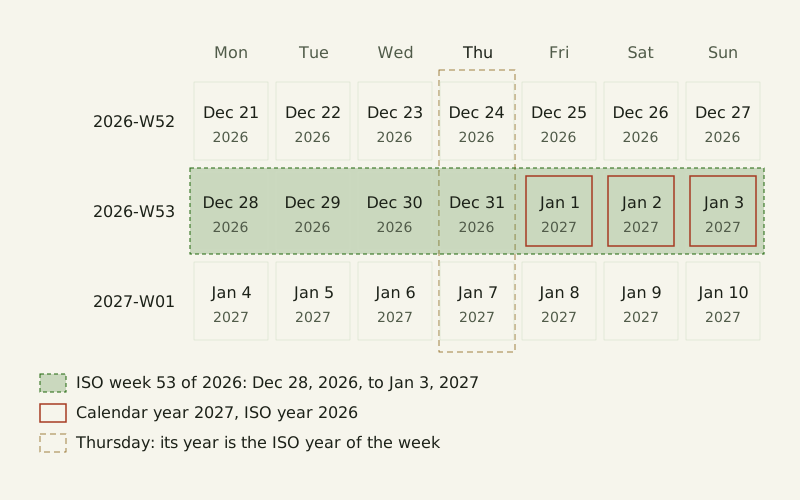
Figure: The Yardstick Almanac, CC BY 4.0
Credit line to copy
"ISO weeks at the turn of 2026 into 2027" by The Yardstick Almanac, https://theyardstickalmanac.com/calendars/iso-week-number/, licensed under CC BY 4.0 (https://creativecommons.org/licenses/by/4.0/).
Data: Week rules from the Python datetime documentation; computed 2026-11-01 with two independent date routines, CC BY 4.0
2026 has 53 ISO weeks, one more than most years; in each 400-year cycle, 71 years do. The rule behind that count is spelled out in Python's documentation for date.isocalendar(), and the CALENDRICA code that Edward Reingold and Nachum Dershowitz wrote for the fourth edition of their book Calendrical Calculations tests for it in a function called iso-long-year?. We counted every year from 2001 to 2400 with two independent date routines and got 71 both times. The extra week is a periodic adjustment for what we call the remainder: 52 weeks of 7 days make 364 days, one or two short of a calendar year.
An ISO week runs from Monday to Sunday. Python's documentation states the start rule this way: “The first week of an ISO year is the first (Gregorian) calendar week of a year containing a Thursday.” A year gets a week 53 when January 1 falls on a Thursday, or on a Wednesday in a leap year. Over the 400-year Gregorian cycle that comes to 20,871 weeks, an average of 52.1775 weeks a year [exact by definition].
How is week 1 chosen?
Week 1 can start as early as December 29 of the year before or as late as January 4. Only the weekday of January 1 matters, so there are seven cases. The same documentation gives a second test that picks the same week: “Week 01 is the week containing Jan 4.” We checked that both tests land on the same Monday in all 400 years of the cycle.
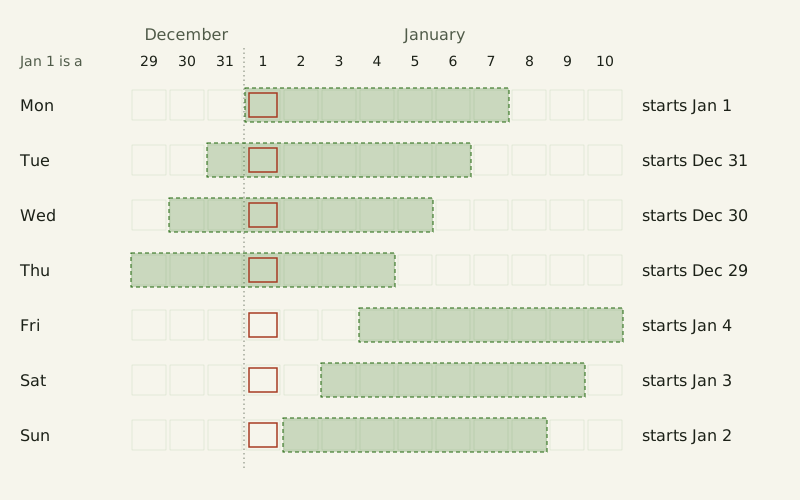
Figure: The Yardstick Almanac, CC BY 4.0
Credit line to copy
"Where ISO week 1 starts, for each weekday of January 1" by The Yardstick Almanac, https://theyardstickalmanac.com/calendars/iso-week-number/, licensed under CC BY 4.0 (https://creativecommons.org/licenses/by/4.0/).
Data: Week rules from the Python datetime documentation; computed 2026-11-01 with two independent date routines, CC BY 4.0
| January 1 is a | ISO week 1 starts | Early-January days in the previous ISO year | Years in a 400-year cycle |
|---|---|---|---|
| Monday | January 1 | 0 | 56 |
| Tuesday | December 31 | 0 | 58 |
| Wednesday | December 30 | 0 | 57 |
| Thursday | December 29 | 0 | 57 |
| Friday | January 4 | 3 | 58 |
| Saturday | January 3 | 2 | 56 |
| Sunday | January 2 | 1 | 58 |
Python's documentation notes that %G, the format code for the ISO year, and %Y, the code for the calendar year, “are not interchangeable.” Its own example is 2004. That year began on a Thursday, so week 1 of ISO year 2004 began on Monday, December 29, 2003. An ISO year and a calendar year can disagree by up to three days at either end.
Which years have 53 weeks?
A year has a week 53 when its days reach far enough past 52 full weeks to own another Thursday. CALENDRICA's iso-long-year? tests this directly: the year is long if January 1 or December 31 is a Thursday. In a common year December 31 falls on the same weekday as January 1, so the second test only adds leap years that begin on a Wednesday.
Of the 400 years from 2001 to 2400, 57 begin on a Thursday and 14 are leap years that begin on a Wednesday, 71 in all [exact by definition]. The other 329 have 52 weeks, so a week 53 turns up in 17.75% of years, a little more than one year in six. The Gregorian cycle of 146,097 days is a whole number of weeks, 20,871 [exact by definition], so the pattern repeats every 400 years; the years 1601 to 2000 give the same week counts, year by year.
An ISO year therefore lasts either 364 or 371 days [exact by definition], never the 365 or 366 of a calendar year. To tell which kind a year is, look up the ISO week of December 28. That date falls in the last ISO week of its year every year, so its week number is the year's count of weeks, 52 or 53.
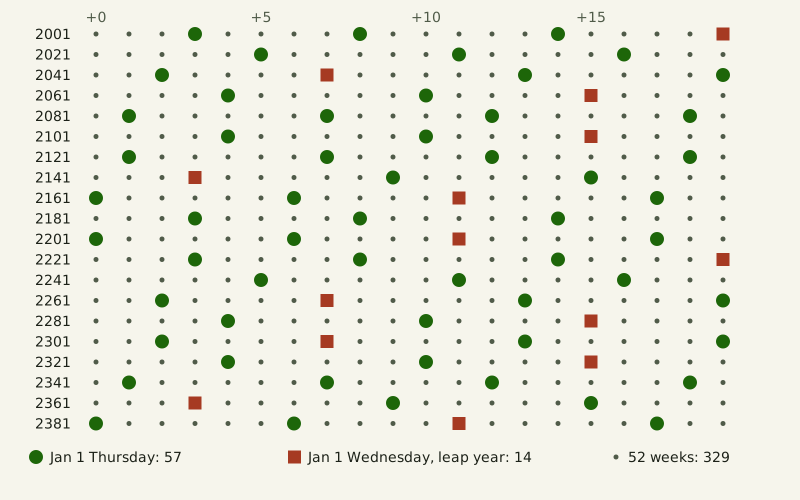
Figure: The Yardstick Almanac, CC BY 4.0
Credit line to copy
"Years with an ISO week 53, 2001–2400" by The Yardstick Almanac, https://theyardstickalmanac.com/calendars/iso-week-number/, licensed under CC BY 4.0 (https://creativecommons.org/licenses/by/4.0/).
Data: Week rule from the Python datetime documentation and CALENDRICA 4.0 (Apache License 2.0); computed 2026-11-01 with two independent date routines, CC BY 4.0
| Years | Count | Years with a week 53 |
|---|---|---|
| 2001–2100 | 18 | 2004, 2009, 2015, 2020, 2026, 2032, 2037, 2043, 2048, 2054, 2060, 2065, 2071, 2076, 2082, 2088, 2093, 2099 |
| 2101–2200 | 17 | 2105, 2111, 2116, 2122, 2128, 2133, 2139, 2144, 2150, 2156, 2161, 2167, 2172, 2178, 2184, 2189, 2195 |
| 2201–2300 | 18 | 2201, 2207, 2212, 2218, 2224, 2229, 2235, 2240, 2246, 2252, 2257, 2263, 2268, 2274, 2280, 2285, 2291, 2296 |
| 2301–2400 | 18 | 2303, 2308, 2314, 2320, 2325, 2331, 2336, 2342, 2348, 2353, 2359, 2364, 2370, 2376, 2381, 2387, 2392, 2398 |
When is the next week 53?
After 2026, the next years with a week 53 are 2032, 2037, 2043 and 2048. In each 400-year cycle the gaps between them are six years 43 times and five years 27 times; there is one seven-year gap, from 2296 to 2303, and it spans 2300, a century year with no February 29.
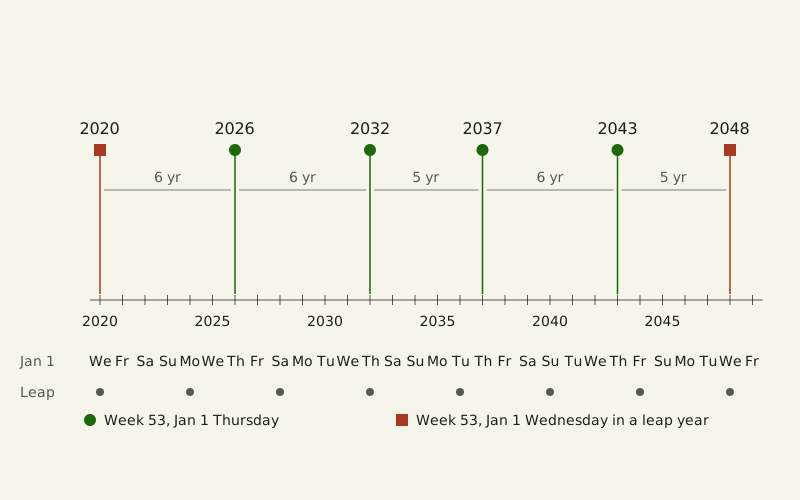
Figure: The Yardstick Almanac, CC BY 4.0
Credit line to copy
"Years with an ISO week 53, 2020–2049" by The Yardstick Almanac, https://theyardstickalmanac.com/calendars/iso-week-number/, licensed under CC BY 4.0 (https://creativecommons.org/licenses/by/4.0/).
Data: Week rule from the Python datetime documentation and CALENDRICA 4.0 (Apache License 2.0); computed 2026-11-01 with two independent date routines, CC BY 4.0
Week 53 of 2026 runs from Monday, December 28, 2026, to Sunday, January 3, 2027, and week 1 of 2027 starts on Monday, January 4. The leap-year test adds only the Wednesday case, as 2020 did and 2048 will; a leap year that begins on a Thursday, such as 2032, already qualifies. February 29 shapes other counts too, such as the number of people born on February 29.
Why do other week numbers disagree?
ISO weeks are one rule among several. Next to the ISO code %V, Python's documentation describes %W, which counts Monday-first weeks, and %U, which counts Sunday-first weeks. In both, the days of a new year before its first Monday (or Sunday) are week 0, and both use the calendar year, so neither has a week that crosses New Year's Day.
The gap is easy to miss. On every day of 2026, the Monday-first count from week 0 is one lower than the ISO week number. ISO week 1 of 2026 began on Monday, December 29, 2025, while the other count waits for Monday, January 5, 2026, to start its week 1.
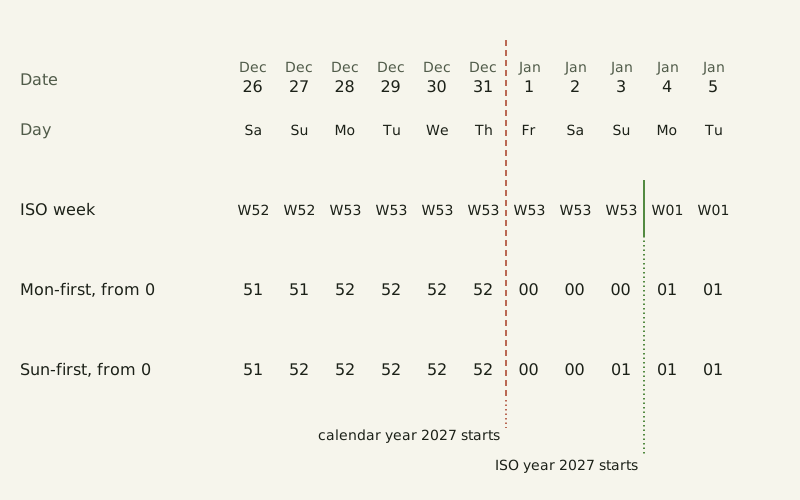
Figure: The Yardstick Almanac, CC BY 4.0
Credit line to copy
"Three week numbers for December 26, 2026, to January 5, 2027" by The Yardstick Almanac, https://theyardstickalmanac.com/calendars/iso-week-number/, licensed under CC BY 4.0 (https://creativecommons.org/licenses/by/4.0/).
Data: Week rules from the Python datetime documentation; computed 2026-11-01 with two independent date routines, CC BY 4.0
| Date | ISO week | Monday-first, from week 0 (%W) | Sunday-first, from week 0 (%U) |
|---|---|---|---|
| Sunday, December 27, 2026 | 2026-W52 | 51 | 52 |
| Monday, December 28, 2026 | 2026-W53 | 52 | 52 |
| Thursday, December 31, 2026 | 2026-W53 | 52 | 52 |
| Friday, January 1, 2027 | 2026-W53 | 00 | 00 |
| Sunday, January 3, 2027 | 2026-W53 | 00 | 01 |
| Monday, January 4, 2027 | 2027-W01 | 01 | 01 |
When a calendar app and a spreadsheet show week numbers one apart, a different rule is the first thing to check. Weekly data feel the extra week too: a weekly series for ISO year 2026 has 53 points and 2025 has 52, so a week-by-week comparison leaves one week with no partner. The daylight hours charts on this site plot every date of the year instead.
How do you find the ISO week of any date?
You need only the date's weekday and its day number within the year. Each ISO week belongs to the year that holds its Thursday, so three steps are enough:
- Find the Thursday of your date's week, with weeks running Monday to Sunday.
- That Thursday's calendar year is the ISO year.
- Take the Thursday's day of the year, divide by 7 and round up. The result is the week number.
We ran these steps on all 146,097 days from 2001 to 2400, and they matched both date routines every time. Take Friday, January 1, 2027: its Thursday is December 31, 2026, day 365 of that year, and 365 divided by 7 rounds up to 53. So January 1, 2027, is in week 53 of ISO year 2026, written 2026-W53-5 with Monday as day 1.
Illustration: The Yardstick Almanac. Generated schematic illustration — not a photograph or historical record. © The Yardstick Almanac, all rights reserved.
That written form follows the grammar that RFC 3339 (2002) collected from the 1988 version of ISO 8601, where a “W” comes before the week and week numbers run “01-52, 01-53 based on year”. The RFC labels that grammar informational. Week numbers depend only on the calendar date, so a leap second leaves them unchanged.
Sources
- Python Software Foundation, Python 3.15.2 documentation, “datetime — Basic date and time types”: date.isocalendar(), date.fromisocalendar(), date.isoweekday(), and the strftime() and strptime() format codes %G, %V, %u, %W and %U with their notes. https://docs.python.org/3/library/datetime.html Read: sections on date.isocalendar(), date.fromisocalendar() and the format codes, read in full Text license: Python Software Foundation License Version 2
- Edward M. Reingold and Nachum Dershowitz, CALENDRICA 4.0 — Common Lisp, calendar.l (last modified 20 December 2016), Section: ISO Calendar (iso-date, fixed-from-iso, iso-from-fixed, iso-long-year?); the file header says the functions are explained in the authors' book Calendrical Calculations, 4th ed. https://github.com/EdReingold/calendar-code2/blob/main/calendar.l Read: license header and the ISO Calendar section, read in full Text license: Apache-2.0
- G. Klyne and C. Newman, RFC 3339, Date and Time on the Internet: Timestamps (July 2002), sec. 5.5 and Appendix A, ISO 8601 Collected ABNF. https://www.rfc-editor.org/rfc/rfc3339.txt Read: sec. 5.5 and Appendix A (syntax only)
- Bureau International des Poids et Mesures, The International System of Units (SI), 9th edition (2019), version 4.01 (June 2026), DOI 10.59161/AUEZ1291. Sec. 4 and Table 8, “Non-SI units” (p. 140). https://www.bipm.org/documents/20126/41483022/SI-Brochure-9-EN.pdf Read: sec. 4 and Table 8 Text license: CC BY 4.0
Data files (computed 2026-11-01 with Python's datetime module and, independently, with integer Julian Day Number arithmetic, cross-checked against the convertdate 2.5.1 Python package, MIT license; each file comes with a notes file giving its sources and license):
- ISO weeks in every year, 2001–2400 (CSV, source and license notes) Data: Week rule from the Python datetime documentation and CALENDRICA 4.0 (Apache License 2.0); computed 2026-11-01 with two independent date routines, CC BY 4.0
- Where ISO week 1 starts, by weekday of January 1 (CSV, source and license notes) Data: Week rule from the Python datetime documentation and CALENDRICA 4.0 (Apache License 2.0); computed 2026-11-01 with two independent date routines, CC BY 4.0
- Three week numbers, December 21, 2026, to January 10, 2027 (CSV, source and license notes) Data: Week rules from the Python datetime documentation; computed 2026-11-01 with two independent date routines, CC BY 4.0
Cite this page
The Yardstick Almanac. "ISO Week Number: 71 of Every 400 Years Have a Week 53." Published November 1, 2026. https://theyardstickalmanac.com/calendars/iso-week-number/. Accessed [the date you read it].
More in Calendars & Time
Calendars & Time
Leap Year Isn't Every 4 Years: Why 2100 Skips February 29
Image credit
"An Election Entertainment, Plate I: Four Prints of an Election" by William Hogarth — https://commons.wikimedia.org/wiki/File:An_Election_Entertainment,_Plate_I-_Four_Prints_of_an_Election_MET_DP827052.jpg — CC0 1.0 (https://creativecommons.org/publicdomain/zero/1.0/)

Calendars & Time
Leap Second: 27 Through 2026, Then Continuous UTC From 2027
Image credit
"Atomic Clock017 (atomic clock NBS-1)" by National Institute of Standards and Technology — https://commons.wikimedia.org/wiki/File:Atomic_Clock017.jpg — Public domain (work of the U.S. federal government, 17 U.S.C. §105)
Calendars & Time
Old Style vs New Style Dates: Feb 11, 1731 Was Feb 22, 1732
Image credit
"George Washington (Gibbs-Channing-Avery Portrait)" by Gilbert Stuart — https://commons.wikimedia.org/wiki/File:George_Washington_MET_DT62.jpg — CC0 1.0 (https://creativecommons.org/publicdomain/zero/1.0/)
How this page is checked: Where the numbers come from explains the value tags, the source order and how every figure is recomputed.
Corrections: every substantive change is logged in What we got wrong.
Spotted an error? Email contact@theyardstickalmanac.com with the sentence and your source, or read Write in first.