Eratosthenes' Earth Circumference: Pliny Says 252,000 Stadia
The Yardstick Almanac Published No substantive revisions
Short answer
Pliny reports Eratosthenes' Earth as 252,000 stadia, or 31,500 Roman miles; at stadion lengths from 1855 notes, that is about 37,600–46,600 km [estimate, range 37,600–46,600 km], against the WGS 84 meridian, about 40,008 km.
Station index 7 sections
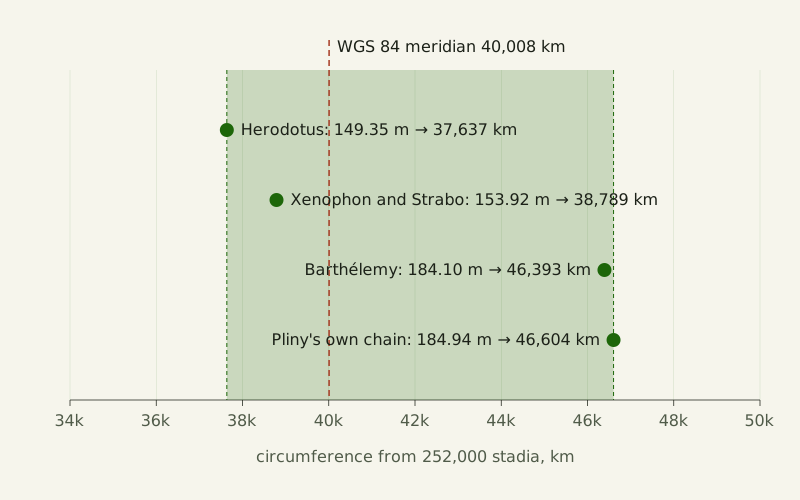
Figure: The Yardstick Almanac, CC BY 4.0
Credit line to copy
"Eratosthenes' 252,000 stadia at four stadion lengths" by The Yardstick Almanac, https://theyardstickalmanac.com/scale/eratosthenes-earth-circumference/, licensed under CC BY 4.0 (https://creativecommons.org/licenses/by/4.0/).
Data: Pliny, Natural History, trans. Bostock and Riley 1855 (public domain); WGS 84 parameters from PROJ 9.8.1 (MIT); computed 2026-11-01, CC BY 4.0
Depending on the stadion, Pliny's 252,000 stadia for Eratosthenes' Earth lands 6% short to 16% long of today's meridian. The figure sits in Book 2 of Pliny the Elder's Natural History, which we read in the 1855 English translation by John Bostock and H. T. Riley. There Eratosthenes “has stated the whole of this circuit to be 252,000 stadia, which, according to the Roman estimate, makes 31,500 miles.” Pliny fixes the stadium at 625 Roman feet, but nothing he wrote fixes a Roman foot in meters, so the error in the ancient figure is what we call the remainder: a measurement error whose size depends on the unit you assume.
In kilometers, Eratosthenes' figure as Pliny reports it comes to about 37,600 to 46,600 km [estimate, range 37,600–46,600 km], depending on which of four stadion lengths you accept. The WGS 84 ellipsoid puts a full meridian, pole to pole and back, at 40,007.86 km (rounded) [exact by definition]. Use Pliny's own chain of units with the translators' Roman foot, and 252,000 stadia is 46,604 km, about 16.5% long [contested].
What does Pliny's text say?
Pliny gives one number for Eratosthenes, then a second for the same distance in Roman miles. Divide 252,000 by 31,500 and you get 8 stadia to the mile. Pliny's stadium is “125 of our Roman paces, or 625 feet” (Book 2, chapter 21), so 8 stadia make 1,000 paces. We can think of the two figures as a short traverse that closes: the stadia, the miles and the stadium length all agree.
The same chapter 112 holds more numbers. Pliny admires Eratosthenes' “subtle arguments,” then reports that Hipparchus “has added to the above number not much less than 25,000 stadia.” He also tells of Dionysodorus, whose letter, said to be found in his tomb, gave 42,000 stadia down to “the lowest part of the earth”; geometers read that as the center and turned it into 252,000 stadia around.
| Figure | Attributed to, in Pliny | Chapter |
|---|---|---|
| 252,000 stadia, the whole circuit | Eratosthenes | 112 |
| 31,500 miles, “according to the Roman estimate” | Pliny, converting | 112 |
| not much less than 25,000 stadia added | Hipparchus | 112 |
| 42,000 stadia to “the lowest part of the earth” | Dionysodorus, in a letter said to be found in his tomb | 112 |
| 252,000 stadia, reading the 42,000 as the distance to the center | unnamed geometers | 112 |
| 12,000 stadia added for “harmonical proportion” | Pliny | 113 |
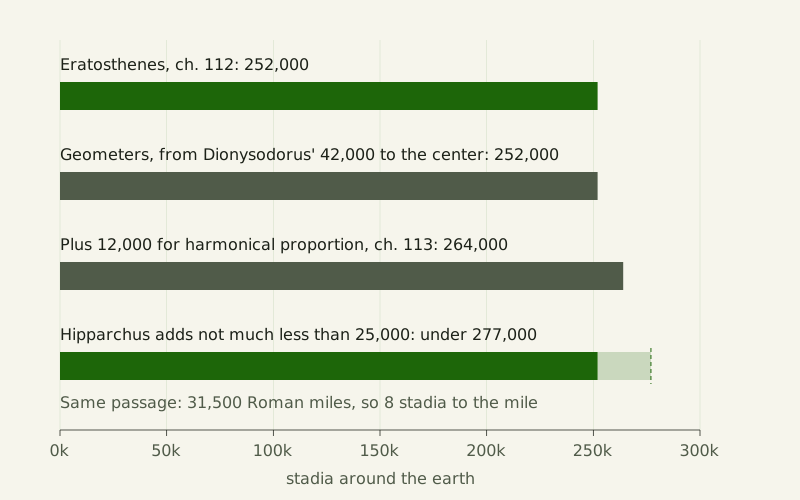
Figure: The Yardstick Almanac, CC BY 4.0
Credit line to copy
"Circumference figures in Pliny, Natural History, Book 2" by The Yardstick Almanac, https://theyardstickalmanac.com/scale/eratosthenes-earth-circumference/, licensed under CC BY 4.0 (https://creativecommons.org/licenses/by/4.0/).
Data: Pliny, Natural History, trans. Bostock and Riley 1855 (public domain); computed 2026-11-01, CC BY 4.0
Two of these fit together in a way Pliny does not point out. Our arithmetic: 42,000 × 2 × 3 is 252,000, and 42,000 × 2 × 22/7 is 264,000, which equals the 252,000 plus the 12,000 stadia he adds a chapter later.
How is the method usually told?
The method usually told, from Cleomedes' account, compares the noon Sun on one day at two places on the same north–south line. At one place the Sun stands overhead; at the other, an upright pointer casts a short shadow. Because sunlight arrives in parallel lines, the shadow's angle at the pointer equals the angle between the two places at Earth's center. The distance between them is then the same share of the full circle, so the circumference is that distance × 360° ÷ the angle.
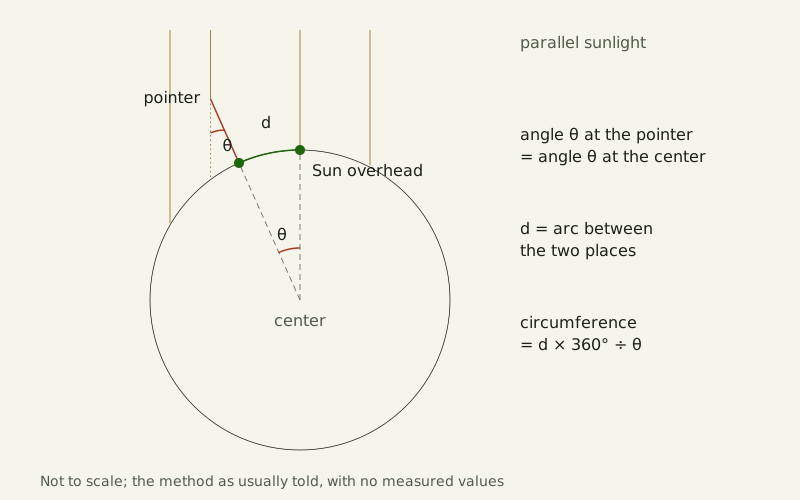
Figure: The Yardstick Almanac, CC BY 4.0
Credit line to copy
"The shadow-angle geometry, as usually told" by The Yardstick Almanac, https://theyardstickalmanac.com/scale/eratosthenes-earth-circumference/, licensed under CC BY 4.0 (https://creativecommons.org/licenses/by/4.0/).
Data: Drawn 2026-11-01 from the geometry of parallel sunlight; no measured values, CC BY 4.0
That account is usually credited to Cleomedes' The Heavens, which Alan C. Bowen and Robert B. Todd translated into English (2004). We have read only the bibliographic record, so this page does not give the angle or the distance that account uses. A story often repeated adds that Eratosthenes was the first to measure Earth; we found no readable source that says so. Pliny's chapter 112 describes no method at all; it says only that the figure rests on arguments “that we cannot refuse our assent.”
What did Pliny hear about Syene?
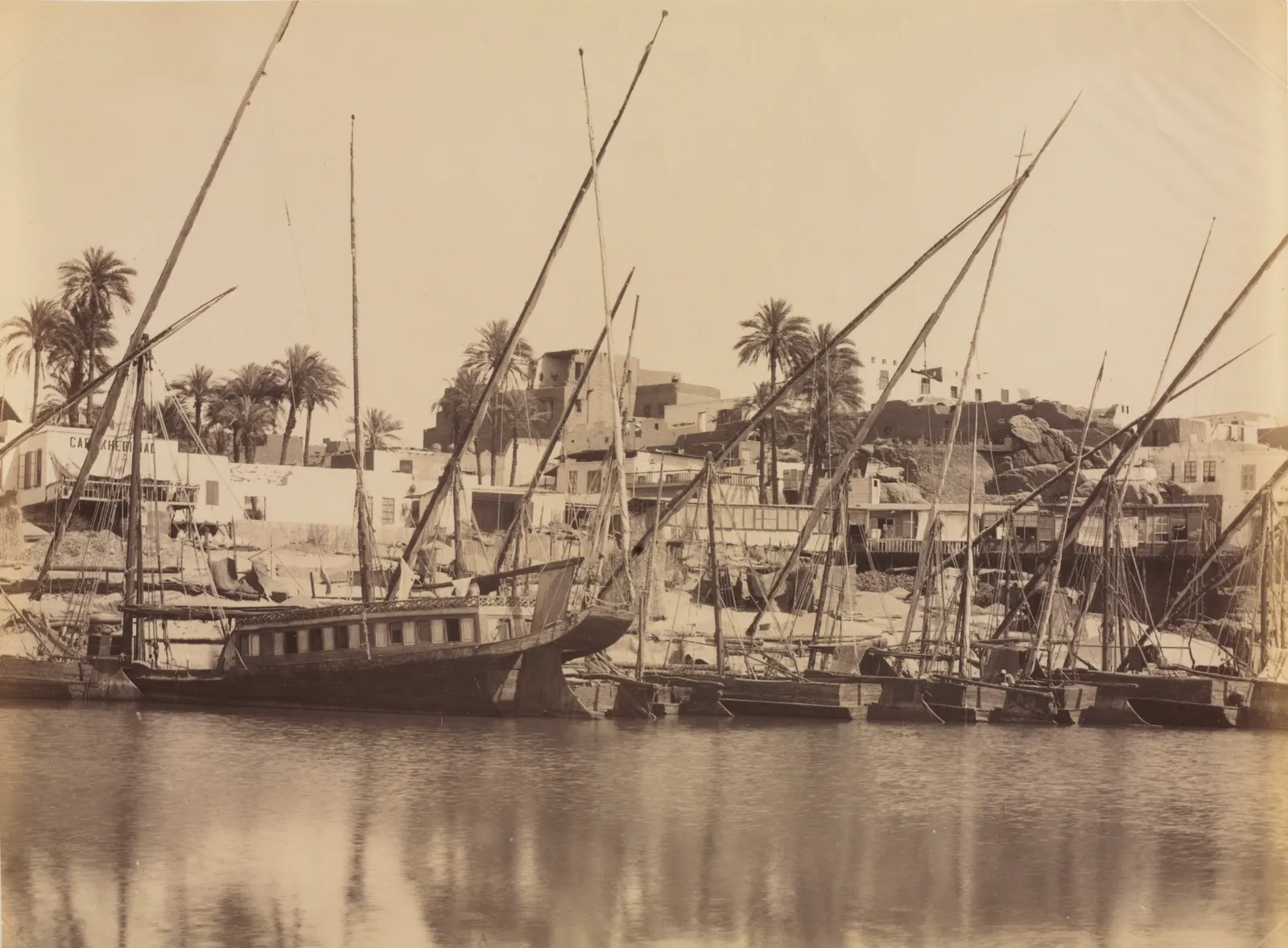
Pliny does report a shadowless town, in a different chapter and without naming Eratosthenes. “It is likewise said, that in the town of Syene, which is 5000 stadia south of Alexandria, there is no shadow at noon, on the day of the solstice,” he writes in chapter 75, adding that a well dug for the purpose is lit by the Sun “in every part.” He presents both as things people say. The translators' note on Syene says its “present name is Assouan,” an older spelling of Aswan.
"View of Aswan - Along the Nile" by Antonio Beato — https://commons.wikimedia.org/wiki/File:Antonio_Beato_-_View_of_Aswan_-_Along_the_Nile_-_1993.94_-_Cleveland_Museum_of_Art.tif — CC0 1.0 (https://creativecommons.org/publicdomain/zero/1.0/); modified: converted from the 5,000 × 3,681 px TIFF original to JPEG (quality 92, same pixel size, embedded color profile kept); no crop, retouching or color change
The 1855 notes do not agree with each other about the town. One says Syene was “lying just under the tropic of Cancer.” Another, on the shadow passage itself, says “Syene is, however, a little to the north of the tropic.” We can think of the two notes as a closure error inside one benchmark, and this page does not settle it.
Suppose the 5,000 stadia were one slice of the 252,000. The slice would be 1/50.4 of a circle, about 7.14°. That angle is our division, not a measurement in any source we read.
Which stadion?
To turn 252,000 stadia into kilometers you need a stadion length, and the 1855 translators give four ways to set it. In their note to chapter 21 they estimate “the Roman foot at 11·6496 English inches,” and report three stadium lengths in English feet that other writers proposed. The note does not say which, if any, Eratosthenes used, so each is a scenario, and the length itself is contested [contested].
We converted feet and inches at the values the U.S. National Bureau of Standards set as exact in 1959 (24 FR 5348): 0.3048 m and 0.0254 m [exact by definition]. The table gives each scenario with its source and how much of that source we read.
| Scenario | Stadion as given | Stadion | Source, and how much we read | 252,000 stadia | Against the WGS 84 meridian |
|---|---|---|---|---|---|
| Herodotus | 490 English feet | 149.35 m | 1855 note 261, citing the Edinburgh Review; note read, review not read | 37,637 km | −5.9% |
| Xenophon and Strabo | 505 English feet | 153.92 m | Same note and review | 38,789 km | −3.0% |
| Barthélemy | 604 English feet | 184.10 m | Same note, citing Barthélemy; note read, book not read | 46,393 km | +16.0% |
| Pliny's own chain | 625 Roman feet at 11.6496 in | 184.94 m | Pliny, chapter 21, full text; Roman foot from note 261 | 46,604 km | +16.5% |
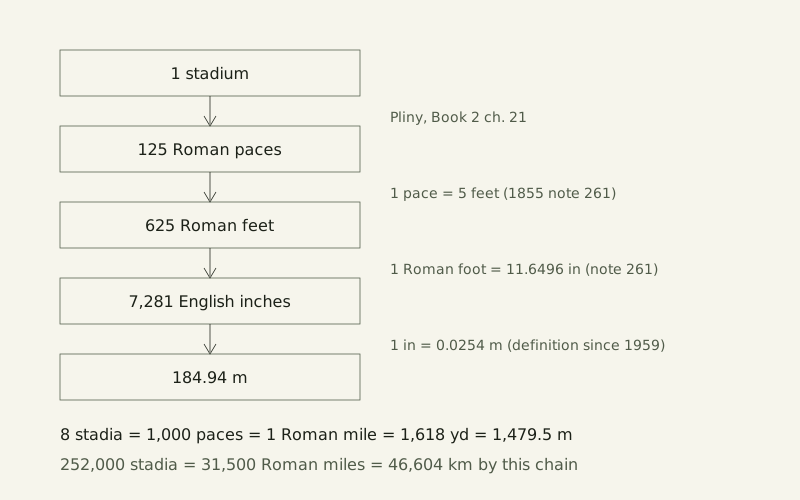
Figure: The Yardstick Almanac, CC BY 4.0
Credit line to copy
"Pliny's stadium carried down to meters" by The Yardstick Almanac, https://theyardstickalmanac.com/scale/eratosthenes-earth-circumference/, licensed under CC BY 4.0 (https://creativecommons.org/licenses/by/4.0/).
Data: Pliny, Natural History, trans. Bostock and Riley 1855 (public domain); computed 2026-11-01, CC BY 4.0
The same note checks itself. Its Roman mile of 8 stadia comes to 1,618 English yards, and 5,000 Roman feet at 11.6496 inches gives that same figure.
The stadion question has a literature of its own. Donald Engels' 1985 article “The Length of Eratosthenes' Stade” and Dmitry Shcheglov's 2018 article on the “Itinerary Stade” and the accuracy of Eratosthenes' measurement carry it in their titles. We have read only their bibliographic records and use no figure from them.
How wide is the band, and does a second route agree?
The worksheet runs once for each stadion length. It has three steps:
- Take Pliny's 252,000 stadia as given.
- Convert the stadion length to meters, using the 1959 foot and inch.
- Multiply, and compare the product with the WGS 84 meridian circumference of 40,007.86 km.
The band, 37,600 to 46,600 km [estimate, range 37,600–46,600 km], is a set of scenarios, not a statistical confidence interval. Its two ends are the shortest and longest stadion lengths in the notes, 149.35 m and 184.94 m. Hipparchus' addition would stretch it further. On the four stadion lengths, a little under 277,000 stadia sets a ceiling of 41,371 to 51,228 km, or 3.4% to 28.0% over the WGS 84 meridian.
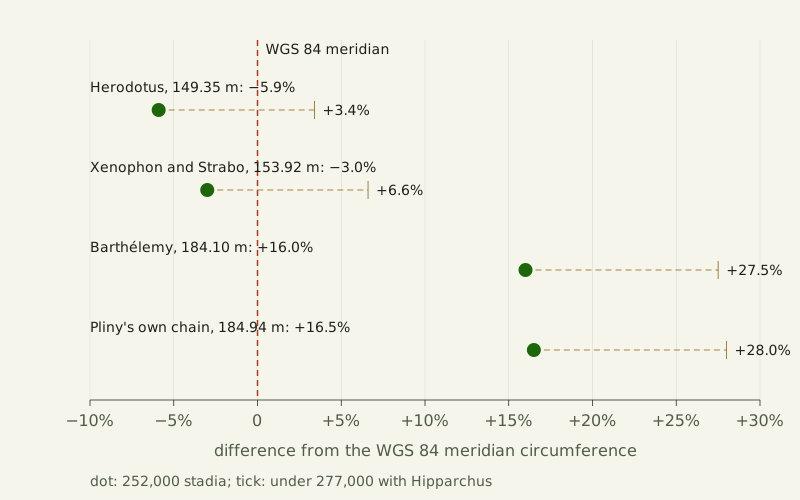
Figure: The Yardstick Almanac, CC BY 4.0
Credit line to copy
"Eratosthenes' figure against the WGS 84 meridian, with Hipparchus' addition" by The Yardstick Almanac, https://theyardstickalmanac.com/scale/eratosthenes-earth-circumference/, licensed under CC BY 4.0 (https://creativecommons.org/licenses/by/4.0/).
Data: Pliny, Natural History, trans. Bostock and Riley 1855 (public domain); WGS 84 parameters from PROJ 9.8.1 (MIT); computed 2026-11-01, CC BY 4.0
A second route skips the stadia. Pliny's 31,500 Roman miles of 5,000 Roman feet each, at 11.6496 inches to the foot, also gives 46,604 km, the same as the stadia route, because 8 stadia make a mile.
For the modern side, we computed the WGS 84 meridian two independent ways from the ellipsoid's defining numbers in the PROJ source code, and the two results agree to well under a millimeter. A meridian here means any full north–south loop through both poles, not only the prime meridian at Greenwich. Around the equator WGS 84 is a little longer, 40,075.02 km (rounded) [exact by definition], and against that figure each scenario stays on the same side.
Eratosthenes questions
How accurate was Eratosthenes?
It depends on the stadion. With the four lengths in the 1855 notes, Eratosthenes' 252,000 stadia runs from 5.9% below the WGS 84 meridian circumference of 40,007.86 km to 16.5% above it. Pliny's own chain, 625 Roman feet to the stadium, gives the high end, 46,604 km.
How long was a stadion?
No text we read gives Eratosthenes' stadion in meters. Pliny sets a stadium at 125 Roman paces, or 625 Roman feet, and the 1855 translators put a Roman foot at 11.6496 inches, which makes that stadium 184.94 m [contested]. The same note reports stadium lengths of 490, 505 and 604 English feet that others proposed, 149.35 m to 184.10 m [contested].
Did the Sun light a well to the bottom at Syene?
Pliny reports it as hearsay: a well “sunk for the purpose of the experiment” at Syene was said to be lit by the Sun “in every part” at noon on the solstice. He does not connect the well to Eratosthenes, and we found no readable source that does.
Can you repeat the measurement?
You can rerun the geometry with a partner several hundred kilometers north or south of you. Measure the shadow, not the Sun. Never look at the Sun, and work on a safe, level spot you are allowed to use, not a road or roof.
- Stand a straight pointer upright on level ground, checked with a level or plumb line.
- Around local noon, mark the tip of the shadow every few minutes; the shortest shadow is the noon one.
- Find the angle from shadow length ÷ pointer height, with a calculator's inverse tangent.
- Work out the angle between you: the difference between your angle and your partner's, measured the same day. If your shadows point opposite ways, one north and one south, add the two angles instead.
- Multiply your north–south distance by 360 and divide by the angle between you.
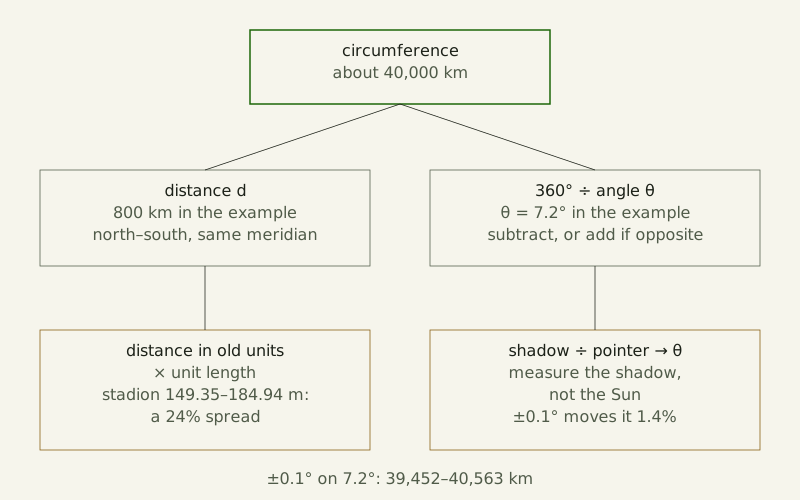
Figure: The Yardstick Almanac, CC BY 4.0
Credit line to copy
"Repeat the measurement: the worksheet as a tree" by The Yardstick Almanac, https://theyardstickalmanac.com/scale/eratosthenes-earth-circumference/, licensed under CC BY 4.0 (https://creativecommons.org/licenses/by/4.0/).
Data: Pliny, Natural History, trans. Bostock and Riley 1855 (public domain); computed 2026-11-01, CC BY 4.0
Measure the distance in kilometers and the unit problem is gone, because a kilometer means the same length to everyone; the chain from the meter to the speed of light is on the nanosecond page. One step up the scale, the astronomical unit went from a measured length to a defined one: see the astronomical unit.
With made-up inputs of 800 km and 7.2°, the answer is 40,000 km. An error of 0.1° in the angle moves it to 39,452 or 40,563 km, about 1.4%. In the ancient figure the unit alone spans far more. The longest stadion in the notes is 24% longer than the shortest.
Sources
- Pliny the Elder, The Natural History, vol. 1, trans. John Bostock and H. T. Riley (London: Henry G. Bohn, 1855), Book 2, chapters 21 (23), 75 (73), 112 (108) and 113, with the translators' notes 261 and 508, and Book 5, chapter 10, with note 3542. Project Gutenberg eBook #57493. https://www.gutenberg.org/ebooks/57493 Read: full text
- National Bureau of Standards and U.S. Coast and Geodetic Survey, “Refinement of Values for the Yard and the Pound,” Federal Register 24, no. 128 (July 1, 1959), 5348–5349 (24 FR 5348), F.R. Doc. 59-5442. https://www.govinfo.gov/content/pkg/FR-1959-07-01/pdf/FR-1959-07-01.pdf Read: full notice
- PROJ contributors, PROJ 9.8.1, src/ellps.cpp (ellipsoid table: WGS84 a = 6378137.0, rf = 298.257223563). MIT license. WGS 84 values correspond to NGA TR8350.2. https://github.com/OSGeo/PROJ/blob/9.8.1/src/ellps.cpp Read: full file Text license: MIT
- Alan C. Bowen and Robert B. Todd, Cleomedes' Lectures on Astronomy: A Translation of The Heavens (Berkeley: University of California Press, 2004), ISBN 9780520233256, DOI 10.1525/california/9780520233256.001.0001. https://doi.org/10.1525/california/9780520233256.001.0001 Read: bibliographic record only
- Donald Engels, “The Length of Eratosthenes' Stade,” The American Journal of Philology 106, no. 3 (1985): 298ff., DOI 10.2307/295030. https://doi.org/10.2307/295030 Read: bibliographic record only
- Dmitry A. Shcheglov, “The so-called ‚Itinerary Stade‘ and the Accuracy of Eratosthenes' Measurement of the Earth,” Klio 100, no. 1 (2018): 153–177, DOI 10.1515/klio-2018-0005. https://doi.org/10.1515/klio-2018-0005 Read: bibliographic record only
Data files (computed 2026-11-01 from Pliny's figures, the 1855 translators' notes and the WGS 84 ellipsoid parameters, with exact fractions checked against a second floating-point calculation using numpy 2.5.4 (BSD-3-Clause) and pyproj 3.8.0 (MIT license); each file comes with a notes file giving its sources and license):
- Eratosthenes' 252,000 stadia under four stadion lengths (CSV, source and license notes) Data: Pliny, Natural History, trans. Bostock and Riley 1855 (public domain); WGS 84 parameters from PROJ 9.8.1 (MIT); computed 2026-11-01, CC BY 4.0
- Figures for the size of the earth in Pliny, Book 2 (CSV, source and license notes) Data: Pliny, Natural History, trans. Bostock and Riley 1855 (public domain); computed 2026-11-01, CC BY 4.0
Cite this page
The Yardstick Almanac. "Eratosthenes' Earth Circumference: Pliny Says 252,000 Stadia." Published November 1, 2026. https://theyardstickalmanac.com/scale/eratosthenes-earth-circumference/. Accessed [the date you read it].
More in Scale & Estimation

Scale & Estimation
Nanosecond: Light Covers About 11.8 Inches in a Vacuum
Image credit
"Commodore Grace M. Hopper, USN (covered)" by James S. Davis — https://commons.wikimedia.org/wiki/File:Commodore_Grace_M._Hopper,_USN_(covered).jpg — Public domain (work of the U.S. federal government, 17 U.S.C. §105)
Scale & Estimation
Born on February 29: About 214,000 U.S. Residents as of 2025
Image credit
"Der Geburtstagskuchen (The Birthday Cake)" by Eduard Geselschap — https://commons.wikimedia.org/wiki/File:Eduard_Geselschap_Der_Geburtstagskuchen_1872.jpg — Public domain (Oil on canvas by Eduard Geselschap (1814–1878), signed and dated 1872; the painter died 5 January 1878, so the work is in the public domain in the Netherlands and Germany and across the EU (life plus 70 years) and in the United States (published before 1931, per the file page). Faithful photographic reproduction of a two-dimensional public-domain work (PD-Art; EU Directive 2019/790 art. 14); the file is marked with the Public Domain Mark 1.0)
Scale & Estimation
Astronomical Unit: Exactly 149,597,870,700 Meters Since 2012
Image credit
"1882 transit of venus" by US Naval Observatory — https://commons.wikimedia.org/wiki/File:1882_transit_of_venus.jpg — Public domain (work of the U.S. federal government, 17 U.S.C. §105 (the Commons file page tags it as made by U.S. Navy staff as part of official duties); independently, an anonymous work made in 1882, so any U.S. term (at most 120 years from creation for an unpublished anonymous work) and any EU term for an anonymous work have expired)
How this page is checked: Where the numbers come from explains the value tags, the source order and how every figure is recomputed.
Corrections: every substantive change is logged in What we got wrong.
Spotted an error? Email contact@theyardstickalmanac.com with the sentence and your source, or read Write in first.